College of Management and Economics, Center for Social Science Survey and Data Tianjin University, Tianjin 300072, China.
Politics and Public Administration College, Qinghai Nationalities University, Xining 810007, China.
Int J Environ Res Public Health. 2021 Jan 26;18(3):1096. doi: 10.3390/ijerph18031096.
The distribution of medical resources in China is seriously imbalanced due to imbalanced economic development in the country; unbalanced distribution of medical resources makes patients try to seek better health services. Against this backdrop, this study aims to analyze the spatial network characteristics and spatial effects of China's health economy, and then find evidence that affects patient mobility.
Data for this study were drawn from the and . The gravitational value of China's health spatial network was calculated to establish a network of gravitational relationships. The social network analysis method was used for centrality analysis and spillover effect analysis.
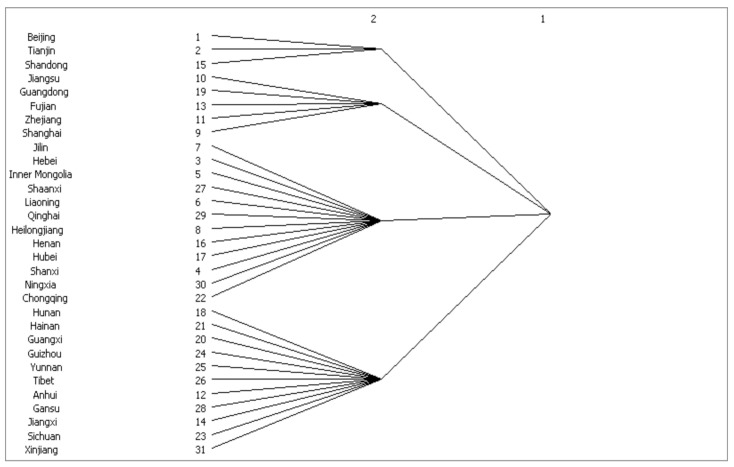
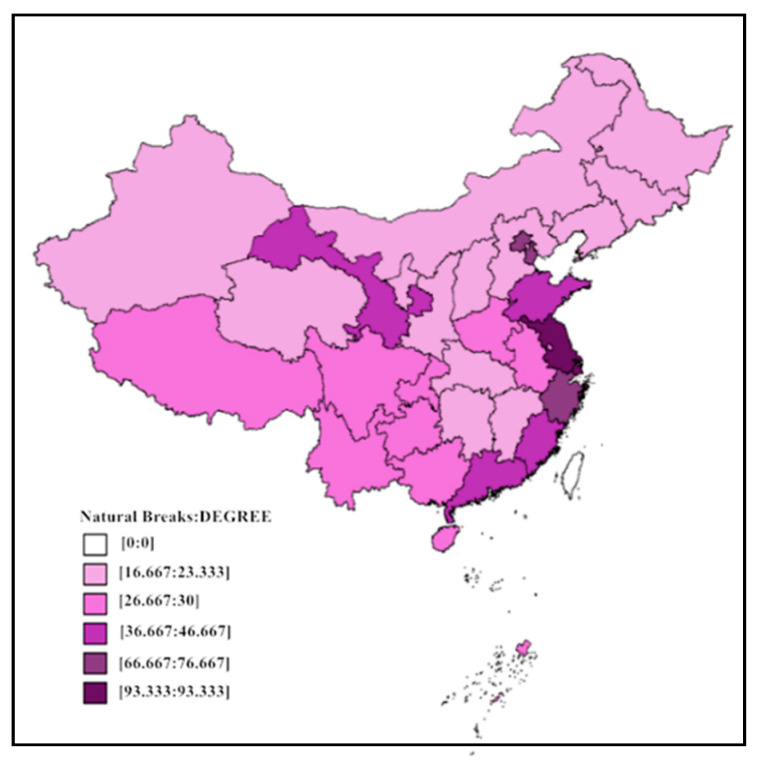
A gravity correlation matrix was constructed among provinces by calculating the gravitational value, indicating the spatial relationships of different provinces in the health economic network. Economically developed provinces, such as Shanghai and Jiangsu, are at the center of the health economic network (centrality degree = 93.333). These provinces also play a strong intermediary role in the network and have connections with other provinces. In the CONCOR analysis, 31 provinces are divided into four blocks. The spillover effect of the blocks indicates provinces with medical resource centers have beneficial effects, while provinces with insufficient resources have obvious spillover effects.
There is a significant gap in the geographical distribution of medical resources, and the health economic spatial network structure needs to be improved. Most medical resources are concentrated in economically developed provinces, and these provinces' positions in the health economic spatial network are becoming more centralized. By contrast, economically underdeveloped regions are at the edge of the network, causing patients to move to provinces with medical resource centers. There are health risks of the increasing pressure to seek medical treatment in developed provinces with abundant medical resources.
中国的医疗资源分布严重失衡,这是由于国家经济发展不平衡造成的;医疗资源分布不均使得患者试图寻求更好的医疗服务。在此背景下,本研究旨在分析中国卫生经济的空间网络特征和空间效应,并找到影响患者流动的证据。
本研究的数据来自和。计算了中国卫生空间网络的引力值,建立了网络引力关系。采用社会网络分析方法进行中心度分析和溢出效应分析。
通过计算引力值,构建了各省之间的引力相关矩阵,表明了卫生经济网络中不同省份的空间关系。经济发达的省份,如上海和江苏,处于卫生经济网络的中心(中心度=93.333)。这些省份在网络中也发挥着强大的中介作用,与其他省份有着联系。在 CONCOR 分析中,将 31 个省份分为四个块。块的溢出效应表明,医疗资源中心的省份具有有益的影响,而资源不足的省份具有明显的溢出效应。
医疗资源在地理上的分布存在显著差距,需要改善卫生经济的空间网络结构。大多数医疗资源集中在经济发达的省份,这些省份在卫生经济空间网络中的地位越来越集中。相比之下,经济欠发达地区处于网络的边缘,导致患者流向医疗资源中心的省份。在医疗资源丰富的发达省份,患者就医压力不断增加,存在健康风险。