Cergas (Centre for Research on Health and Social Care Management), SDA Bocconi School of Management, 20136 Milan, Italy.
Independent Pharmacologist Scientific Advisor in Rare Disease Pharmaceuticals and Registries, 00184 Rome, Italy.
Int J Environ Res Public Health. 2021 Jan 26;18(3):1101. doi: 10.3390/ijerph18031101.
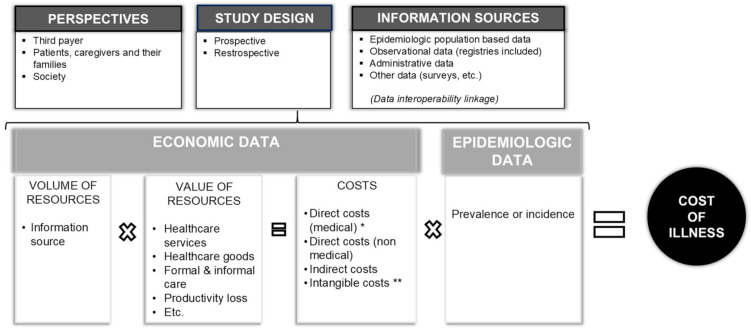
In the field of rare diseases (RDs), the evidence standard is often lower than that required by health technology assessment (HTA) and payer authorities. In this commentary, we propose that appropriate economic evaluation for rare disease treatments should be initially informed by cost-of-illness (COI) studies conducted using a societal perspective. Such an approach contributes to improving countries' understanding of RDs in their entirety as societal and not merely clinical, or product-specific issues. In order to exemplify how the disease burden's distribution has changed over the last fifteen years, key COI studies for Hemophilia, Fragile X Syndrome, Cystic Fibrosis, and Juvenile Idiopathic Arthritis are examined. Evidence shows that, besides methodological variability and cross-country differences, the disease burden's share represented by direct costs generally grows over time as novel treatments become available. Hence, to support effective decision-making processes, it seems necessary to assess the re-allocation of the burden produced by new medicinal products, and this approach requires identifying cost drivers through COI studies with robust design and standardized methodology.
在罕见病(RDs)领域,证据标准通常低于健康技术评估(HTA)和支付方机构的要求。在这篇评论中,我们提出,对于罕见病治疗的适当经济评估,最初应基于采用社会视角进行的疾病成本(COI)研究。这种方法有助于提高各国对整个 RD 的认识,使其不仅是临床问题,还是社会问题,或者是特定产品的问题。为了举例说明过去十五年疾病负担分布的变化,我们对血友病、脆性 X 综合征、囊性纤维化和幼年特发性关节炎的关键 COI 研究进行了考察。证据表明,除了方法学的可变性和国家间的差异外,随着新的治疗方法的出现,直接成本所代表的疾病负担份额通常会随着时间的推移而增加。因此,为了支持有效的决策过程,似乎有必要评估新产品带来的负担的再分配,而这种方法需要通过设计稳健且方法标准化的 COI 研究来确定成本驱动因素。