SAPRE, Child and Adolescent Neuropsychiatric Service, Fondazione IRCCS Ca' Granda Ospedale Maggiore Policlinico, Viale Ungheria 29, 20138, Milan, Italy.
Dipartimento di Elettronica, Informazione e Bioingegneria, Politecnico di Milano, Piazza Leonardo Da Vinci, Milan, Italy.
J Neurodev Disord. 2021 Feb 2;13(1):9. doi: 10.1186/s11689-021-09355-4.
Spinal muscular atrophy (SMA) is a chronic, neuromuscular disease characterized by degeneration of spinal cord motor neurons, resulting in progressive muscular atrophy and weakness. SMA1 is the most severe form characterized by significant bulbar, respiratory, and motor dysfunction. SMA1 prevents children from speaking a clearly understandable and fluent language, with their communication being mainly characterized by eye movements, guttural sounds, and anarthria (type 1a); severe dysarthria (type 1b); and nasal voice and dyslalia (type 1c). The aim of this study was to analyze for the first time cognitive functions, language comprehension, and speech in natural history SMA1 children according to age and subtypes, to develop cognitive and language benchmarks that provide outcomes for the clinical medication trials that are changing SMA1 course/trajectory.
This is a retrospective study including 22 children with SMA1 (10 affected by subtype 1a-1b: AB and 12 by 1c: C) aged 3-11 years in clinical stable condition with a coded way to communicate "yes" and "no". Data from the following assessments have been retrieved from patient charts: one-dimensional Raven test (RCPM), to evaluate cognitive development (IQ); ALS Severity Score (ALSSS) to evaluate speech disturbances; Brown Bellugy modified for Italian standards (TCGB) to evaluate language comprehension; and Children's Hospital of Philadelphia Infant Test of Neuromuscular Disorders (CHOP-INTEND) to assess motor functioning.
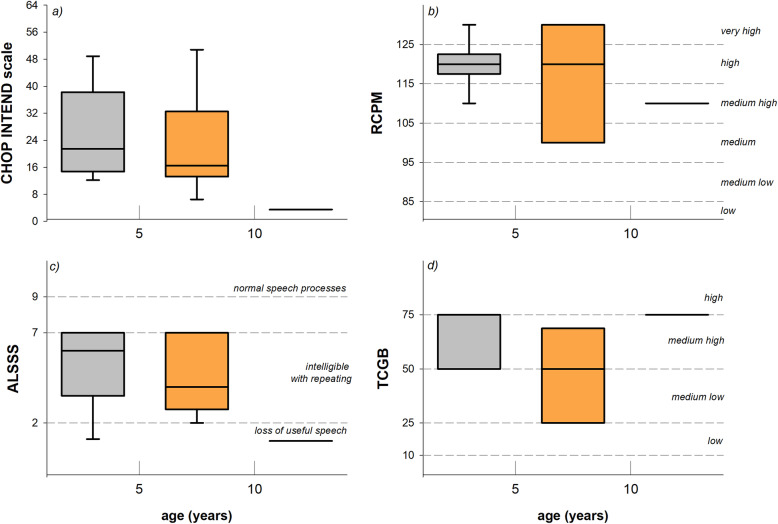
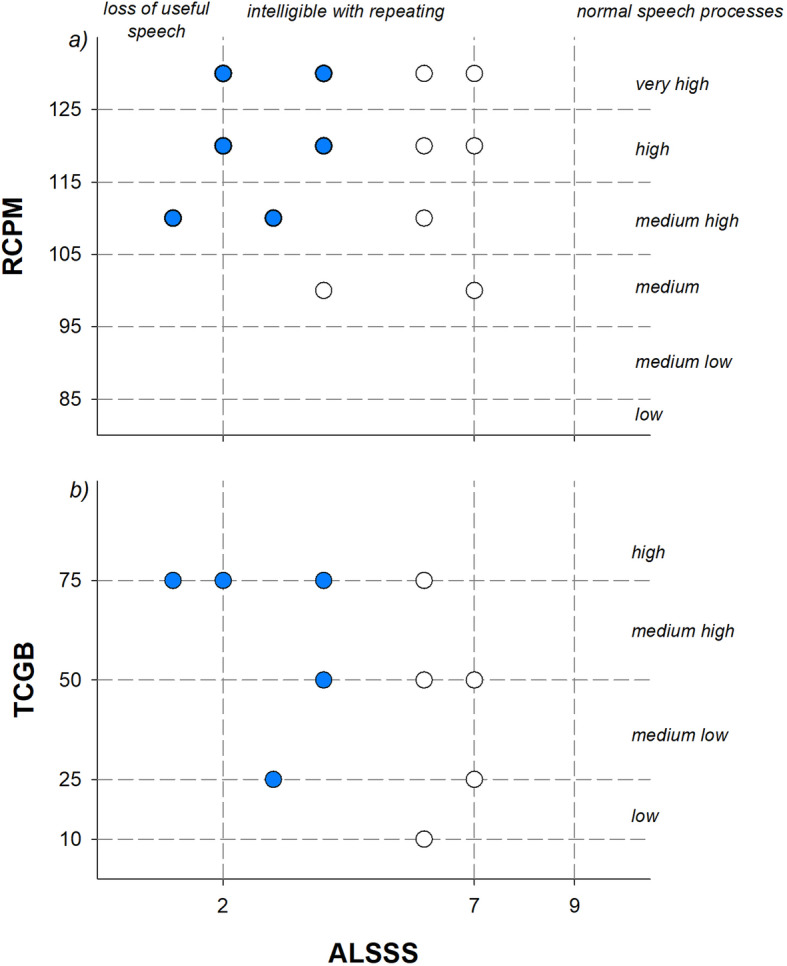
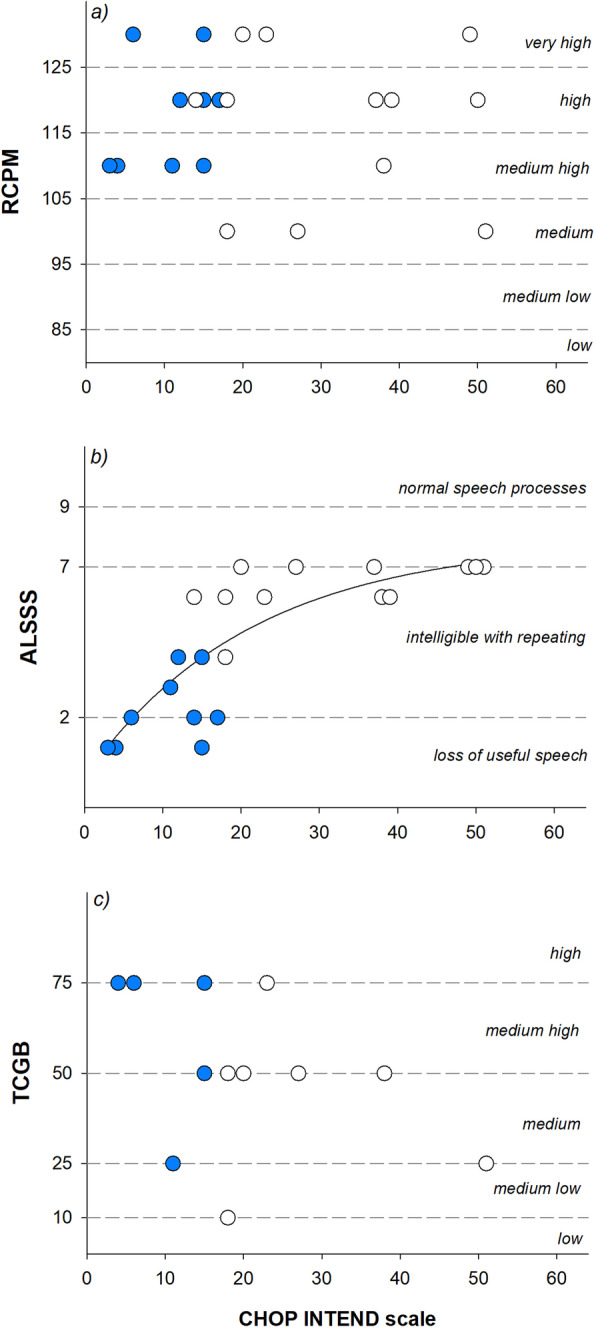
SMA 1AB and 1C children were similar in age, with the former characterized by lower CHOP-INTEND scores compared to the latter. All 22 children had collaborated to RCPM and their median IQ was 120 with no difference (p = 0.945) between AB and C. Global median score of the speech domain of the ALSSS was 5; however, it was 2 in AB children, being significantly lower than C (6.5, p < 0.001). TCGB test had been completed by 13 children, with morphosyntactic comprehension being in the normal range (50). Although ALSSS did not correlate with both IQ and TCGB, it had a strong (p < 0.001) correlation with CHOP-INTEND described by an exponential rise to maximum.
Although speech and motor function were severely compromised, children with SMA1 showed general intelligence and language comprehension in the normal range. Speech impairment was strictly related to global motor impairment.
脊髓性肌萎缩症(SMA)是一种慢性神经肌肉疾病,其特征是脊髓运动神经元的退化,导致进行性肌肉萎缩和无力。SMA1 是最严重的形式,其特点是明显的延髓、呼吸和运动功能障碍。SMA1 使儿童无法清晰、流畅地说话,其交流主要表现为眼球运动、喉音和构音障碍(1a 型);严重构音障碍(1b 型);鼻音和构音障碍(1c 型)。本研究的目的是首次根据年龄和亚型分析 SMA1 儿童的认知功能、语言理解和自然史中的言语,为正在改变 SMA1 病程/轨迹的临床药物试验提供认知和语言基准。
这是一项回顾性研究,纳入 22 名 SMA1 儿童(10 名受 1a-1b 亚型影响:AB,12 名受 1c 亚型影响:C),年龄 3-11 岁,采用编码方式“是”和“否”进行交流。从病历中检索了以下评估的数据:一维 Raven 测试(RCPM),用于评估认知发育(智商);ALS 严重程度评分(ALSSS),用于评估言语障碍;意大利标准的布朗·贝鲁吉改良版(TCGB),用于评估语言理解;费城儿童医院婴儿神经肌肉疾病测试(CHOP-INTEND),用于评估运动功能。
SMA1AB 和 1C 儿童年龄相似,前者 CHOP-INTEND 评分低于后者。所有 22 名儿童均完成了 RCPM 测试,其平均智商为 120,差异无统计学意义(p = 0.945)。ALSSS 言语域的总评分中位数为 5,但 AB 儿童为 2,明显低于 C(6.5,p < 0.001)。TCGB 测试已完成 13 名儿童,形态句法理解在正常范围内(50)。尽管 ALSSS 与智商和 TCGB 均无相关性,但与 CHOP-INTEND 呈强相关性(p < 0.001),呈指数上升至最大值。
尽管言语和运动功能严重受损,但 SMA1 儿童表现出正常范围的整体智力和语言理解能力。言语障碍与整体运动障碍密切相关。