Weststrate Harriet, Stimpson Georgia, Thomas Lily, Scoto Mariacristina, Johnson Emily, Stewart Alexandra, Muntoni Francesco, Baranello Giovanni, Conway Eleanor
The Dubowitz Neuromuscular Centre, Developmental Neuroscience Research and Teaching Department, UCL Great Ormond Street Institute of Child Health, NIHR Great Ormond Street Hospital Biomedical Research Centre & Great Ormond Street Hospital NHS Foundation Trust, UCL Great Ormond Street Institute of Child Health, London, UK.
Department of Language and Communication, University College London, London, UK.
Dev Med Child Neurol. 2022 Jul;64(7):907-914. doi: 10.1111/dmcn.15171. Epub 2022 Feb 1.
To assess the evolution of bulbar function in nusinersen-treated spinal muscular atrophy type 1 (SMA1).
This single-centre retrospective study identified 24 patients (14 females and 10 males) with SMA1, treated with nusinersen between 2017 and 2020. We adapted and validated the Paediatric Functional Oral Intake Scale (p-FOIS), which is an outcome measure to assess bulbar function. Analysis considered SMA1 subtype, nutritional support, and Children's Hospital of Philadelphia Infant Test of Neuromuscular Disorders (CHOP INTEND) and p-FOIS scores at initiation of nusinersen treatment (baseline) and at 6, 12, and 24 months after initiation.
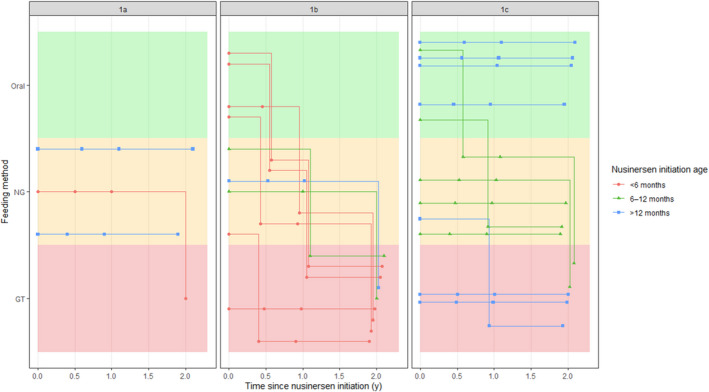
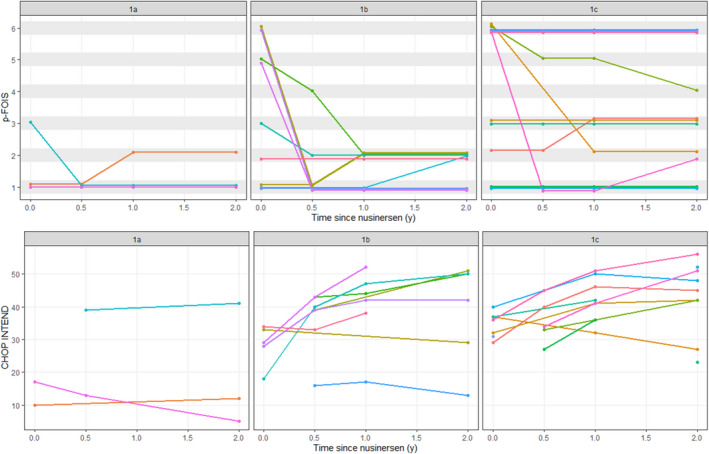
The median age at baseline was 11 months (range 1 month-7 years 6 months). Median age at initiation of tube feeding was 8 months (range 0-2 years 2 months). Fourteen patients were tube fed at baseline. The median p-FOIS score was 3 at baseline and 2 at 12 and 24 months. Four patients, all with type 1c SMA, remained orally fed at 24 months. Median CHOP INTEND scores increased from 32 at baseline to 42 at 12 and 24 months.
Impaired bulbar function persisted as a significant complication in most nusinersen-treated patients with SMA1, in contrast to the improvement in motor abilities demonstrated in the majority. p-FOIS allows for tracking of bulbar function progression and treatment response. Larger, prospective studies investigating the longer-term impacts of nusinersen on bulbar function are warranted.
评估经诺西那生治疗的1型脊髓性肌萎缩症(SMA1)患者延髓功能的演变。
这项单中心回顾性研究纳入了2017年至2020年间接受诺西那生治疗的24例SMA1患者(14例女性和10例男性)。我们对儿科功能性口服摄入量量表(p-FOIS)进行了调整和验证,该量表是一种评估延髓功能的结果指标。分析考虑了SMA1亚型、营养支持,以及诺西那生治疗开始时(基线)、开始后6个月、12个月和24个月时的费城儿童医院婴儿神经肌肉疾病测试(CHOP INTEND)和p-FOIS评分。
基线时的中位年龄为11个月(范围为1个月至7岁6个月)。开始管饲的中位年龄为8个月(范围为0至2岁2个月)。14例患者在基线时接受管饲。基线时p-FOIS评分中位数为3分,12个月和24个月时为2分。4例患者均为1c型SMA,在24个月时仍通过口服进食。CHOP INTEND评分中位数从基线时的32分增加到12个月和24个月时的42分。
与大多数患者运动能力的改善形成对比的是,延髓功能受损在大多数接受诺西那生治疗的SMA1患者中仍然是一个显著的并发症。p-FOIS可用于追踪延髓功能进展和治疗反应。有必要开展更大规模的前瞻性研究,以调查诺西那生对延髓功能的长期影响。