Timlin Deirdre, Giannantoni Barbara, McCormack Jacqueline M, Polito Angela, Ciarapica Donatella, Azzini Elena, Giles Melanie, Simpson Ellen E A
School of Psychology, Ulster University, Ulster, UK.
CREA - Council for Agricultural Research and Economics Research Centre for Food and Nutrition, Via Ardeatina, 546, 00178, Rome, Italy.
BMC Public Health. 2021 Feb 2;21(1):265. doi: 10.1186/s12889-021-10307-9.
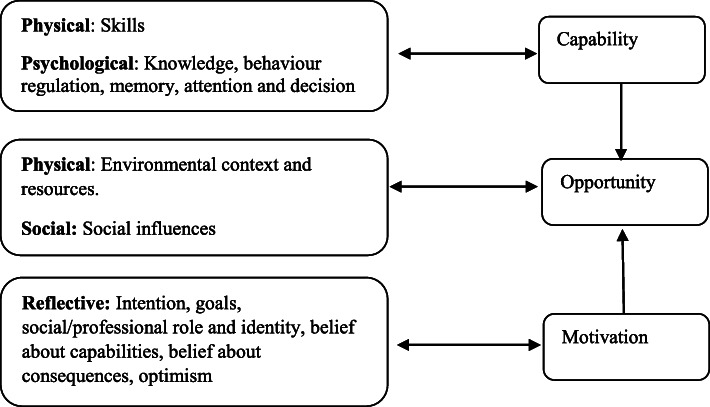
The aim of the study was to identify and compare components of the COM-B (capability, opportunity, motivation and behaviour) model, that influences behaviour to modify dietary patterns in 40-55-year olds living in Northern Ireland (NI) and Italy, in order to reduce the risk of cognitive decline in later life.
This was a qualitative study examining factors influencing Mediterranean-DASH (Dietary Approaches to Stop Hypertension) Intervention for Neurodegenerative Delay (MIND) diet behaviour. This study further elaborated the COM-B components into the 14 domains of the Theoretical Domains Framework to further understand behaviour. Twenty-five Northern Irish and Italian participants were recruited onto the study, to take part in either a focus group or an interview. Participants were both male and female aged between 40 and 55 years.
Thematic analysis revealed that the main barriers to the uptake of the MIND diet were; time, work environment (opportunity), taste preference and convenience (motivation). Culture (motivation), seasonal foods and lack of family support (opportunity) to be a barrier to the Italian sample only. The main facilitators reported were; improved health, memory, planning and organisation (motivation) and access to good quality food (opportunity). Cooking skills, knowledge (capability) and heathy work lunch (opportunity) reported as a facilitator to the Italian sample only.
Cross-cultural differences in relation to psychosocial barriers and facilitators were found in both samples. More barriers than facilitators towards uptake of the MIND diet were found. There is a need for interventions that increase capability, opportunity, and motivation to aid behaviour change. The findings from this study will be used to design a behaviour change intervention using the subsequent steps from the Behaviour Change Wheel.
本研究旨在识别和比较COM-B(能力、机会、动机和行为)模型的组成部分,该模型影响居住在北爱尔兰(NI)和意大利的40至55岁人群改变饮食习惯的行为,以降低晚年认知能力下降的风险。
这是一项定性研究,考察影响地中海-DASH(防治高血压饮食方法)延缓神经退行性变干预(MIND)饮食行为的因素。本研究进一步将COM-B的组成部分细化为理论领域框架的14个领域,以进一步理解行为。招募了25名北爱尔兰和意大利参与者参与该研究,他们参加焦点小组或访谈。参与者年龄在40至55岁之间,有男有女。
主题分析显示,采用MIND饮食的主要障碍包括:时间、工作环境(机会)、口味偏好和便利性(动机)。文化(动机)、季节性食物以及缺乏家庭支持(机会)仅对意大利样本构成障碍。报告的主要促进因素包括:健康改善、记忆力、规划和组织能力(动机)以及获得优质食物的机会(机会)。烹饪技能、知识(能力)和健康的工作午餐(机会)仅对意大利样本起到促进作用。
在两个样本中均发现了心理社会障碍和促进因素方面的跨文化差异。发现采用MIND饮食的障碍多于促进因素。需要采取干预措施来提高能力、机会和动机,以促进行为改变。本研究的结果将用于使用行为改变轮的后续步骤设计行为改变干预措施。