Medical Informatics Research Center, Institute for Futures Studies in Health, Kerman University of Medical Sciences, Kerman, Iran.
Gastroenterology and Hepatology Research Center, Institute of Basic and Clinical Physiology Sciences, Kerman University of Medical Sciences, Kerman, Iran.
BMC Med Inform Decis Mak. 2021 Feb 2;21(1):36. doi: 10.1186/s12911-021-01407-y.
Questionnaires are commonly used tools in telemedicine services that can help to evaluate different aspects. Selecting the ideal questionnaire for this purpose may be challenging for researchers. This study aims to review which questionnaires are used to evaluate telemedicine services in the studies, which are most common, and what aspects of telemedicine evaluation do they capture.
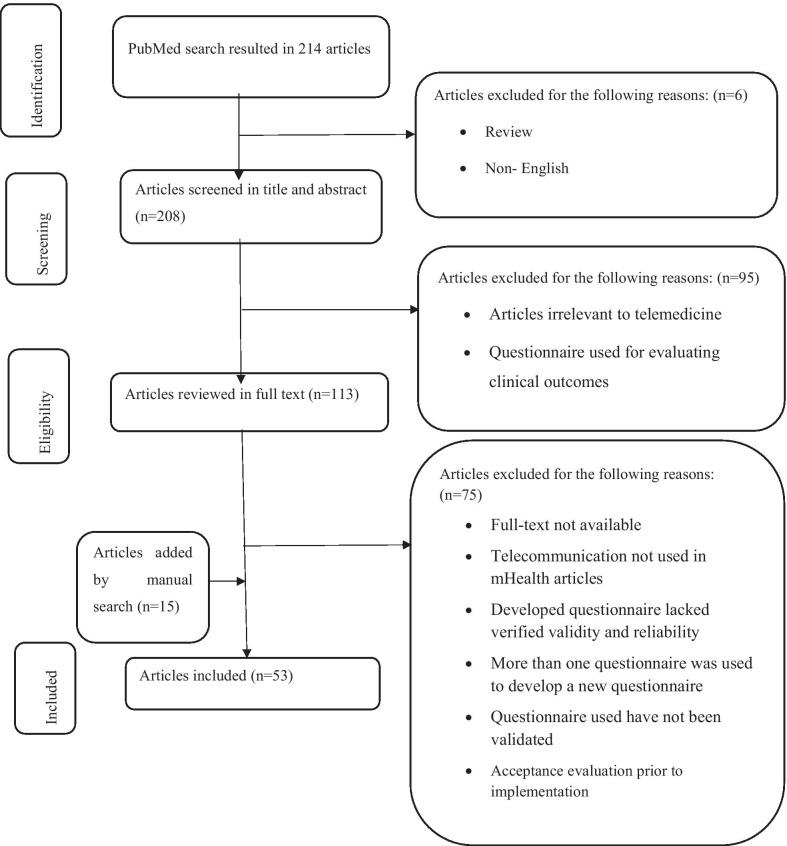
The PubMed database was searched in August 2020 to retrieve articles. Data extracted from the final list of articles included author/year of publication, journal of publication, type of evaluation, and evaluation questionnaire. Data were analyzed using descriptive statistics.
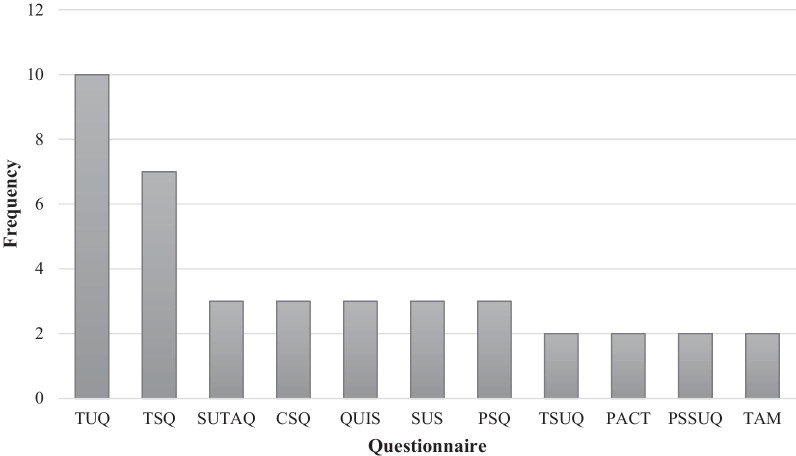
Fifty-three articles were included in this study. The questionnaire was used for evaluating the satisfaction (49%), usability (34%), acceptance (11.5%), and implementation (2%) of telemedicine services. Among telemedicine specific questionnaires, Telehealth Usability Questionnaire (TUQ) (19%), Telemedicine Satisfaction Questionnaire (TSQ) (13%), and Service User Technology Acceptability Questionnaire (SUTAQ) (5.5%), were respectively most frequently used in the collected articles. Other most used questionnaires generally used for evaluating the users' satisfaction, usability, and acceptance of technology were Client Satisfaction Questionnaire (CSQ) (5.5%), Questionnaire for User Interaction Satisfaction (QUIS) (5.5%), System Usability Scale (SUS) (5.5%), Patient Satisfaction Questionnaire (PSQ) (5.5%), and Technology Acceptance Model (TAM) (3.5%) respectively.
Employing specifically designed questionnaires or designing a new questionnaire with fewer questions and more comprehensiveness in terms of the issues studied provides a better evaluation. Attention to user needs, end-user acceptance, and implementation processes, along with users' satisfaction and usability evaluation, may optimize telemedicine efforts in the future.
问卷在远程医疗服务中是常用的工具,可以帮助评估不同方面。为达到这一目的,研究人员可能需要选择理想的问卷。本研究旨在回顾用于评估远程医疗服务的问卷有哪些,最常用的是哪些,以及它们能捕捉到远程医疗评估的哪些方面。
2020 年 8 月,在 PubMed 数据库中检索文献。从最终的文章列表中提取的数据包括作者/发表年份、出版物的类型、评价类型和评价问卷。使用描述性统计分析数据。
本研究共纳入 53 篇文章。问卷用于评估远程医疗服务的满意度(49%)、可用性(34%)、接受度(11.5%)和实施(2%)。在专门用于评估远程医疗的问卷中,远程医疗可用性问卷(TUQ)(19%)、远程医疗满意度问卷(TSQ)(13%)和服务用户技术接受度问卷(SUTAQ)(5.5%)分别是在收集的文章中最常使用的。其他一般用于评估用户对技术的满意度、可用性和接受度的最常用问卷是客户满意度问卷(CSQ)(5.5%)、用户交互满意度问卷(QUIS)(5.5%)、系统可用性量表(SUS)(5.5%)、患者满意度问卷(PSQ)(5.5%)和技术接受模型(TAM)(3.5%)。
使用专门设计的问卷或设计一个新的问卷,问题较少,且在研究问题方面更全面,可以提供更好的评估。关注用户需求、最终用户接受度和实施过程,以及用户满意度和可用性评估,可能会优化未来的远程医疗工作。