Division of Pediatric Critical Care, Children's Healthcare of Atlanta, Emory University, Atlanta, GA, USA.
Division of Pediatric Critical Care, Helen DeVos Children's Hospital, Spectrum Health, Grand Rapids, MI, USA.
Pediatr Res. 2021 Nov;90(5):1031-1038. doi: 10.1038/s41390-021-01363-3. Epub 2021 Feb 2.
Assessment of acute kidney injury (AKI) in septic patients remains imprecise. In adults, the classification of septic patients by clinical AKI phenotypes (severity and timing) demonstrates unique associations with patient outcome vs. broadly defined AKI.
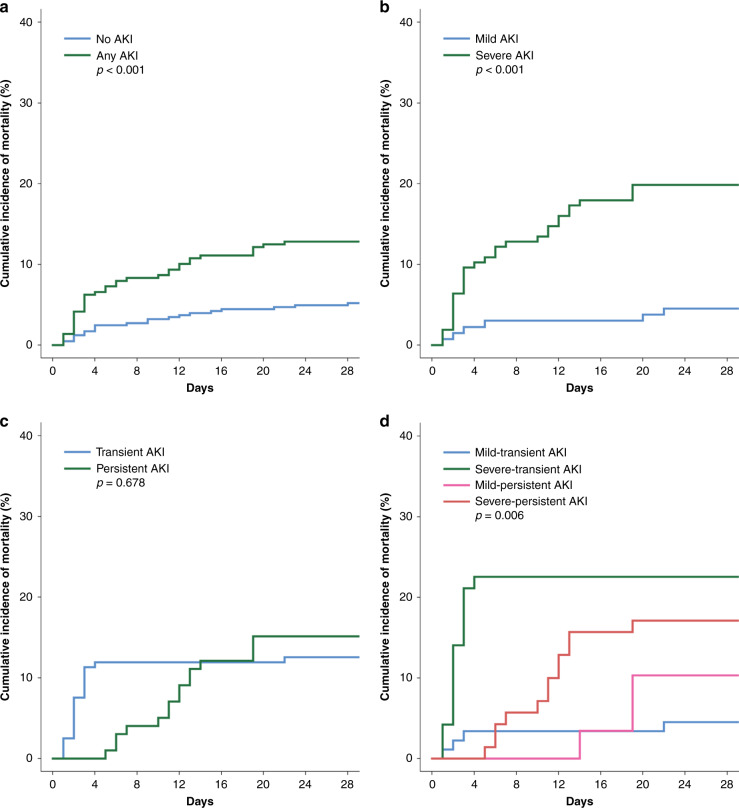
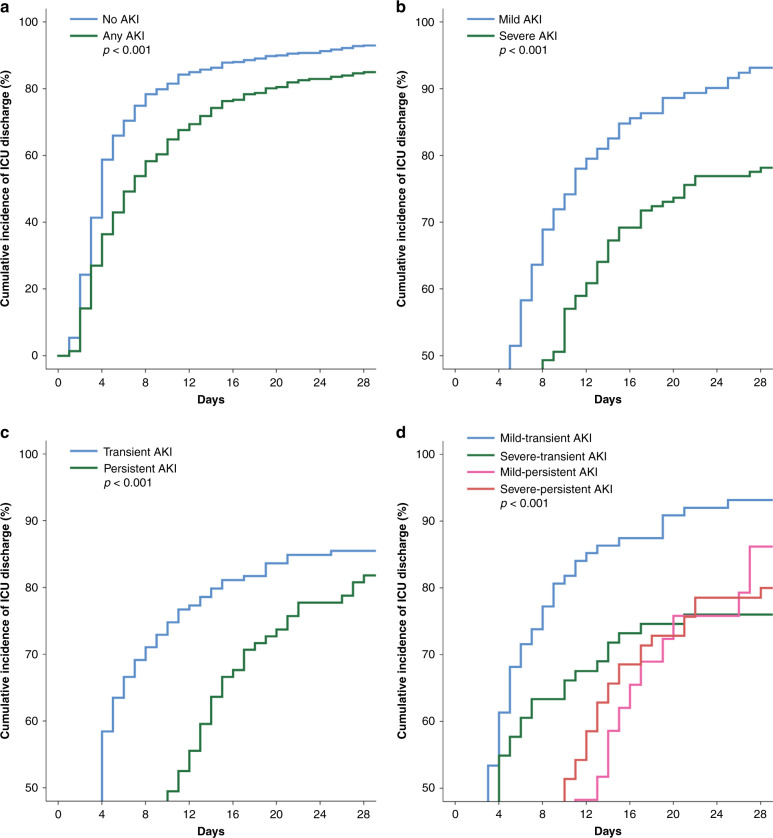
In a multinational prospective observational study, AKI diagnosis in critically ill septic children was stratified by duration (transient vs. persistent) and severity (mild vs. severe by creatinine change and urine output). The outcomes of interest were mortality and intensive care unit resource complexity at 28 days.
Seven hundred and fifty-seven septic children were studied (male 52.7%, age 4.6 years (1.5-11.9)). Mortality (overall 12.1%) was different between severe AKI and mild AKI (18.3 vs. 4.4%, p < 0.001) as well as intensive care unit (ICU) complexity (overall 34.5%, 45 vs. 21.7%, p < 0.001). Patients with Persistent AKI had fewer ICU-free days (17 (7, 21) vs. 24 (17, 26), p < 0.001) and higher ICU complexity (52.8 vs. 22.9%, p = 0.002) than transient AKI, even after exclusion of patients with early mortality. AKI phenotypes incorporating temporal and severity data correlate with unique survival (range 4.4-21.6%) and ICU-free days (range of 15-25 days) CONCLUSIONS: The outcome of septic children with AKI changes by clinical phenotype. Our findings underscore the importance of prognostic enrichment in sepsis and AKI for the purpose of trial design and patient management.
Although AKI occurs commonly in patients with sepsis (S-AKI), outcomes for children with S-AKI varies based on the severity and timing of the AKI. Existing S-AKI pediatric data utilize a broad singular definition of kidney injury. Increasing the precision of AKI classification results in a new understanding of how S-AKI associates with patient outcome. A refined classification of S-AKI identifies subgroups of children, making possible a targeted and a personalized medicine approach to S-AKI study and management.
脓毒症患者急性肾损伤(AKI)的评估仍然不够精确。在成人中,根据临床 AKI 表型(严重程度和时间)对脓毒症患者进行分类,与广泛定义的 AKI 相比,与患者预后具有独特的相关性。
在一项多中心前瞻性观察性研究中,通过持续时间(短暂与持续)和严重程度(肌酐变化和尿量的轻度与重度)对重症脓毒症儿童的 AKI 进行分层。研究的主要结局是 28 天的死亡率和重症监护病房(ICU)资源复杂性。
共研究了 757 例脓毒症儿童(男性占 52.7%,年龄为 4.6 岁(1.5-11.9))。严重 AKI 与轻度 AKI 之间的死亡率(总体为 12.1%)不同(18.3%比 4.4%,p<0.001),ICU 复杂性也不同(总体为 34.5%,45%比 21.7%,p<0.001)。持续性 AKI 患者 ICU 无天数更少(17(7,21)比 24(17,26),p<0.001),ICU 复杂性更高(52.8%比 22.9%,p=0.002),即使排除了早期死亡的患者也是如此。纳入时间和严重程度数据的 AKI 表型与独特的生存率(范围为 4.4%-21.6%)和 ICU 无天数(范围为 15-25 天)相关。
AKI 合并脓毒症儿童的结局因临床表型而异。我们的研究结果强调了在脓毒症和 AKI 中进行预后富集的重要性,目的是为试验设计和患者管理服务。
虽然脓毒症患者(S-AKI)常发生 AKI,但 S-AKI 患儿的预后因 AKI 的严重程度和时间而异。现有的 S-AKI 儿科数据采用 AKI 损伤的广泛单一定义。提高 AKI 分类的精确性可使人们对 S-AKI 与患者预后的关系有新的认识。对 S-AKI 的更精细分类确定了儿童亚组,从而使 S-AKI 的靶向和个体化医学研究和管理成为可能。