BK21 PLUS Team, College of Pharmacy, The Catholic University of Korea, Bucheon, 14662, Republic of Korea.
Arch Pharm Res. 2021 Jan;44(1):16-35. doi: 10.1007/s12272-021-01307-9. Epub 2021 Feb 3.
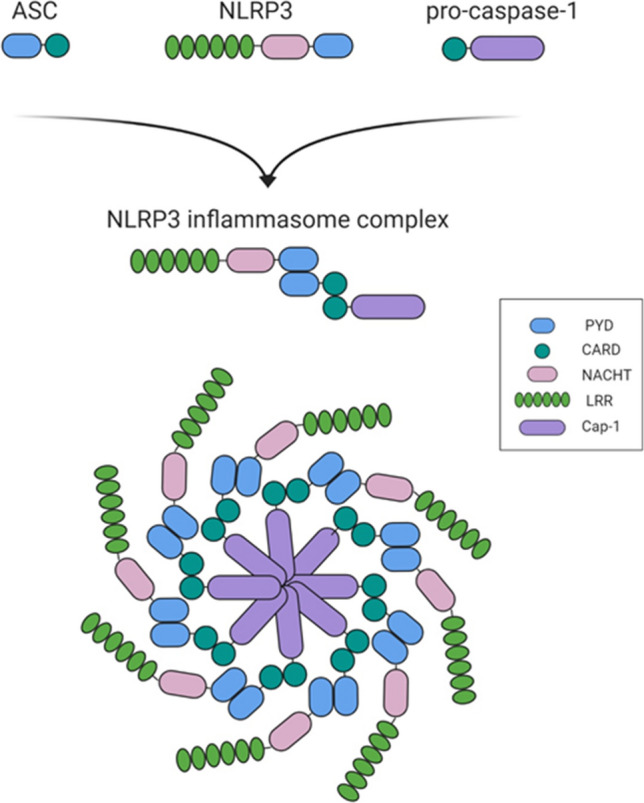
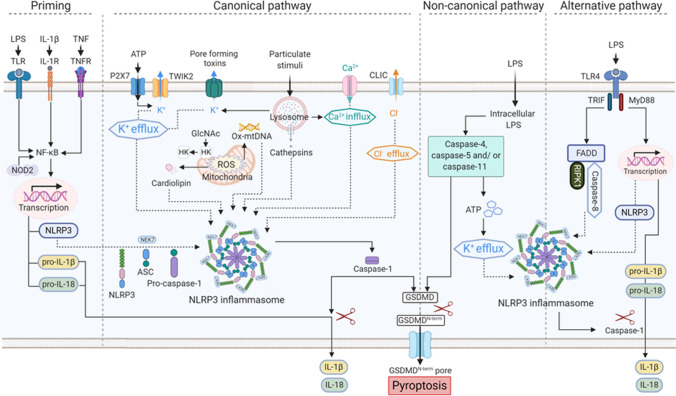
Inflammasomes are cytosolic pattern recognition receptors that recognize pathogen-associated molecular patterns (PAMPs) and danger-associated molecular patterns (DAMPs) derived from invading pathogens and damaged tissues, respectively. Upon activation, the inflammasome forms a complex containing a receptor protein, an adaptor, and an effector to induce the autocleavage and activation of procaspase-1 ultimately culminating in the maturation and secretion of IL-1β and IL-18 and pyroptosis. Inflammasome activation plays an important role in host immune responses to pathogen infections and tissue repair in response to cellular damage. The NLRP3 inflammasome is a well-characterized pattern recognition receptor and is well known for its critical role in the regulation of immunity and the development and progression of various inflammatory diseases. In this review, we summarize recent efforts to develop therapeutic applications targeting the NLRP3 inflammasome to cure and prevent chronic inflammatory diseases. This review extensively discusses NLRP3 inflammasome-related diseases and current development of small molecule inhibitors providing beneficial information on the design of therapeutic strategies for NLRP3 inflammasome-related diseases. Additionally, small molecule inhibitors are classified depending on direct or indirect targeting mechanism to describe the current status of the development of pharmacological inhibitors.
炎症小体是细胞溶质模式识别受体,分别识别来自入侵病原体和受损组织的病原体相关分子模式 (PAMP) 和危险相关分子模式 (DAMP)。激活后,炎症小体形成包含受体蛋白、衔接蛋白和效应蛋白的复合物,诱导原胱天蛋白酶-1的自切割和激活,最终导致 IL-1β 和 IL-18 的成熟和分泌以及细胞焦亡。炎症小体的激活在宿主对病原体感染的免疫反应以及对细胞损伤的组织修复中起着重要作用。NLRP3 炎症小体是一种特征明确的模式识别受体,其在免疫调节以及各种炎症性疾病的发生和发展中的关键作用是众所周知的。在这篇综述中,我们总结了最近针对 NLRP3 炎症小体开发治疗应用的努力,以治疗和预防慢性炎症性疾病。这篇综述广泛讨论了 NLRP3 炎症小体相关疾病和小分子抑制剂的当前发展,为 NLRP3 炎症小体相关疾病的治疗策略设计提供了有益信息。此外,根据直接或间接靶向机制对小分子抑制剂进行分类,以描述药理抑制剂开发的现状。