Department of Dermatology, The Second Affiliated Hospital of Guangzhou Medical University, Guangzhou, China.
Department of Endocrinology, The Second Affiliated Hospital of Guangzhou Medical University, Guangzhou, China.
Front Immunol. 2021 Oct 11;12:732933. doi: 10.3389/fimmu.2021.732933. eCollection 2021.
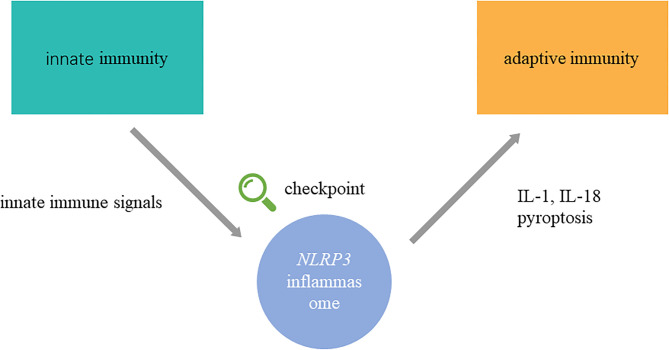
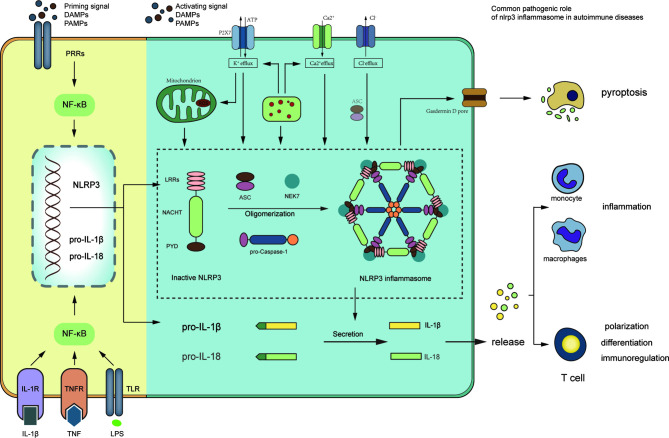
Autoimmune diseases are a broad spectrum of human diseases that are characterized by the breakdown of immune tolerance and the production of autoantibodies. Recently, dysfunction of innate and adaptive immunity is considered to be a key step in the initiation and maintenance of autoimmune diseases. NOD-like receptor family pyrin domain containing 3 (NLRP3) inflammasome is a multimeric protein complex, which can detect exogenous pathogen irritants and endogenous danger signals. The main function of NLRP3 inflammasome is to promote secretion of interleukin (IL)-1β and IL-18, and pyroptosis mediated by caspase-1. Served as a checkpoint in innate and adaptive immunity, aberrant activation and regulation of NLRP3 inflammasome plays an important role in the pathogenesis of autoimmune diseases. This paper reviewed the roles of NLRP3 inflammasome in autoimmune diseases, which shows NLRP3 inflammasome may be a potential target for autoimmune diseases deserved further study.
自身免疫性疾病是一大类人类疾病,其特征是免疫耐受的破坏和自身抗体的产生。最近,先天免疫和适应性免疫的功能障碍被认为是自身免疫性疾病发生和维持的关键步骤。NOD 样受体家族含pyrin 结构域蛋白 3(NLRP3)炎性小体是一种多聚体蛋白复合物,能够检测外源性病原体刺激物和内源性危险信号。NLRP3 炎性小体的主要功能是促进白细胞介素(IL)-1β和 IL-18 的分泌以及半胱天冬酶-1 介导的细胞焦亡。作为先天免疫和适应性免疫的检查点,NLRP3 炎性小体的异常激活和调节在自身免疫性疾病的发病机制中起着重要作用。本文综述了 NLRP3 炎性小体在自身免疫性疾病中的作用,表明 NLRP3 炎性小体可能是自身免疫性疾病的一个有潜力的治疗靶点,值得进一步研究。