Centre for Epidemiology and Biostatistics, Melbourne School of Population and Global Health, The University of Melbourne, 207 Bouverie Street, Parkville, VIC, 3010, Australia.
Centre for Cancer Genetic Epidemiology, Department of Public Health and Primary Care, University of Cambridge, Cambridge, UK.
BMC Med Genomics. 2021 Feb 3;14(1):38. doi: 10.1186/s12920-021-00887-1.
Lifestyle factors including obesity and smoking are suggested to be correlated with increased risk of COVID-19 severe illness or related death. However, whether these relationships are causal is not well known; neither for the relationships between COVID-19 severe illness and other common lifestyle factors, such as physical activity and alcohol consumption.
Genome-wide significant genetic variants associated with body mass index (BMI), lifetime smoking, physical activity and alcohol consumption identified by large-scale genome-wide association studies (GWAS) of up to 941,280 individuals were selected as instrumental variables. Summary statistics of the genetic variants on severe illness of COVID-19 were obtained from GWAS analyses of up to 6492 cases and 1,012,809 controls. Two-sample Mendelian randomisation analyses were conducted.
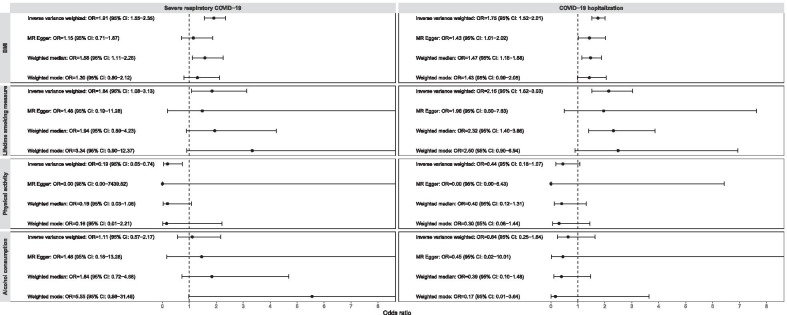
Both per-standard deviation (SD) increase in genetically predicted BMI and lifetime smoking were associated with about two-fold increased risks of severe respiratory COVID-19 and COVID-19 hospitalization (all P < 0.05). Per-SD increase in genetically predicted physical activity was associated with decreased risks of severe respiratory COVID-19 (odds ratio [OR] = 0.19; 95% confidence interval [CI], 0.05, 0.74; P = 0.02), but not with COVID-19 hospitalization (OR = 0.44; 95% CI 0.18, 1.07; P = 0.07). No evidence of association was found for genetically predicted alcohol consumption. Similar results were found across robust Mendelian randomisation methods.
Evidence is found that BMI and smoking causally increase and physical activity might causally decrease the risk of COVID-19 severe illness. This study highlights the importance of maintaining a healthy lifestyle in protecting from COVID-19 severe illness and its public health value in fighting against COVID-19 pandemic.
生活方式因素,包括肥胖和吸烟,被认为与 COVID-19 重症或相关死亡的风险增加有关。然而,这些关系是否具有因果关系尚不清楚;对于 COVID-19 重症与其他常见生活方式因素(如身体活动和饮酒)之间的关系也是如此。
选择通过对多达 941280 人的大规模全基因组关联研究(GWAS)确定的与体重指数(BMI)、终生吸烟、身体活动和饮酒相关的全基因组显著遗传变异作为工具变量。从多达 6492 例 COVID-19 重症病例和 1012809 例对照的 GWAS 分析中获得了遗传变异与 COVID-19 重症的汇总统计数据。进行了两样本 Mendelian 随机化分析。
遗传预测 BMI 每增加一个标准差(SD)和终生吸烟与严重呼吸道 COVID-19 和 COVID-19 住院的风险增加约两倍相关(均 P<0.05)。遗传预测身体活动每增加一个 SD 与严重呼吸道 COVID-19 的风险降低相关(比值比[OR] = 0.19;95%置信区间[CI],0.05,0.74;P = 0.02),但与 COVID-19 住院无关(OR = 0.44;95% CI 0.18,1.07;P = 0.07)。没有发现遗传预测饮酒与 COVID-19 之间存在关联的证据。稳健的 Mendelian 随机化方法得到了类似的结果。
有证据表明 BMI 和吸烟会导致 COVID-19 重症的风险增加,而身体活动可能会导致 COVID-19 重症的风险降低。本研究强调了保持健康生活方式对于预防 COVID-19 重症的重要性,以及其在抗击 COVID-19 大流行中的公共卫生价值。