Department of Obstetrics and Gynecology, Peking Union Medical College, Peking Union Medical College Hospital, Chinese Academy of Medical Sciences, No.1 Shuaifuyuan, Dongcheng District, 100730, Beijing, China.
J Ovarian Res. 2021 Feb 3;14(1):25. doi: 10.1186/s13048-021-00780-6.
To describe the diagnostic criteria used and their application accuracy in the practice of polycystic ovary syndrome (PCOS) caring among obstetricians and gynaecologists across China.
This was an Online cross-sectional survey of Obstetricians and gynecologists involved in PCOS caring conducted via the largest continuing education platform of obstetrics and gynecology across China from September 2019 to November 2019.
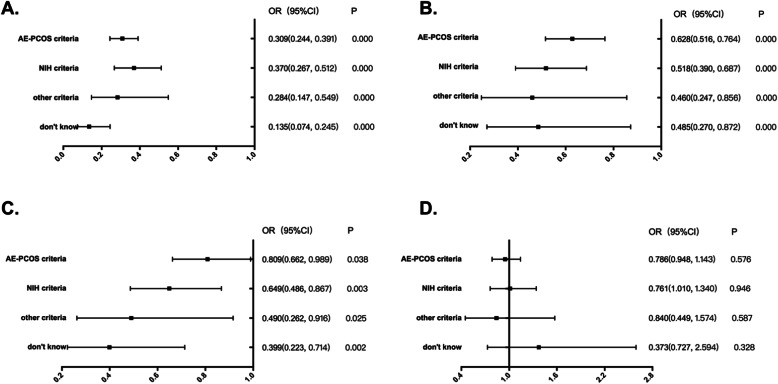
A total of 2,328 respondents were eligible for the final analysis. Of these, 94.5 % were general obstetricians and gynaecologists (Ge-ObGyn), and 5.5 % were reproductive endocrinologists (Re-ObGyn). Overall, the most frequently used criteria were the Androgen Excess and Polycystic Ovary Syndrome Society (AE-PCOS) criteria (48.2 %), followed by the Rotterdam criteria (35.7 %) and NIH criteria (12.1 %). Of the respondents, 31.3 % used their diagnostic criteria in their clinical practice. More respondents who chose the Rotterdam criteria could accurately apply the diagnostic criteria than those who chose the AE-PCOS criteria (41.2 % vs. 32.1 %, P < 0.001). Compared with Ge-ObGyn, Re-ObGyn were less likely to use the AE-PCOS criteria (adjusted odds ratio, 0.513; 95 % CI, 0.328-0.802; P < 0.05) and 1.492 times more likely to accurately use their criteria (95 % CI, 1.014-2.196; P < 0.05).
Less than one-third of obstetricians and gynaecologists across China could accurately use the diagnostic criteria they choose to diagnose PCOS. There is an urgent need to train obstetricians and gynaecologists on PCOS diagnosis in an effort to improve the medical care quality of patients with PCOS.
描述中国妇产科医生在多囊卵巢综合征(PCOS)诊治实践中使用的诊断标准及其应用准确性。
这是一项 2019 年 9 月至 11 月在中国最大的妇产科继续教育平台上进行的针对参与 PCOS 诊治的妇产科医生的在线横断面调查。
共有 2328 名符合条件的受访者纳入最终分析。其中,94.5%为普通妇产科医生(Ge-ObGyn),5.5%为生殖内分泌学家(Re-ObGyn)。总体而言,最常使用的标准是雄激素过多和多囊卵巢综合征协会(AE-PCOS)标准(48.2%),其次是鹿特丹标准(35.7%)和 NIH 标准(12.1%)。在受访者中,31.3%在临床实践中使用自己的诊断标准。选择鹿特丹标准的受访者比选择 AE-PCOS 标准的受访者更能准确应用诊断标准(41.2%比 32.1%,P<0.001)。与 Ge-ObGyn 相比,Re-ObGyn 更不可能使用 AE-PCOS 标准(调整后的优势比,0.513;95%CI,0.328-0.802;P<0.05),更有可能准确使用自己的标准(95%CI,1.014-2.196;P<0.05)。
中国不到三分之一的妇产科医生能够准确使用他们选择的诊断标准来诊断 PCOS。迫切需要对妇产科医生进行 PCOS 诊断培训,以提高 PCOS 患者的医疗质量。