Indian Institute of Tropical Meteorology, MoES, Pune, 411008, India.
Department of Atmospheric and Space Sciences, Savitribai Phule Pune University, Pune, 411007, India.
Sci Rep. 2021 Feb 3;11(1):2931. doi: 10.1038/s41598-021-82321-1.
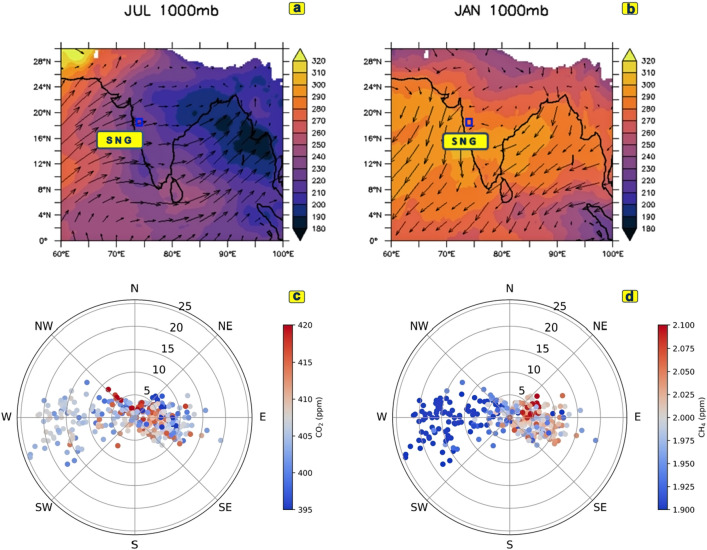
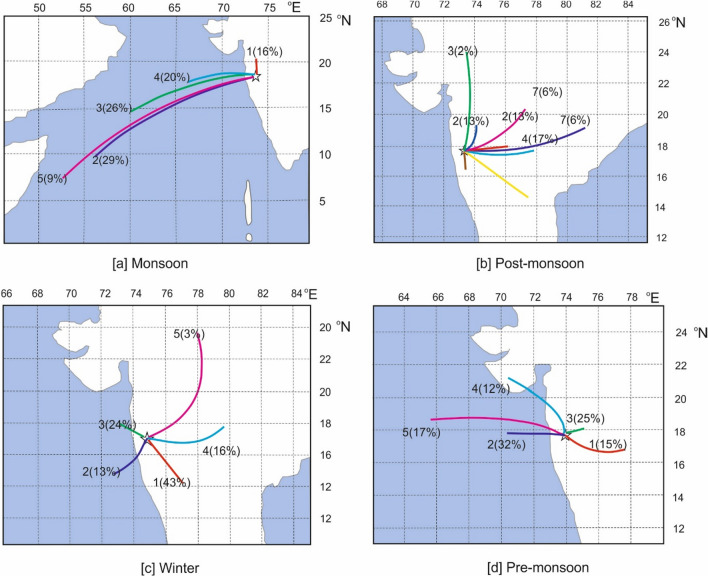
Amongst all the anthropogenically produced greenhouse gases (GHGs), carbon dioxide (CO) and methane (CH) are the most important, owing to their maximum contribution to the net radiative forcing of the Earth. India is undergoing rapid economic development, where fossil fuel emissions have increased drastically in the last three decades. Apart from the anthropogenic activities, the GHGs dynamics in India are governed by the biospheric process and monsoon circulation; however, these aspects are not well addressed yet. Towards this, we have measured CO and CH concentration at Sinhagad, located on the Western Ghats in peninsular India. The average concentrations of CO and CH observed during the study period are 406.05 ± 6.36 and 1.97 ± 0.07 ppm (µ ± 1σ), respectively. They also exhibit significant seasonal variabilities at this site. CH (CO) attains its minimum concentration during monsoon (post-monsoon), whereas CO (CH) reaches its maximum concentration during pre-monsoon (post-monsoon). CO poses significant diurnal variations in monsoon and post-monsoon. However, CH exhibits a dual-peak like pattern in pre-monsoon. The study suggests that the GHG dynamics in the western region of India are significantly influenced by monsoon circulation, especially during the summer season.
在所有人为产生的温室气体(GHGs)中,二氧化碳(CO)和甲烷(CH)最为重要,因为它们对地球的净辐射强迫贡献最大。印度正在经历快速的经济发展,在过去的三十年中,化石燃料排放急剧增加。除了人为活动外,印度的温室气体动态还受生物圈过程和季风环流的控制;然而,这些方面尚未得到很好的解决。为此,我们在印度半岛西高止山脉的辛哈加德测量了 CO 和 CH 的浓度。在研究期间,观察到的 CO 和 CH 的平均浓度分别为 406.05±6.36 和 1.97±0.07 ppm(µ±1σ)。它们在该地点也表现出显著的季节性变化。CH(CO)在季风(后季风)期间达到最低浓度,而 CO(CH)在季风前(后季风)期间达到最高浓度。CO 在季风和后季风期间表现出显著的日变化。然而,CH 在季风前表现出双峰模式。研究表明,印度西部地区的温室气体动态受到季风环流的显著影响,特别是在夏季。