Lischke Alexander, Pahnke Rike, Mau-Moeller Anett, Weippert Matthias
Department of Psychology, University of Greifswald, Greifswald, Germany.
Department of Sport Science, University of Rostock, Rostock, Germany.
Front Neurosci. 2021 Jan 11;14:612445. doi: 10.3389/fnins.2020.612445. eCollection 2020.
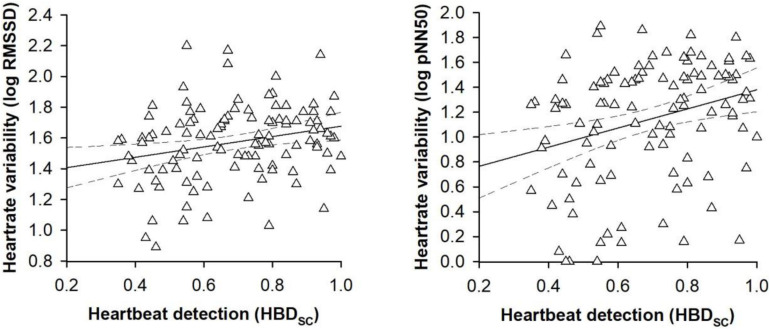
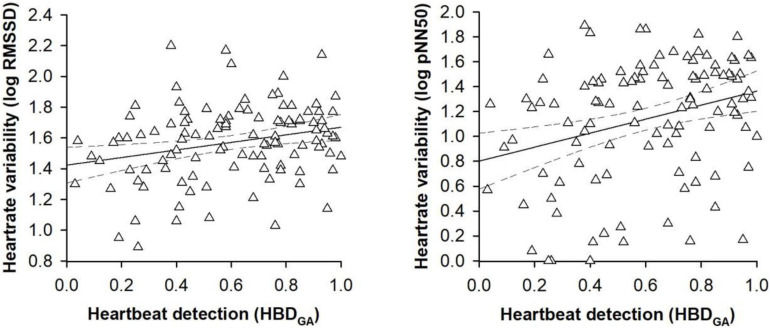
Our emotional experiences depend on our interoceptive ability to perceive and interpret changes in our autonomous nervous system. An inaccurate perception and interpretation of autonomic changes impairs our ability to understand and regulate our emotional reactions. Impairments in emotion understanding and emotion regulation increase our risk for mental disorders, indicating that interoceptive deficits play an important role in the etiology and pathogenesis of mental disorders. We, thus, need measures to identify those of us whose interoceptive deficits impair their emotion understanding and emotion regulation. Here, we used cardiac measures to investigate how our ability to engage prefrontal and (para-)limbic brain region regions affects our ability to perceive and interpret cardiac changes. We administered a heartbeat detection task to a sample of healthy individuals ( = 113) whose prefrontal-(para-) limbic engagement had been determined on basis of a heart rate variability recording. We found a positive association between heartbeat detection and heart rate variability, implying that individuals with higher heart rate variability were more accurate in heartbeat detection than individuals with lower heart rate variability. These findings suggest that our interoceptive accuracy depends on our prefrontal-(para-)limbic engagement during the perception and interpretation of cardiac changes. Our findings also show that cardiac measures may be useful to investigate the association between interoceptive accuracy and prefrontal-(para-)limbic engagement in a time- and cost-efficient manner.
我们的情感体验取决于我们感知和解释自主神经系统变化的内感受能力。对自主神经变化的不准确感知和解释会损害我们理解和调节情绪反应的能力。情绪理解和情绪调节方面的损害会增加我们患精神障碍的风险,这表明内感受缺陷在精神障碍的病因和发病机制中起重要作用。因此,我们需要采取措施来识别那些内感受缺陷会损害其情绪理解和情绪调节能力的人。在这里,我们使用心脏测量方法来研究我们激活前额叶和(副)边缘脑区的能力如何影响我们感知和解释心脏变化的能力。我们对一组健康个体(n = 113)进行了心跳检测任务,这些个体的前额叶 - (副)边缘激活情况已根据心率变异性记录确定。我们发现心跳检测与心率变异性之间存在正相关,这意味着心率变异性较高的个体在心跳检测方面比心率变异性较低的个体更准确。这些发现表明,我们的内感受准确性取决于我们在感知和解释心脏变化过程中前额叶 - (副)边缘的激活情况。我们的研究结果还表明,心脏测量方法可能有助于以高效省时且经济的方式研究内感受准确性与前额叶 - (副)边缘激活之间的关联。