Haruki Yusuke, Kaneko Kei, Ogawa Kenji
Department of Psychology, Graduate School of Humanities and Human Sciences, Hokkaido University, Sapporo, 060-0810, Japan.
Japan Society for the Promotion of Science (JSPS), Tokyo, 102-8472, Japan.
BMC Psychol. 2025 Feb 28;13(1):176. doi: 10.1186/s40359-025-02432-6.
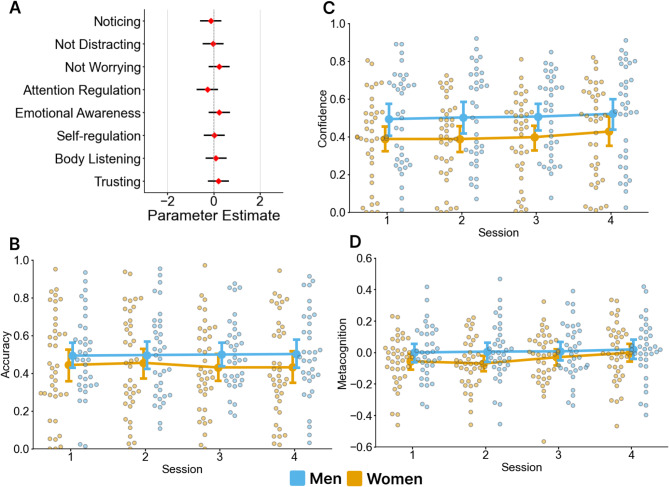
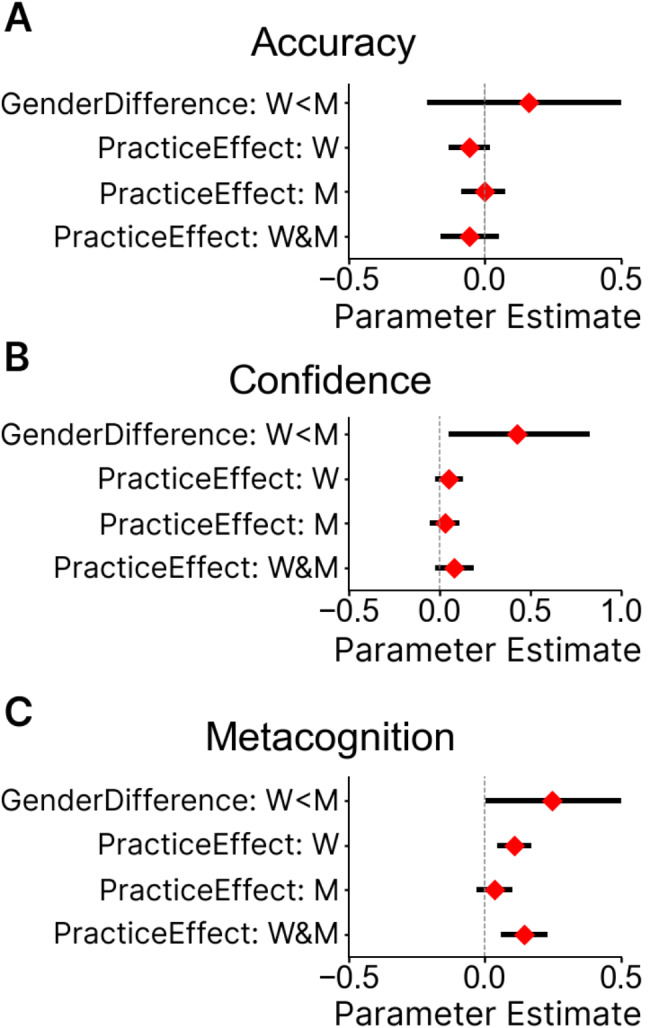
Gender differences in interoceptive awareness-awareness of internal bodily signals such as heartbeat perception-have been suggested, with some findings indicating behaviourally reduced but subjectively enhanced awareness in women, though these findings are still contentious. This study aimed to comprehensively examine gender differences in three aspects of interoceptive awareness: behavioural accuracy, subjective confidence, and relationship between them (i.e., metacognition). We used a modified heartbeat counting task that prohibited estimation strategies and increased the number of trials up to 20. Using data from 74 healthy young adults (39 women and 35 men), we evaluated gender differences and practice effects for each measure via Bayesian linear mixed models, controlling for individual heart rate and trial duration on a trial-by-trial basis. Contrary to previous research, the results revealed no reduced interoceptive accuracy in women; instead, higher interoceptive accuracy score was associated with shorter trial durations and lower heart rates regardless of gender. Moreover, women exhibited underconfidence about their performance, and therefore lower metacognition scores, compared to men. Trial repetitions moderated women's lowered metacognition but did not affect accuracy or confidence. These findings highlight potential physiological and psychological confounding factors in the heartbeat counting task, such as heart rate and reporting style, and emphasise several cautions for studying gender differences in interoceptive awareness.
内感受性觉知(即对诸如心跳感知等身体内部信号的觉知)方面的性别差异已被提出,一些研究结果表明,女性在行为上的觉知有所降低,但主观上的觉知却有所增强,不过这些结果仍存在争议。本研究旨在全面考察内感受性觉知三个方面的性别差异:行为准确性、主观信心以及两者之间的关系(即元认知)。我们使用了一种经过改良的心跳计数任务,该任务禁止使用估计策略,并将试验次数增加到20次。利用74名健康年轻成年人(39名女性和35名男性)的数据,我们通过贝叶斯线性混合模型评估了每种测量方法的性别差异和练习效果,在每次试验的基础上控制个体心率和试验持续时间。与先前的研究相反,结果显示女性的内感受性准确性并未降低;相反,无论性别如何,更高的内感受性准确性得分与更短的试验持续时间和更低的心率相关。此外,与男性相比,女性对自己的表现缺乏信心,因此元认知得分较低。试验重复减轻了女性较低的元认知,但并未影响准确性或信心。这些发现突出了心跳计数任务中潜在的生理和心理混杂因素,如心率和报告方式,并强调了在研究内感受性觉知性别差异时的几点注意事项。