Department of Epidemiology, Institute of Social Medicine, State University of Rio de Janeiro (UERJ), Rio de Janeiro, Brazil.
PLoS One. 2021 Feb 4;16(2):e0243793. doi: 10.1371/journal.pone.0243793. eCollection 2021.
This study evaluated the influence of family meal frequency on the occurrence of common mental disorders (CMD) in children and adolescents over eight months of follow-up.
Data from this longitudinal study were derived from the PAAPAS-Parents, Students, Community Health Agents, and Teachers for Healthy Eating-community trial. CMD were evaluated using the General Health Questionnaire. Frequency of family meals (breakfast and dinner) was categorized as "breakfast and dinner regularly with the family", "at least breakfast or dinner regularly with the family", and "does not have any meal regularly with the family." The effect of family meal frequency on CMD was analyzed using generalized estimation equations with log-binomial models for repeated measures.
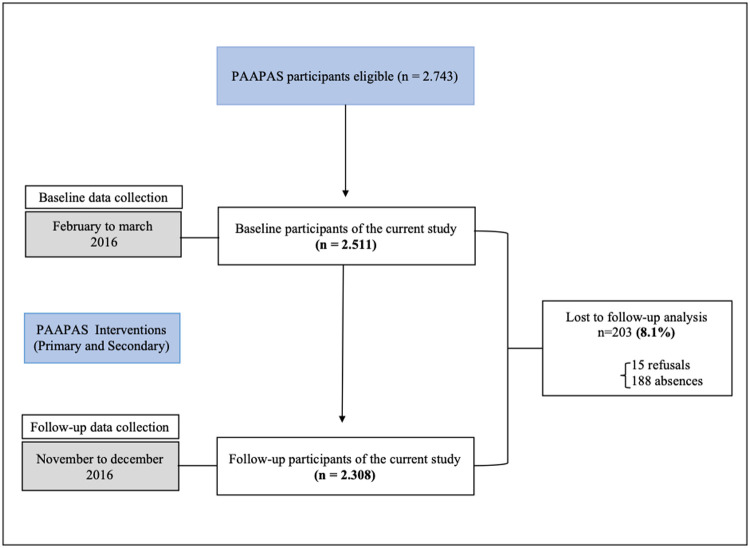
This study was conducted in public schools (N = 18) of Duque de Caxias, Rio de Janeiro, Brazil, in 2016.
Children (aged 9-11 years) and adolescents (aged 12-17 years) from the fifth and sixth grades (N = 2,743).
These findings suggested that regular family meals were a protective factor for mental health. The adjusted relative risk of CMD was 0.75 (95% confidence interval = 0.69-0.83) for those who had two family meals regularly and 0.87 (95% confidence interval = 0.77-0.97) for those who had only one regular family meal, compared to students who had no regular family meals.
Potential strategies that educate and encourage families about the mental health benefits of eating regular meals together must be explored and implemented.
本研究旨在评估家庭用餐频率对儿童和青少年在 8 个月随访期间常见精神障碍(CMD)发生的影响。
本纵向研究的数据来自 PAAPAS-Parents、Students、Community Health Agents、and Teachers for Healthy Eating-community 试验。采用一般健康问卷评估 CMD。家庭用餐频率(早餐和晚餐)分为“与家人定期共进早餐和晚餐”、“至少定期与家人共进早餐或晚餐”和“与家人没有定期用餐”。使用广义估计方程和对数二项式模型对重复测量进行分析,评估家庭用餐频率对 CMD 的影响。
本研究于 2016 年在巴西里约热内卢杜奎德卡西亚斯的公立学校(N=18)进行。
来自五年级和六年级的儿童(9-11 岁)和青少年(12-17 岁)(N=2743)。
这些发现表明,定期家庭用餐是心理健康的保护因素。与没有定期家庭用餐的学生相比,每天有两餐与家人一起规律进食的儿童和青少年 CMD 的调整后相对风险为 0.75(95%置信区间=0.69-0.83),而每天只与家人一起规律进食一餐的儿童和青少年 CMD 的调整后相对风险为 0.87(95%置信区间=0.77-0.97)。
必须探索和实施潜在的策略,对家庭进行有关一起规律进食对心理健康益处的教育和鼓励。