Hirsch Institute of Tropical Medicine, Asella, Ethiopia.
Department of Gastroenterology, Hepatology and Infectious Diseases, University Hospital, Heinrich Heine University, Düsseldorf, Germany.
PLoS One. 2021 Feb 4;16(2):e0245496. doi: 10.1371/journal.pone.0245496. eCollection 2021.
The physiological range of different vital signs is dependent on various environmental and individual factors. There is a strong interdependent relationship between vital signs and health conditions. Deviations of the physiological range are commonly used for risk assessment in clinical scores, e.g. respiratory rate (RR) and systolic blood pressure (BPsys) in patients with infections within the quick sequential organ failure assessment (qSOFA) score. A limited number of studies have evaluated the performance of such scores in resource-limited health care settings, showing inconsistent results with mostly poor discriminative power. Divergent standard values of vital parameters in different populations, e.g. could influence the accuracy of various clinical scores.
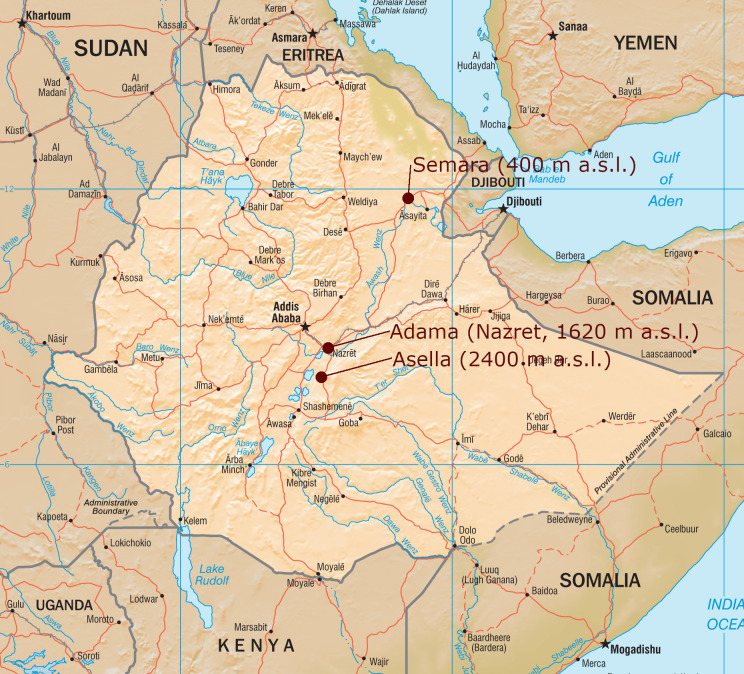
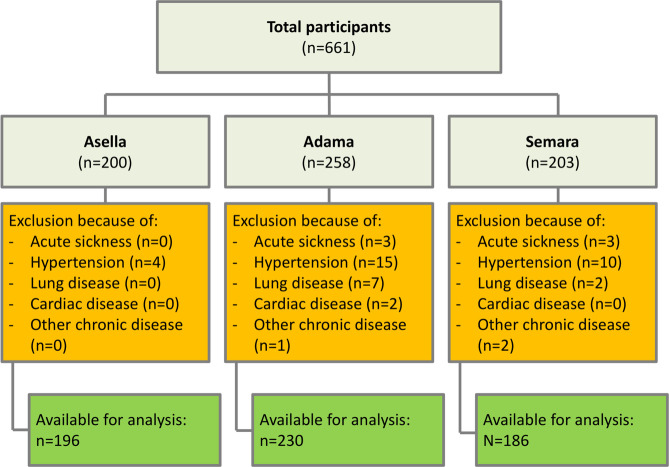
This multisite cross-sectional observational study was performed among Ethiopians residing at various altitudes in the cities of Asella (2400m above sea level (a.s.l.)), Adama (1600m a.s.l.), and Semara (400m a.s.l.). Volunteers from the local general population were asked to complete a brief questionnaire and have vital signs measured. Individuals reporting acute or chronic illness were excluded.
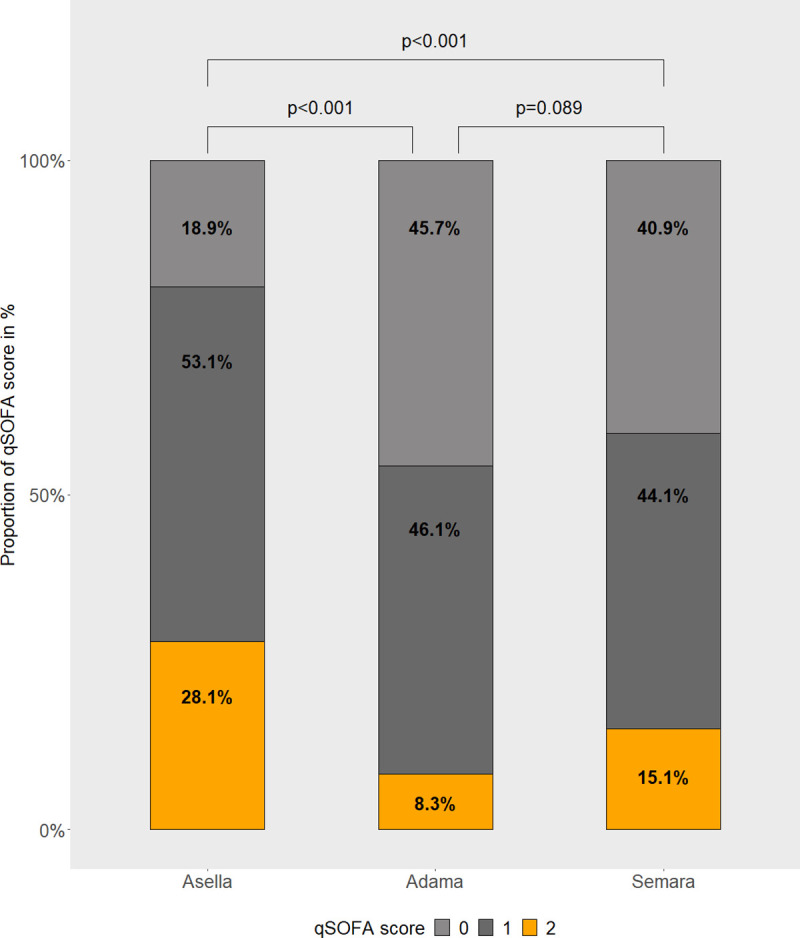
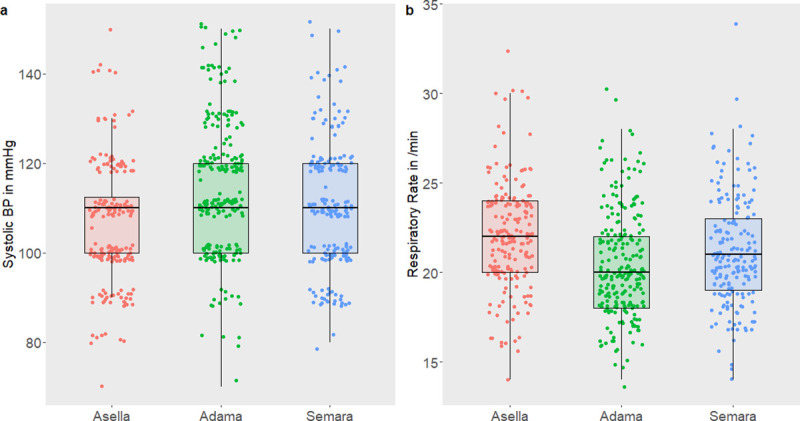
A positive qSOFA score (i.e. ≥2), indicating severe illness in patients with infection, was common among the studied population (n = 612). The proportion of participants with a positive qSOFA score was significantly higher in Asella (28.1%; 55/196), compared with Adama, (8.3%; 19/230; p<0.001) and Semara (15.1%; 28/186; p = 0.005). Concerning the parameters comprised in qSOFA, the thresholds for RR (≥22/min) were reached in 60.7%, 34.8%, and 38.2%, and for BPsys (≤100 mmHg) in 48.5%, 27.8%, and 36.0% in participants from Asella, Adama, and Semara, respectively.
The high positivity rate of qSOFA score in the studied population without signs of acute infection may be explained by variations of the physiological range of different vital signs, possibly related to the altitude of residence. Adaptation of existing scores using local standard values could be helpful for reliable risk assessment.
不同生命体征的生理范围取决于各种环境和个体因素。生命体征与健康状况之间存在着强烈的相互依存关系。在快速序贯器官衰竭评估(qSOFA)评分中,感染患者的生理范围偏差通常用于风险评估,例如呼吸频率(RR)和收缩压(BPsys)。少数研究评估了这些评分在资源有限的医疗保健环境中的表现,结果不一致,大多数评分的区分能力较差。不同人群中生命参数的标准值不同,例如可能会影响各种临床评分的准确性。
这项多地点横断面观察性研究在埃塞俄比亚人居住的不同海拔城市中进行,包括阿塞拉(海拔 2400 米)、阿达玛(海拔 1600 米)和塞马勒(海拔 400 米)。要求当地普通人群中的志愿者填写一份简短的问卷并测量生命体征。排除报告急性或慢性疾病的个体。
研究人群中(n = 612),qSOFA 评分(即≥2)阳性(表示感染患者严重疾病)的比例较高。在阿塞拉(28.1%,55/196),qSOFA 评分阳性的参与者比例明显高于阿达玛(8.3%,19/230;p<0.001)和塞马勒(15.1%,28/186;p = 0.005)。关于 qSOFA 包含的参数,RR(≥22/min)的阈值在阿塞拉、阿达玛和塞马勒的参与者中分别达到了 60.7%、34.8%和 38.2%,BPsys(≤100mmHg)的阈值达到了 48.5%、27.8%和 36.0%。
研究人群中无急性感染迹象的 qSOFA 评分阳性率较高,可能是由于不同生命体征的生理范围发生了变化,可能与居住的海拔高度有关。使用当地标准值调整现有评分可能有助于进行可靠的风险评估。