Marchand Greg, Masoud Ahmed Taher, Galitsky Anthony, Azadi Ali, Ware Kelly, Vallejo Janelle, Anderson Sienna, King Alexa, Ruther Stacy, Brazil Giovanna, Cieminski Kaitlynne, Hopewell Sophia, Eberhardt Kaitlyn, Sainz Katelyn
The Marchand Institute for Minimally Invasive Surgery, Mesa, AZ, USA.
Faculty of Medicine, Fayoum University, Fayoum, Egypt.
Obstet Gynecol Sci. 2021 Mar;64(2):156-173. doi: 10.5468/ogs.20299. Epub 2021 Feb 4.
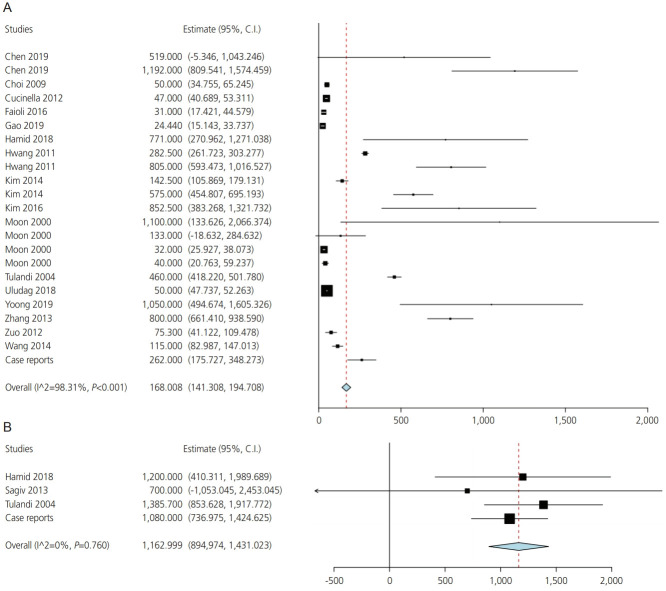
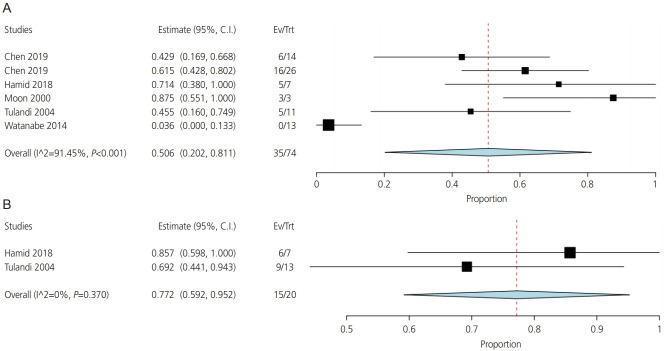
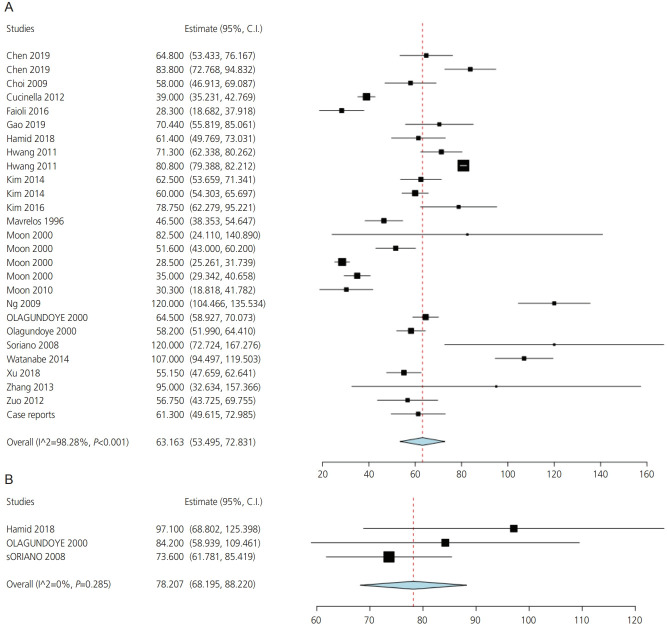
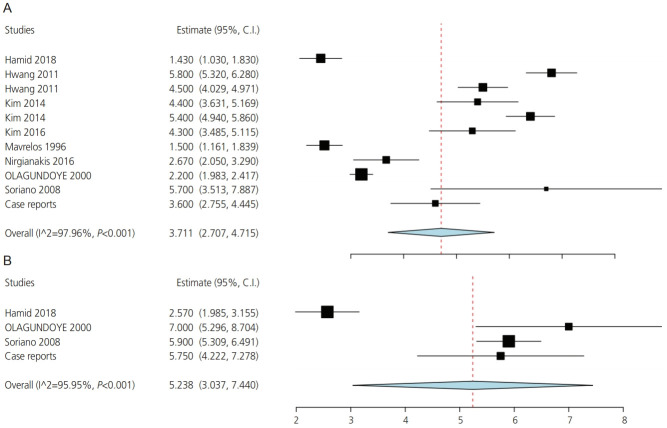
Interstitial pregnancy is a rare, life-threatening condition that requires high clinical suspicion for diagnosis. Most cases are discovered after complications have occurred. Many authors have described laparoscopic management. Although previous systematic reviews have compared the attributes and complications associated with interstitial pregnancy, we endeavored to complete the first systematic review and meta-analysis to compare the laparoscopic treatment of interstitial pregnancy with the open approach in the modern age of laparoscopic surgery. We systematically searched PubMed, ClinicalTrials.gov, Scopus, Web of Science, and Cochrane until June 2020 using relevant keywords and screened them for eligibility. We found a statistically significant difference in blood loss between laparoscopic and open surgery (168 mL compared to 1,163 mL). Further, cumulative meta-analysis has revealed that blood loss in laparoscopy has been decreasing over time from 1991 to 2020. Laparoscopic patients took less operative time (63.2 minutes) compared to laparotomy patients (78.2 minutes). Patients in the laparoscopic group spent less time hospitalized (3.7 days) compared to laparotomy patients (5.2 days). Our findings add strength to the position that laparoscopic approaches to interstitial pregnancy can be considered first-line in most situations. The laparoscopic approach was found to have a mean blood loss of 168 mL, and this blood loss seems to decrease over time. Increased gravidity and duration of amenorrhea are positive factors that increase bleeding during the procedure. We are unable to find enough high-quality data to significantly compare successful pregnancy following surgery or risk of mortality in these populations.
间质部妊娠是一种罕见的、危及生命的疾病,诊断时需要高度的临床怀疑。大多数病例在出现并发症后才被发现。许多作者都描述过腹腔镜治疗方法。尽管之前的系统评价比较了与间质部妊娠相关的特征和并发症,但我们致力于完成第一项系统评价和荟萃分析,以比较在现代腹腔镜手术时代,腹腔镜治疗间质部妊娠与开放手术的效果。我们使用相关关键词在PubMed、ClinicalTrials.gov、Scopus、Web of Science和Cochrane中进行了系统检索,直至2020年6月,并对检索结果进行了资格筛选。我们发现腹腔镜手术和开放手术在失血量方面存在统计学上的显著差异(分别为168毫升和1163毫升)。此外,累积荟萃分析表明,从1991年到2020年,腹腔镜手术的失血量一直在减少。与开腹手术患者(78.2分钟)相比,腹腔镜手术患者的手术时间更短(63.2分钟)。与开腹手术患者(5.2天)相比,腹腔镜组患者的住院时间更短(3.7天)。我们的研究结果进一步证明,在大多数情况下,腹腔镜治疗间质部妊娠可被视为一线治疗方法。腹腔镜手术的平均失血量为168毫升,而且这种失血量似乎随着时间的推移而减少。妊娠次数增加和闭经时间延长是手术过程中出血增加的积极因素。我们无法找到足够的高质量数据来显著比较这些人群手术后的成功妊娠情况或死亡率风险。