Winship Cancer Institute, Emory University School of Medicine, Atlanta, Georgia.
Dana-Farber Cancer Institute, Harvard Medical School, Boston, Massachusetts.
J Thorac Oncol. 2021 Jun;16(6):960-967. doi: 10.1016/j.jtho.2020.12.017. Epub 2021 Feb 1.
Smoking cessation has been reported to benefit patients even after a diagnosis of lung cancer. We studied the smoking behavior of patients who participated in a phase 3 trial of adjuvant therapy following resection of stages IB-IIIA NSCLC.
The ECOG-ACRIN 1505 was conducted to determine whether the addition of bevacizumab to adjuvant chemotherapy would improve overall survival (OS) for patients with early-stage NSCLC. Studying the association between smoking status and OS was a secondary end point. Patients completed a questionnaire on their smoking habits at baseline, 3, 6, 9, and 12 months.
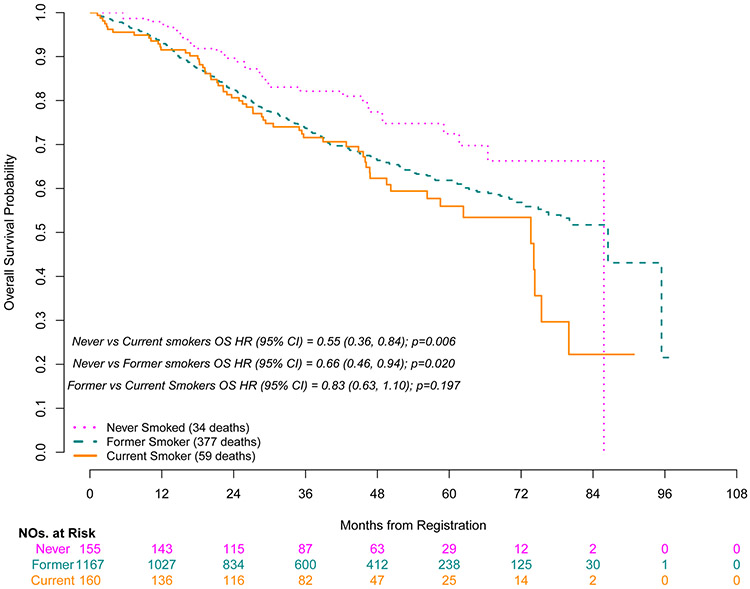
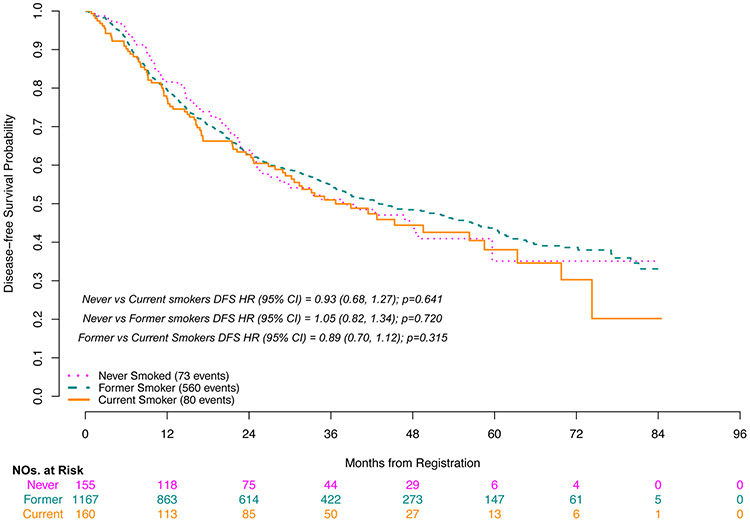
A total of 1501 patients were enrolled, and 99.8%, 95%, 94%, 93%, and 93% responded to the questionnaire at baseline, 3, 6, 9, and 12 months, respectively. A total of 90% reported a current or previous history of cigarette smoking. In addition, 60% of nonsmokers at enrollment reported smoking after diagnosis (before randomization); however, 1% of them reported smoking at 12 months. Furthermore, 94% of the respondents smoked none/fewer cigarettes daily at 12 months. The incidence of grades 3-5 toxicity on treatment was 68%, 76%, and 72% in never, former, and current smokers, respectively (p = 0.05). The disease-free survival for never-smokers relative to current and former smokers was (hazard ratio [HR] 0.93, p = 0.64 and HR 1.05, p = 0.72), and OS was (adjusted HR for death 0.54, p = 0.005 and adjusted HR for death 0.68, p = 0.03), respectively.
This is the first comprehensive, prospective report of smoking habits in patients with NSCLC patients from a phase III early-stage trial. There was a high rate of smoking reduction and cessation following study entry. The disease-free survival did not differ significantly between smokers and never smokers, though there were less grade 3-5 toxicities and more favorable OS in never-smokers.
有报道称,即使在肺癌确诊后,戒烟也对患者有益。我们研究了参加 IIIB 期非小细胞肺癌(NSCLC)切除术后辅助治疗的 3 期试验的患者的吸烟行为。
ECOG-ACRIN 1505 旨在确定贝伐单抗联合辅助化疗是否会改善早期 NSCLC 患者的总生存期(OS)。研究吸烟状况与 OS 之间的关系是次要终点。患者在基线、3、6、9 和 12 个月时完成了一份关于吸烟习惯的问卷。
共纳入 1501 例患者,分别有 99.8%、95%、94%、93%和 93%在基线、3、6、9 和 12 个月时对问卷做出了回应。共有 90%的患者报告了目前或既往吸烟史。此外,在入组时报告不吸烟或以前吸烟的非吸烟者中,有 60%在诊断后(随机分组前)开始吸烟;但其中有 1%在 12 个月时仍在吸烟。此外,94%的应答者在 12 个月时每日吸烟量为零或更少。从未吸烟者、前吸烟者和现吸烟者在治疗期间出现 3-5 级毒性的比例分别为 68%、76%和 72%(p=0.05)。从不吸烟者的无病生存率相对现吸烟者和前吸烟者为(风险比[HR] 0.93,p=0.64 和 HR 1.05,p=0.72),总生存率为(死亡的调整 HR 0.54,p=0.005 和死亡的调整 HR 0.68,p=0.03)。
这是第一项来自 III 期早期试验的 NSCLC 患者吸烟习惯的全面、前瞻性报告。研究入组后,吸烟率明显下降。虽然现吸烟者和从不吸烟者之间的无病生存率无显著差异,但从不吸烟者的 3-5 级毒性反应较少,总生存率更高。