The Neuroscience Institute, Hamad Medical Corporation, Doha, Qatar.
Weill Cornell Medical College- Qatar Foundation, Doha, Qatar.
PLoS One. 2022 Mar 24;17(3):e0255185. doi: 10.1371/journal.pone.0255185. eCollection 2022.
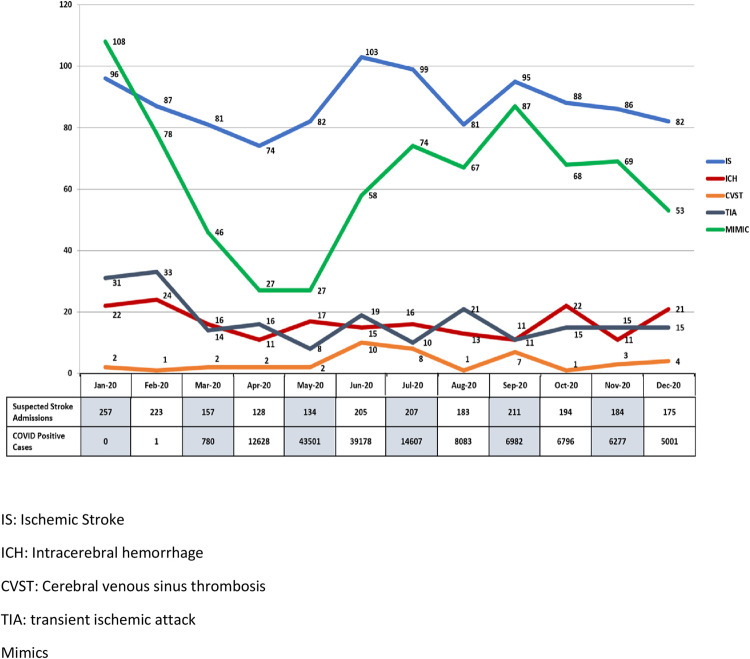
Several reports document a decrease in the rates of stroke hospital admissions during the covid-19 pandemic. There is very little information whether the admission rates will change as the infection is controlled. We report on our rates of admissions before, during and following the peak of covid-19 infections in a prospective database from Qatar.
The stroke admissions in the six months prior to COVID-19 pandemic averaged 229/month. There was a decrease to 157/month in March-June during the peak of the pandemic. In the 6 months following the peak, as covid-19 numbers began to decrease, the average numbers increased back to 192/month. There was an increase in severe ischemic strokes and decreased in functional recovery. The decreased admissions were mainly driven by fewer stroke mimics. Patients presenting with ischemic stroke or cerebral hemorrhage remained unchanged.
Fewer stroke mimics presenting to the hospital can explain the fewer admissions and poor outcome at the height of the covid-19 pandemic. The continued decrease in the number of ischemic stroke and stroke mimic admissions following the pandemic peak requires more study.
有几份报告指出,在新冠疫情期间,卒中住院人数有所下降。关于感染得到控制后,入院率是否会发生变化,相关信息很少。我们在卡塔尔前瞻性数据库中报告了新冠疫情感染高峰期之前、期间和之后的卒中入院率。
在新冠疫情大流行之前的六个月中,卒中入院人数平均每月为 229 人。在疫情高峰期的 3 月至 6 月,降至每月 157 人。在疫情高峰期过后的 6 个月中,随着新冠病毒数量开始减少,平均人数增加回每月 192 人。严重缺血性卒中的数量增加,功能恢复的情况减少。入院人数减少主要是由于较少的卒中模拟病例。表现为缺血性卒中或脑出血的患者数量保持不变。
在新冠疫情高峰期,到医院就诊的卒中模拟病例较少,这可以解释入院人数减少和预后较差的情况。在疫情高峰期过后,缺血性卒中和卒中模拟病例的入院人数继续减少,这需要进一步研究。