Dipartimento di Scienze Biomediche, Chirurgiche ed Odontoiatriche, Università degli Studi di Milano, 20133 Milan, Italy.
IRCCS Istituto Ortopedico Galeazzi, 20161 Milan, Italy.
Int J Mol Sci. 2021 Feb 2;22(3):1481. doi: 10.3390/ijms22031481.
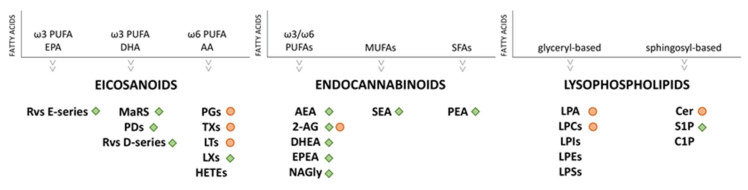
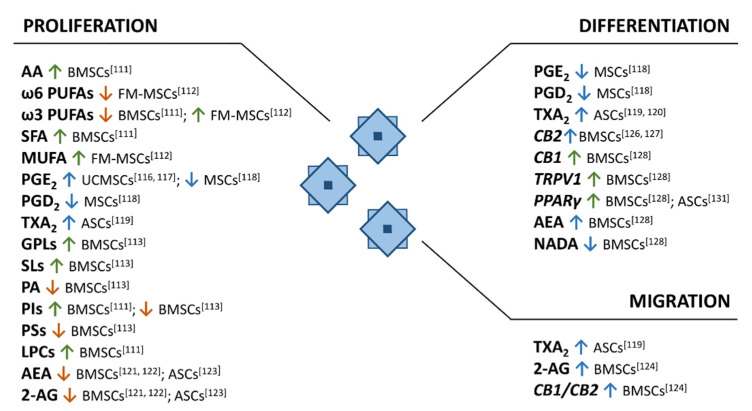
Lipidomics is a lipid-targeted metabolomics approach that aims to the comprehensive analysis of lipids in biological systems in order to highlight the specific functions of lipid species in health and disease. Lipids play pivotal roles as they are major structural components of the cellular membranes and energy storage molecules but also, as most recently shown, they act as functional and regulatory components of intra- and intercellular signaling. Herein, emphasis is given to the recently highlighted roles of specific bioactive lipids species, as polyunsaturated fatty acids (PUFA)-derived mediators (generally known as eicosanoids), endocannabinoids (eCBs), and lysophospholipids (LPLs), and their involvement in the mesenchymal stem cells (MSCs)-related inflammatory scenario. Indeed, MSCs are a heterogenous population of multipotent cells that have attracted much attention for their potential in regulating inflammation, immunomodulatory capabilities, and reparative roles. The lipidomics of the inflammatory disease osteoarthritis (OA) and the influence of MSCs-derived lipids have also been addressed.
脂质组学是一种针对脂质的代谢组学方法,旨在全面分析生物系统中的脂质,以突出脂质种类在健康和疾病中的特定功能。脂质发挥着关键作用,因为它们是细胞膜的主要结构成分和储能分子,但最近也表明,它们还是细胞内和细胞间信号传递的功能和调节成分。本文重点介绍了特定生物活性脂质种类的最新突出作用,如多不饱和脂肪酸(PUFA)衍生的介质(通常称为类二十烷酸)、内源性大麻素(eCBs)和溶血磷脂(LPLs),以及它们在间充质干细胞(MSCs)相关炎症中的作用。事实上,MSCs 是一种异质性的多能细胞群,因其在调节炎症、免疫调节能力和修复作用方面的潜力而备受关注。炎症性疾病骨关节炎(OA)的脂质组学以及 MSCs 衍生脂质的影响也已得到解决。