Scacchi Alessandro, Catozzi Dario, Boietti Edoardo, Bert Fabrizio, Siliquini Roberta
Department of Public Health Sciences and Paediatrics, University of Torino, 10126 Torino, Italy.
City of Health and Science of Turin, Azienda Ospedaliero-Universitaria, 10126 Torino, Italy.
Foods. 2021 Feb 2;10(2):306. doi: 10.3390/foods10020306.
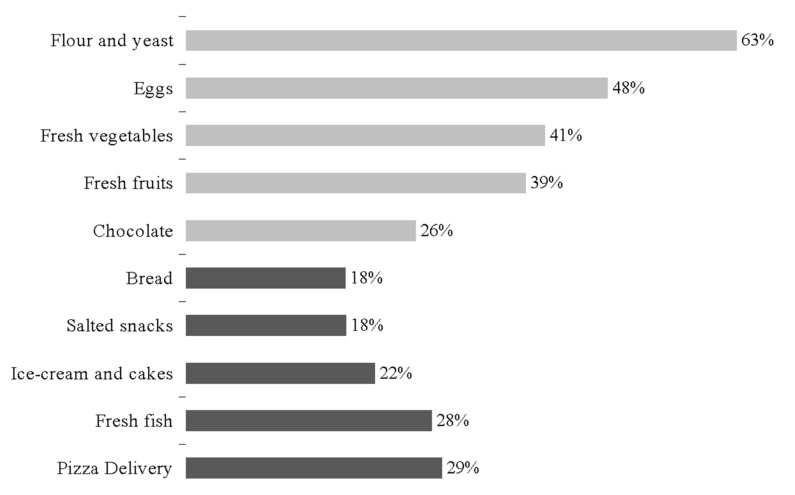
Data about self-perceived food choice (FC) changes and their determinants during COVID-19 lockdowns are limited. This study investigated how the Italian lockdown affected self-perceived food purchases (FP), occurrence of impulse buying (IB), household food waste production (HFWP) and their determinants. A web-based cross-sectional survey was distributed in May 2020, collecting an opportunistic sample of the Italian population. A total of 1865 (70% females) people were enrolled, the median age was 29 (IQR 16.0). Most of the sample increased overall FP (53.4%), food consumption (43.4%), reduced HFWP (53.7%) and halved the prevalence of IB (20.9%) compared to the period before the lockdown (42.5%). Baking ingredients, fresh vegetables, fresh fruit and chocolate had the largest sales increase by individuals, while bakery products, fresh fish and salted snacks purchases highly decreased. Increased FP was associated with the occurrence of IB (adjOR 2.48, < 0.001) and inversely associated with not having worked during lockdown (adjOR 0.71, = 0.003). Multivariable logistic regressions revealed occurrence of IB was associated with low perceived dietary quality (adjOR 2.22, < 0.001), resulting at risk, according to the Emotional Overeating Questionnaire (EOQ, adjOR 1.68, < 0.001), and inversely associated with decreased HFWP (adjOR 0.73, < 0.012). Reduced HFWP was associated with higher perceived dietary quality (adjOR 2.27, < 0.001) and negatively associated with low score at WHO-5 Well-Being Index (adjOR 0.72, = 0.002). The Italian lockdown highly affected FC behaviours, leading to positive and sustainable habits towards food purchase and consumption. Public health interventions are needed to keep these new positive effects and avoid negative consequences in case of future lockdowns.
关于新冠疫情封锁期间自我感知的食物选择(FC)变化及其决定因素的数据有限。本研究调查了意大利的封锁措施如何影响自我感知的食物购买(FP)、冲动购买(IB)的发生率、家庭食物浪费产生量(HFWP)及其决定因素。2020年5月开展了一项基于网络的横断面调查,收集了意大利人群的一个机会性样本。共纳入1865人(70%为女性),年龄中位数为29岁(四分位间距16.0)。与封锁前时期(42.5%)相比,大多数样本总体上增加了食物购买(53.4%)、食物消费(43.4%),减少了家庭食物浪费产生量(53.7%),并使冲动购买的发生率减半(20.9%)。个人购买量增加最多的是烘焙原料、新鲜蔬菜、新鲜水果和巧克力,而烘焙食品、新鲜鱼类和咸味零食的购买量大幅下降。食物购买增加与冲动购买的发生相关(校正比值比2.48,<0.001),与封锁期间未工作呈负相关(校正比值比0.71,=0.003)。多变量逻辑回归显示,冲动购买的发生与低感知饮食质量相关(校正比值比2.22,<0.001),根据情绪性暴饮暴食问卷(EOQ,校正比值比1.68,<0.001)有风险,且与家庭食物浪费产生量减少呈负相关(校正比值比0.73,<0.012)。家庭食物浪费产生量减少与较高的感知饮食质量相关(校正比值比2.27,<0.001),与世界卫生组织-5幸福指数得分低呈负相关(校正比值比0.72,=0.002)。意大利的封锁措施对食物选择行为产生了很大影响,导致了在食物购买和消费方面积极且可持续的习惯。需要采取公共卫生干预措施来保持这些新的积极影响,并在未来封锁时避免负面后果。