Mirkuzie Alemnesh H, Ali Solomon, Abate Ebba, Worku Asnake, Misganaw Awoke
Ethiopian Public Health Institute (EPHI), Addis Ababa, Ethiopia.
University of Bergen, Bergen, Norway.
BMC Public Health. 2021 Feb 4;21(1):285. doi: 10.1186/s12889-021-10269-y.
Sustainable Development Goal (SDG) 3.3, targets to eliminate HIV from being a public health threat by 2030. For better tracking of this target interim Fast Track milestones for 2020 and composite complementary measures have been indicated. This study measured the Fast Track progress in the epidemiology of HIV/AIDS in Ethiopia across ages compared to neighboring countries.
The National Data Management Center for health's research team at the Ethiopian Public Health Institute has analyzed the Global Burden of Disease (GBD) 2017 secondary data for the year 2010 to 2017 for Ethiopia and its neighbors. GBD 2017 data sources were census, demographic and a health survey, prevention of mother-to-child HIV transmission, antiretroviral treatment programs, sentinel surveillance, and UNAIDS reports. Age-standardized and age-specific HIV/AIDS incidence, prevalence, mortality, Disability-Adjusted Life Years (DALYs), incidence:mortality ratio and incidence:prevalence ratio were calculated with corresponding 95% confidence intervals.
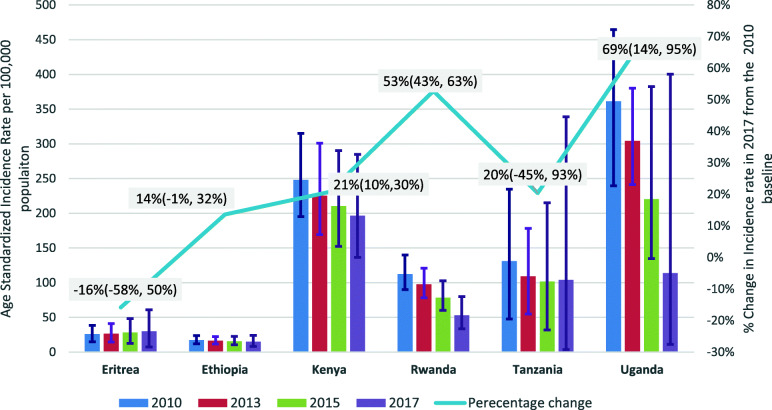
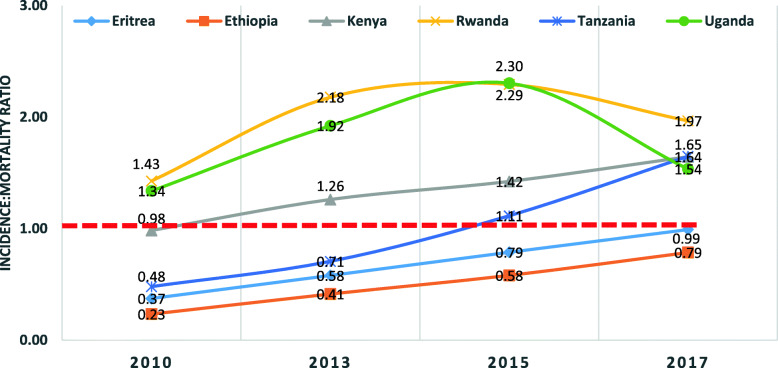
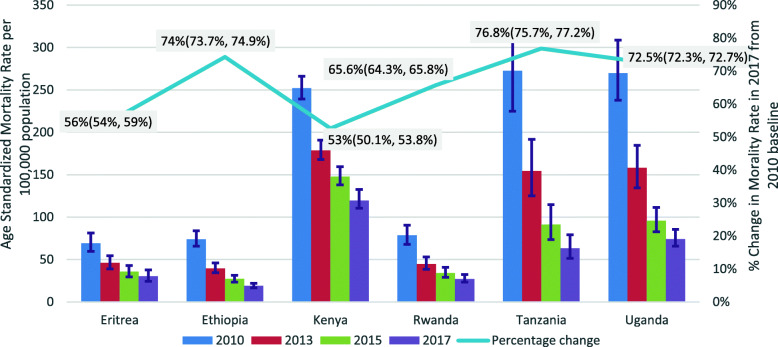
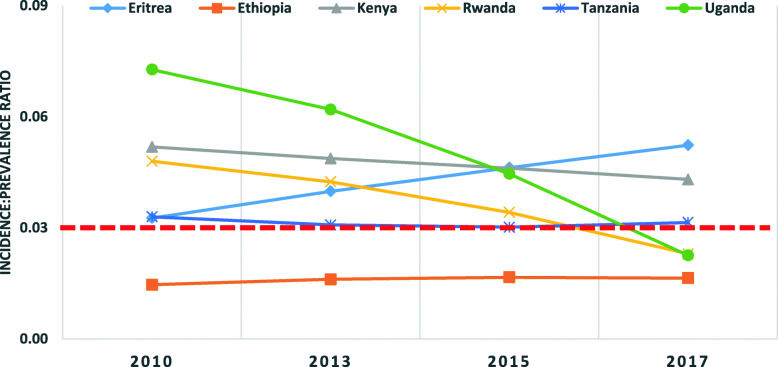
Ethiopia and neighboring countries recorded slow progress in reducing new HIV infection since 2010. Only Uganda would achieve the 75% target by 2020. Ethiopia, Tanzania, and Uganda already achieved the 75% mortality reduction target set for 2020. The incidence: prevalence ratio for Ethiopia, Rwanda, and Uganda were < 0.03, indicating the countries were on track to end HIV by 2030. Ethiopia had an incidence: mortality ratio < 1 due to high mortality; while Kenya, Rwanda, Tanzania and Uganda had a ratio of > 1 due to high incidence. The HIV incidence rate in Ethiopia was dropped by 76% among under 5 children in 2017 compared to 2010 and the country would likely to attain the 2020 national target, but far behind achieving the target among the 15-49 age group.
Ethiopia and neighboring countries have made remarkable progress towards achieving the 75% HIV/AIDS mortality reduction target by 2020, although they progressed poorly in reducing HIV incidence. By recording an incidence:prevalence ratio benchmark of less than 0.03, Ethiopia, Rwanda, and Uganda are well heading towards epidemic control. Nonetheless, the high HIV/AIDS mortality rate in Ethiopia for its incidence requires innovative strategies to reach out undiagnosed cases and to build institutional capacity for generating strong evidence to ensure sustainable epidemic control.
可持续发展目标3.3旨在到2030年消除艾滋病毒对公共卫生的威胁。为了更好地跟踪这一目标,已指明了2020年的快速通道中期里程碑以及综合补充措施。本研究衡量了埃塞俄比亚与邻国相比在各年龄段艾滋病毒/艾滋病流行病学方面的快速通道进展情况。
埃塞俄比亚公共卫生研究所国家卫生数据管理中心的研究团队分析了埃塞俄比亚及其邻国2010年至2017年的全球疾病负担(GBD)2017年二级数据。GBD 2017数据来源包括人口普查、人口与健康调查、预防母婴传播艾滋病毒、抗逆转录病毒治疗项目、哨点监测以及联合国艾滋病规划署的报告。计算了年龄标准化和特定年龄的艾滋病毒/艾滋病发病率、患病率、死亡率、伤残调整生命年(DALYs)、发病率:死亡率比以及发病率:患病率比,并给出相应的95%置信区间。
自2010年以来,埃塞俄比亚及其邻国在减少新的艾滋病毒感染方面进展缓慢。只有乌干达到2020年能够实现75%的目标。埃塞俄比亚、坦桑尼亚和乌干达已经实现了为2020年设定的降低75%死亡率的目标。埃塞俄比亚、卢旺达和乌干达的发病率:患病率比<0.03,表明这些国家有望在2030年前终结艾滋病毒流行。由于死亡率高,埃塞俄比亚的发病率:死亡率比<1;而由于发病率高,肯尼亚、卢旺达、坦桑尼亚和乌干达的该比率>1。与2010年相比,2017年埃塞俄比亚5岁以下儿童的艾滋病毒发病率下降了76%,该国可能实现2020年的国家目标,但在15 - 49岁年龄组实现目标方面仍远远落后。
埃塞俄比亚及其邻国在到2020年实现降低75%艾滋病毒/艾滋病死亡率目标方面取得了显著进展,尽管在降低艾滋病毒发病率方面进展不佳。埃塞俄比亚、卢旺达和乌干达的发病率:患病率比基准低于0.03,正朝着疫情控制稳步迈进。尽管如此,埃塞俄比亚艾滋病毒/艾滋病发病率高但死亡率也高,需要创新策略来发现未确诊病例,并建设机构能力以生成有力证据,确保可持续的疫情控制。