Institute of Molecular Oncology, University Medical Center Göttingen, Göttingen, Germany.
Department of General, Visceral, and Pediatric Surgery, University Medical Center Göttingen, Göttingen, Germany.
Cell Death Dis. 2021 Feb 4;12(2):155. doi: 10.1038/s41419-021-03426-z.
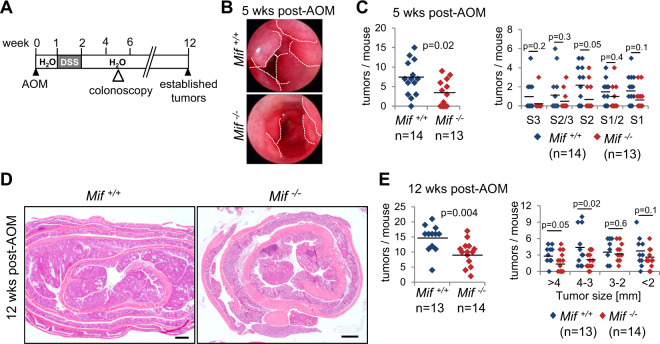
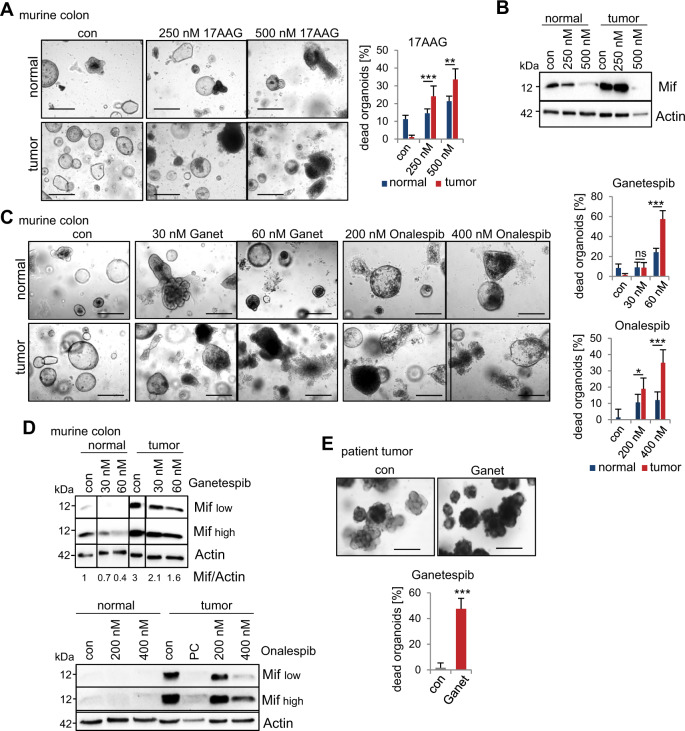
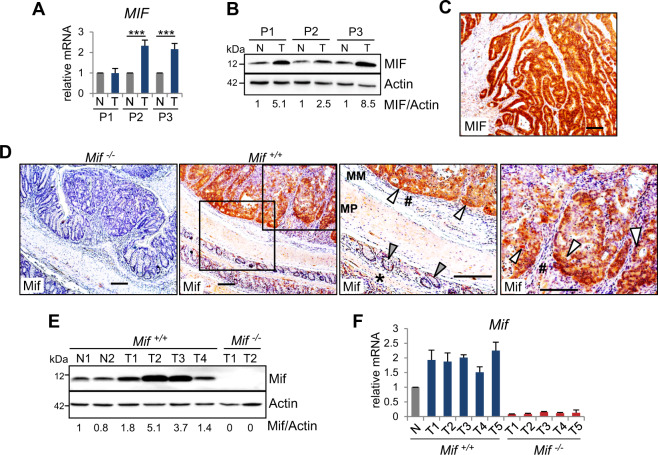
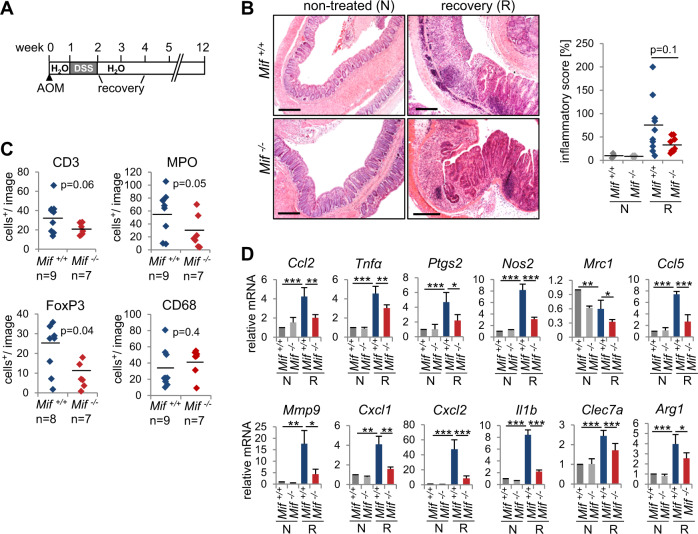
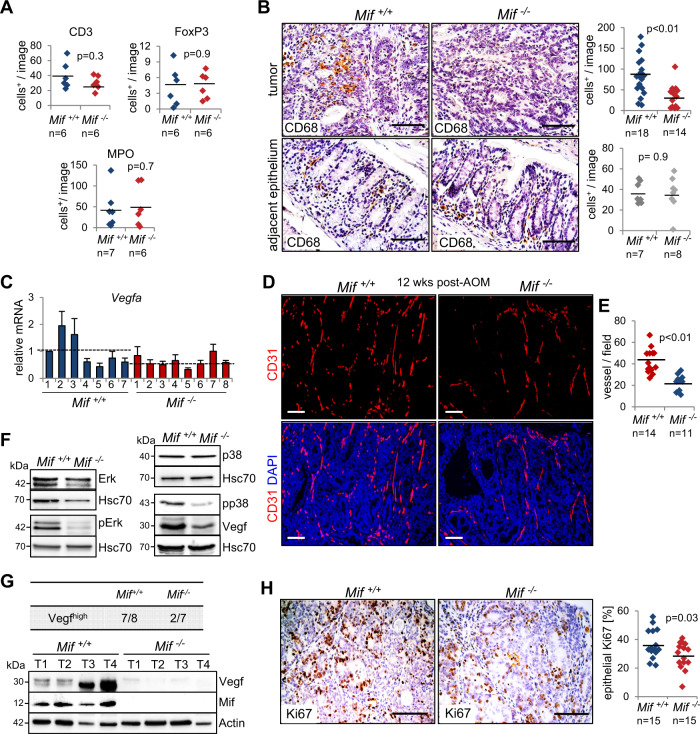
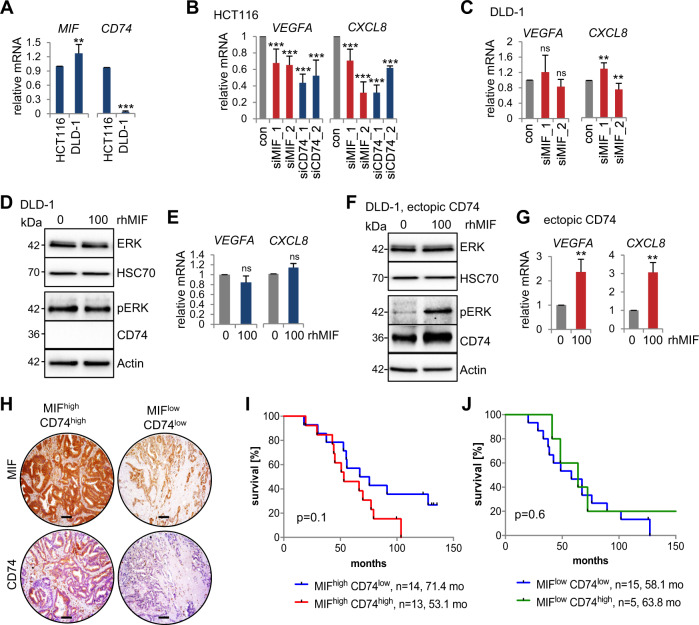
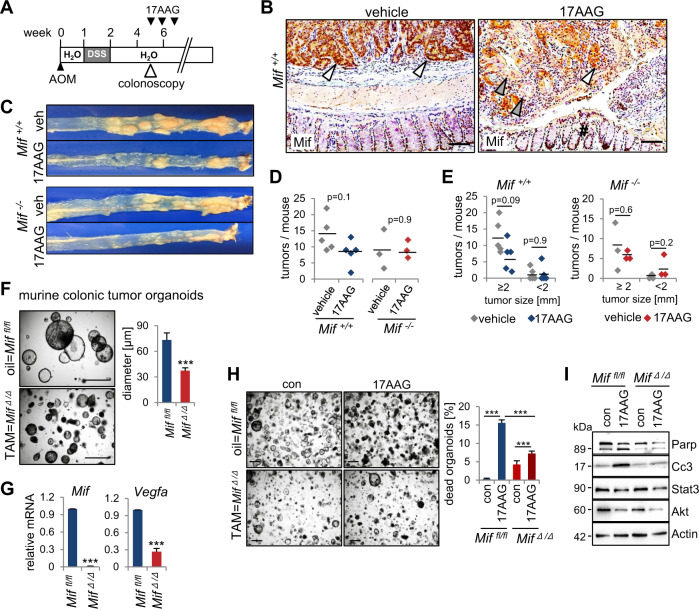
Macrophage migration inhibitory factor (MIF) is an upstream regulator of innate immunity, but its expression is increased in some cancers via stabilization with HSP90-associated chaperones. Here, we show that MIF stabilization is tumor-specific in an acute colitis-associated colorectal cancer (CRC) mouse model, leading to tumor-specific functions and selective therapeutic vulnerabilities. Therefore, we demonstrate that a Mif deletion reduced CRC tumor growth. Further, we define a dual role for MIF in CRC tumor progression. Mif deletion protects mice from inflammation-associated tumor initiation, confirming the action of MIF on host inflammatory pathways; however, macrophage recruitment, neoangiogenesis, and proliferative responses are reduced in Mif-deficient tumors once the tumors are established. Thus, during neoplastic transformation, the function of MIF switches from a proinflammatory cytokine to an angiogenesis promoting factor within our experimental model. Mechanistically, Mif-containing tumor cells regulate angiogenic gene expression via a MIF/CD74/MAPK axis in vitro. Clinical correlation studies of CRC patients show the shortest overall survival for patients with high MIF levels in combination with CD74 expression. Pharmacological inhibition of HSP90 to reduce MIF levels decreased tumor growth in vivo, and selectively reduced the growth of organoids derived from murine and human tumors without affecting organoids derived from healthy epithelial cells. Therefore, novel, clinically relevant Hsp90 inhibitors provide therapeutic selectivity by interfering with tumorigenic MIF in tumor epithelial cells but not in normal cells. Furthermore, Mif-depleted colonic tumor organoids showed growth defects compared to wild-type organoids and were less susceptible toward HSP90 inhibitor treatment. Our data support that tumor-specific stabilization of MIF promotes CRC progression and allows MIF to become a potential and selective therapeutic target in CRC.
巨噬细胞移动抑制因子(MIF)是先天免疫的上游调节剂,但通过与 HSP90 相关伴侣蛋白稳定化,其在一些癌症中的表达增加。在这里,我们表明在急性结肠炎相关结直肠癌(CRC)小鼠模型中,MIF 的稳定化是肿瘤特异性的,导致肿瘤特异性功能和选择性治疗弱点。因此,我们证明 Mif 缺失可减少 CRC 肿瘤生长。此外,我们定义了 MIF 在 CRC 肿瘤进展中的双重作用。Mif 缺失可保护小鼠免受炎症相关肿瘤的起始,这证实了 MIF 对宿主炎症途径的作用;然而,在 Mif 缺陷型肿瘤中,一旦肿瘤形成,巨噬细胞募集、新血管生成和增殖反应减少。因此,在肿瘤发生转化过程中,MIF 的功能从促炎细胞因子转变为我们实验模型中的促血管生成因子。在机制上,Mif 包含的肿瘤细胞通过体外的 MIF/CD74/MAPK 轴调节血管生成基因表达。CRC 患者的临床相关性研究表明,MIF 水平高且 CD74 表达的患者总生存期最短。用 HSP90 抑制物抑制 HSP90 以降低 MIF 水平可减少体内肿瘤生长,并选择性地减少源自小鼠和人类肿瘤的类器官的生长,而不影响源自健康上皮细胞的类器官的生长。因此,新型、临床相关的 Hsp90 抑制剂通过干扰肿瘤上皮细胞中的致癌性 MIF 提供治疗选择性,但不影响正常细胞。此外,与野生型类器官相比,Mif 耗尽的结肠肿瘤类器官显示生长缺陷,并且对 HSP90 抑制剂治疗的敏感性降低。我们的数据支持肿瘤特异性 MIF 稳定化促进 CRC 进展,并使 MIF 成为 CRC 的潜在和选择性治疗靶点。