Nyabuti Marilyn N, Petersen Maya L, Bukusi Elizabeth A, Kamya Moses R, Mwangwa Florence, Kabami Jane, Sang Norton, Charlebois Edwin D, Balzer Laura B, Schwab Joshua D, Camlin Carol S, Black Douglas, Clark Tamara D, Chamie Gabriel, Havlir Diane V, Ayieko James
Kenya Medical Research Institute, Kisumu, Kenya.
Division of Biostatistics and Epidemiology, School of Public Health, University of California Berkeley, Berkeley, California, United States of America.
PLoS One. 2021 Feb 5;16(2):e0243167. doi: 10.1371/journal.pone.0243167. eCollection 2021.
Additional progress towards HIV epidemic control requires understanding who remains at risk of HIV infection in the context of high uptake of universal testing and treatment (UTT). We sought to characterize seroconverters and risk factors in the SEARCH UTT trial (NCT01864603), which achieved high uptake of universal HIV testing and ART coverage in 32 communities of adults (≥15 years) in rural Uganda and Kenya.
In a pooled cohort of 117,114 individuals with baseline HIV negative test results, we described those who seroconverted within 3 years, calculated gender-specific HIV incidence rates, evaluated adjusted risk ratios (aRR) for seroconversion using multivariable targeted maximum likelihood estimation, and assessed potential infection sources based on self-report.
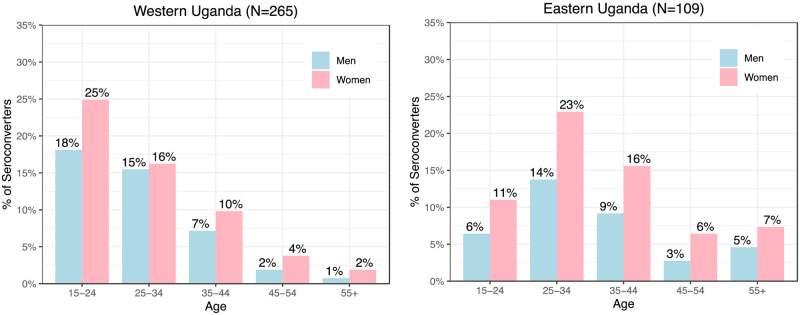
Of 704 seroconverters, 63% were women. Young (15-24 years) men comprised a larger proportion of seroconverters in Western Uganda (18%) than Eastern Uganda (6%) or Kenya (10%). After adjustment for other risk factors, men who were mobile [≥1 month of prior year living outside community] (aRR:1.68; 95%CI:1.09,2.60) or who HIV tested at home vs. health fair (aRR:2.44; 95%CI:1.89,3.23) were more likely to seroconvert. Women who were aged ≤24 years (aRR:1.91; 95%CI:1.27,2.90), mobile (aRR:1.49; 95%CI:1.04,2.11), or reported a prior HIV test (aRR:1.34; 95%CI:1.06,1.70), or alcohol use (aRR:2.07; 95%CI:1.34,3.22) were more likely to seroconvert. Among survey responders (N = 607, 86%), suspected infection source was more likely for women than men to be ≥10 years older (28% versus 8%) or a spouse (51% vs. 31%) and less likely to be transactional sex (10% versus 16%).
In the context of universal testing and treatment, additional strategies tailored to regional variability are needed to address HIV infection risks of young women, alcohol users, mobile populations, and those engaged in transactional sex to further reduce HIV incidence rates.
要在艾滋病流行控制方面取得进一步进展,需要了解在普遍检测和治疗(UTT)高覆盖率的情况下,哪些人仍有感染艾滋病毒的风险。我们试图在SEARCH UTT试验(NCT01864603)中对血清转化者及其风险因素进行特征描述,该试验在乌干达农村和肯尼亚的32个成人(≥15岁)社区实现了高覆盖率的艾滋病毒普遍检测和抗逆转录病毒治疗。
在一个由117,114名基线艾滋病毒检测结果为阴性的个体组成的汇总队列中,我们描述了在3年内发生血清转化的个体,计算了按性别划分的艾滋病毒发病率,使用多变量靶向最大似然估计评估血清转化的调整风险比(aRR),并根据自我报告评估潜在感染源。
在704名血清转化者中,63%为女性。在乌干达西部,年轻(15 - 24岁)男性在血清转化者中所占比例(18%)高于乌干达东部(6%)或肯尼亚(10%)。在对其他风险因素进行调整后,流动的男性[上一年在社区外居住≥1个月](aRR:1.68;95%CI:1.09,2.60)或在家中进行艾滋病毒检测而非在健康集市检测的男性(aRR:2.44;95%CI:1.89,3.23)更有可能发生血清转化。年龄≤24岁的女性(aRR:1.91;95%CI:1.27,2.90)、流动的女性(aRR:1.49;95%CI:1.04,2.11)、报告曾进行艾滋病毒检测的女性(aRR:1.34;95%CI:1.06,1.70)或饮酒的女性(aRR:2.07;95%CI:1.34,3.22)更有可能发生血清转化。在调查受访者(N = 607,86%)中,女性疑似感染源比男性更有可能是年龄大≥10岁的人(28%对8%)或配偶(51%对31%),而不太可能是交易性行为对象(10%对16%)。
在普遍检测和治疗的背景下,需要针对地区差异制定额外策略,以应对年轻女性、饮酒者、流动人口以及从事交易性行为者的艾滋病毒感染风险,从而进一步降低艾滋病毒发病率。