Charité - Universitätsmedizin Berlin, Campus Benjamin Franklin - Klinik für Radiologie, Hindenburgdamm 30, 12203 Berlin, Germany.
Charité - Universitätsmedizin Berlin, Campus Charité Mitte - Klinik für Radiologie, Charitéplatz 1, 10117 Berlin, Germany.
Clin Imaging. 2021 Aug;76:1-5. doi: 10.1016/j.clinimag.2021.01.026. Epub 2021 Jan 30.
This study aimed to improve the accuracy of CT for detection of COVID-19-associated pneumonia and to identify patient subgroups who might benefit most from CT imaging.
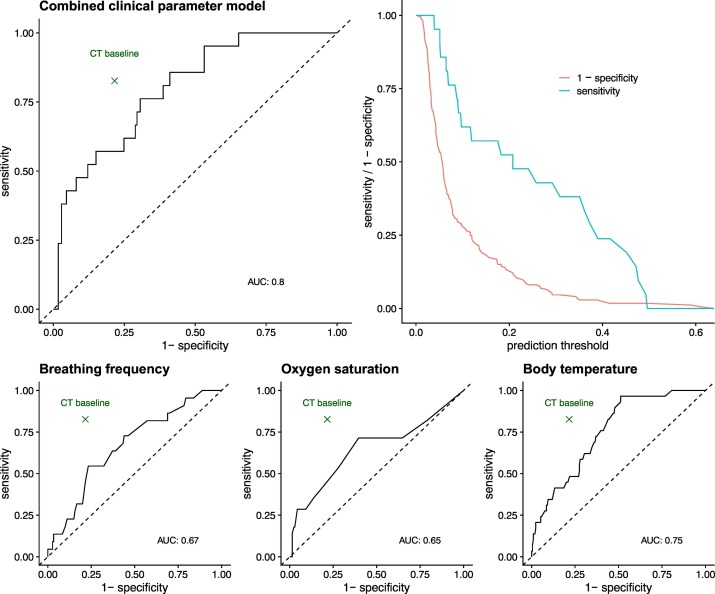
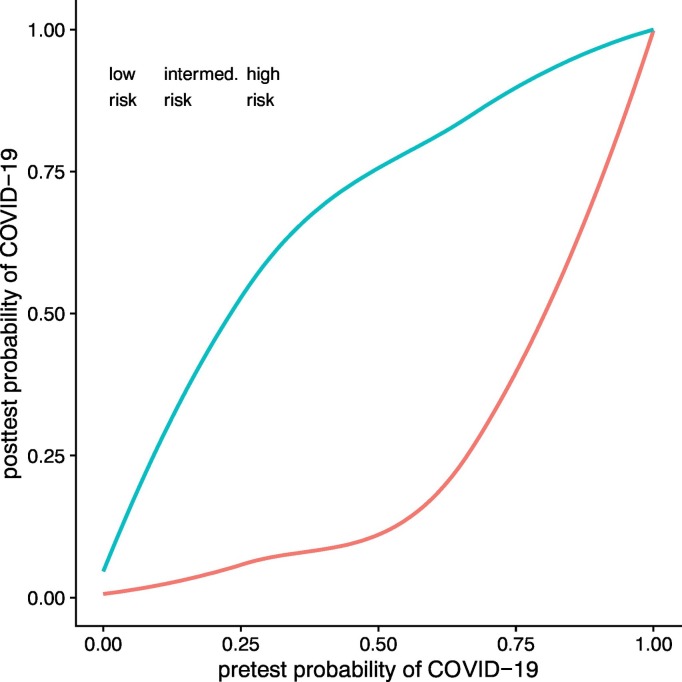
A total of 269 patients who underwent CT for suspected COVID-19 were included in this retrospective analysis. COVID-19 was confirmed by reverse-transcription-polymerase-chain-reaction. Basic demographics (age and sex) and initial vital parameters (O-saturation, respiratory rate, and body temperature) were recorded. Generalized mixed models were used to calculate the accuracy of vital parameters for detection of COVID-19 and to evaluate the diagnostic accuracy of CT. A clinical score based on vital parameters, age, and sex was established to estimate the pretest probability of COVID-19 and used to define low, intermediate, and high risk groups. A p-value of <0.05 was considered statistically significant.
The sole use of vital parameters for the prediction of COVID-19 was inferior to CT. After correction for confounders, such as age and sex, CT showed a sensitivity of 0.86, specificity of 0.78, and positive predictive value of 0.36. In the subgroup analysis based on pretest probability, positive predictive value and sensitivity increased to 0.53 and 0.89 in the high-risk group, while specificity was reduced to 0.68. In the low-risk group, sensitivity and positive predictive value decreased to 0.76 and 0.33 with a specificity of 0.83. The negative predictive value remained high (0.94 and 0.97) in both groups.
The accuracy of CT for the detection of COVID-19 might be increased by selecting patients with a high-pretest probability of COVID-19.
本研究旨在提高 CT 检测 COVID-19 相关肺炎的准确性,并确定可能从 CT 成像中获益最大的患者亚组。
回顾性分析了 269 例因疑似 COVID-19 而行 CT 检查的患者。COVID-19 通过逆转录-聚合酶链反应(RT-PCR)确诊。记录基本人口统计学特征(年龄和性别)和初始生命参数(O-饱和度、呼吸频率和体温)。采用广义混合模型计算生命参数对 COVID-19 检测的准确性,并评估 CT 的诊断准确性。基于生命参数、年龄和性别建立了一个临床评分,以估计 COVID-19 的术前概率,并将其用于定义低、中、高危组。p 值<0.05 为统计学显著。
单独使用生命参数预测 COVID-19 的效果不如 CT。校正年龄和性别等混杂因素后,CT 的敏感性为 0.86,特异性为 0.78,阳性预测值为 0.36。在基于术前概率的亚组分析中,高危组的阳性预测值和敏感性分别提高至 0.53 和 0.89,而特异性降低至 0.68。在低危组中,敏感性和阳性预测值分别降至 0.76 和 0.33,特异性为 0.83。两组的阴性预测值均较高(0.94 和 0.97)。
通过选择 COVID-19 术前概率较高的患者,CT 检测 COVID-19 的准确性可能会提高。