Wu Zhengyuan, Wen Zhenpei, Li Zhengtian, Yu Miao, Ye Guihong
Department of Orthopedics Trauma and Hand Surgery.
Department of Bone and Joint Surgery.
Medicine (Baltimore). 2021 Jan 22;100(3):e23836. doi: 10.1097/MD.0000000000023836.
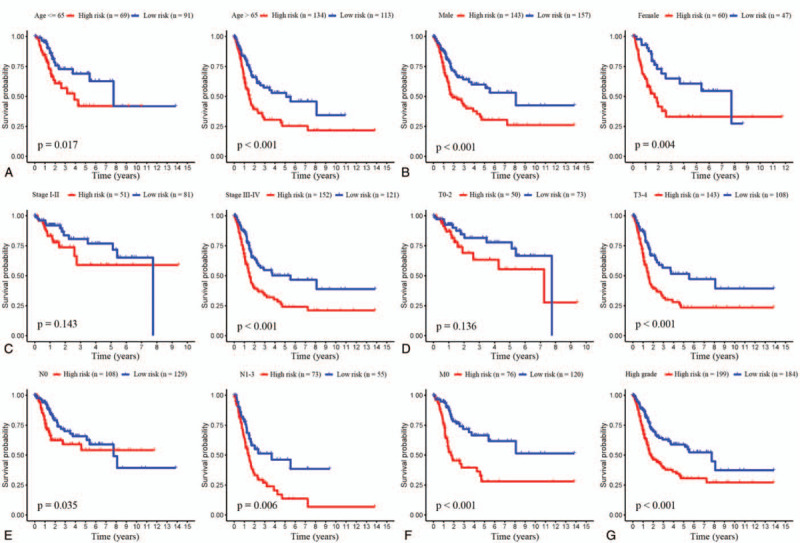
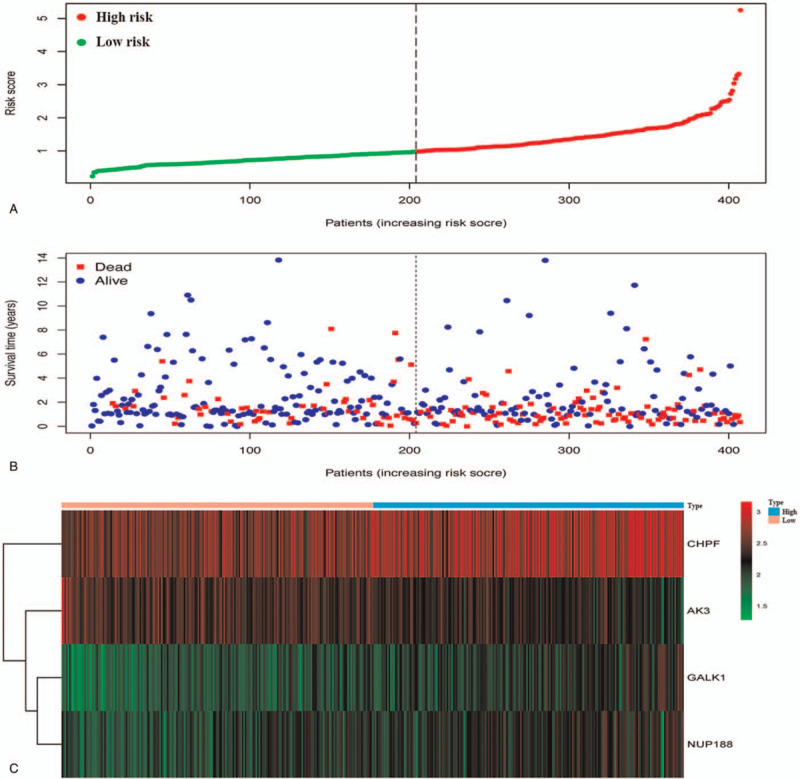
Bladder cancer (BC) is one of the most common malignancies worldwide. Several biomarkers related to the prognosis of patients with BC have previously been identified. However, these prognostic models use only one gene and are thus not reliable or accurate enough. The purpose of our study was to develop an innovative gene signature that has greater prognostic value in BC. So, in this study, we performed mRNA expression profiling of glycolysis-related genes in BC (n = 407) cohorts by mining data from The Cancer Genome Atlas (TCGA) database. The glycolysis-related gene sets were confirmed using the Gene Set Enrichment Analysis (GSEA). Using Cox regression analysis, a risk score staging model was built based on the genes that were determined to be significantly associated with BC outcome. Eventually, the system of risk score was structured to predict a patient's survival, and we identified four genes (CHPF, AK3, GALK1, and NUP188) that were associated with the outcomes of BC patients. According to the above-mentioned gene signature, patients were divided into two risk subgroups. The analysis showed that our constructed risk model was independent of clinical features and that the risk score was a highly powerful tool for predicting the overall survival (OS) of BC patients. Taking together, we identified a gene signature associated with glycolysis that could effectively predict the prognosis of BC patients. Our findings offer a new perspective for the clinical research and treatment of BC.
膀胱癌(BC)是全球最常见的恶性肿瘤之一。此前已鉴定出几种与BC患者预后相关的生物标志物。然而,这些预后模型仅使用一个基因,因此不够可靠或准确。我们研究的目的是开发一种在BC中具有更大预后价值的创新基因特征。因此,在本研究中,我们通过挖掘癌症基因组图谱(TCGA)数据库的数据,对BC(n = 407)队列中的糖酵解相关基因进行了mRNA表达谱分析。使用基因集富集分析(GSEA)对糖酵解相关基因集进行了确认。使用Cox回归分析,基于确定与BC结局显著相关的基因建立了风险评分分期模型。最终,构建了风险评分系统以预测患者的生存情况,我们鉴定出四个与BC患者结局相关的基因(CHPF、AK3、GALK1和NUP188)。根据上述基因特征,将患者分为两个风险亚组。分析表明,我们构建的风险模型独立于临床特征,并且风险评分是预测BC患者总生存期(OS)的有力工具。综上所述,我们鉴定出一种与糖酵解相关的基因特征,可有效预测BC患者的预后。我们的研究结果为BC的临床研究和治疗提供了新的视角。