School of Electronics & Information & Automation, Civil Aviation University of China, Tianjin 300300, China.
Sensors (Basel). 2021 Feb 3;21(4):1032. doi: 10.3390/s21041032.
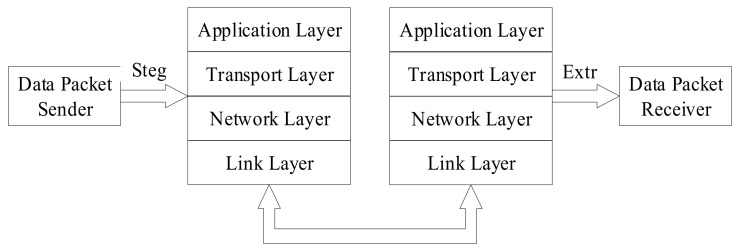
The rapid advance and popularization of VoIP (Voice over IP) has also brought security issues. VoIP-based secure voice communication has two sides: first, for legitimate users, the secret voice can be embedded in the carrier and transmitted safely in the channel to prevent privacy leakage and ensure data security; second, for illegal users, the use of VoIP Voice communication hides and transmits illegal information, leading to security incidents. Therefore, in recent years, steganography and steganography analysis based on VoIP have gradually become research hotspots in the field of information security. Steganography and steganalysis based on VoIP can be divided into two categories, depending on where the secret information is embedded: steganography and steganalysis based on voice payload or protocol. The former mainly regards voice payload as the carrier, and steganography or steganalysis is performed with respect to the payload. It can be subdivided into steganography and steganalysis based on FBC (fixed codebook), LPC (linear prediction coefficient), and ACB (adaptive codebook). The latter uses various protocols as the carrier and performs steganography or steganalysis with respect to some fields of the protocol header and the timing of the voice packet. It can be divided into steganography and steganalysis based on the network layer, the transport layer, and the application layer. Recent research results of steganography and steganalysis based on protocol and voice payload are classified in this paper, and the paper also summarizes their characteristics, advantages, and disadvantages. The development direction of future research is analyzed. Therefore, this research can provide good help and guidance for researchers in related fields.
VoIP(网络电话)的快速发展和普及也带来了安全问题。基于 VoIP 的安全语音通信有两个方面:一方面,对于合法用户,可以将秘密语音嵌入载体中,并在信道中安全传输,防止隐私泄露,确保数据安全;另一方面,对于非法用户,可以利用 VoIP 语音通信进行隐藏和传输非法信息,从而导致安全事件。因此,近年来,基于 VoIP 的隐写术和隐写分析逐渐成为信息安全领域的研究热点。基于 VoIP 的隐写术和隐写分析可以分为两类,这取决于秘密信息嵌入的位置:基于语音有效负载或协议的隐写术和隐写分析。前者主要将语音有效负载视为载体,并针对有效负载进行隐写术或隐写分析。它可以进一步细分为基于固定码本(FBC)、线性预测系数(LPC)和自适应码本(ACB)的隐写术和隐写分析。后者使用各种协议作为载体,并针对协议头和语音数据包的定时的某些字段进行隐写术或隐写分析。它可以分为基于网络层、传输层和应用层的隐写术和隐写分析。本文对基于协议和语音有效负载的隐写术和隐写分析的最新研究成果进行了分类,并总结了它们的特点、优势和劣势。分析了未来研究的发展方向。因此,这项研究可以为相关领域的研究人员提供良好的帮助和指导。