Mullett Martin S, Drenkhan Rein, Adamson Kalev, Boroń Piotr, Lenart-Boroń Anna, Barnes Irene, Tomšovský Michal, Jánošíková Zuzana, Adamčíková Katarína, Ondrušková Emília, Queloz Valentin, Piškur Barbara, Musolin Dmitry L, Davydenko Kateryna, Georgieva Margarita, Schmitz Sophie, Kačergius Audrius, Ghelardini Luisa, Kranjec Orlović Jelena, Müller Michael, Oskay Funda, Hauptman Tine, Halász Ágnes, Markovskaja Svetlana, Solheim Halvor, Vuorinen Martti, Heinzelmann Renate, Hamelin Richard C, Konečný Adam
Phytophthora Research Centre, Faculty of Forestry and Wood Technology, Department of Forest Protection and Wildlife Management, Mendel University in Brno, Zemědělská 3, 61300 Brno, Czech Republic.
Institute of Forestry and Rural Engineering, Estonian University of Life Sciences, 51006 Tartu, Estonia.
J Fungi (Basel). 2021 Feb 3;7(2):111. doi: 10.3390/jof7020111.
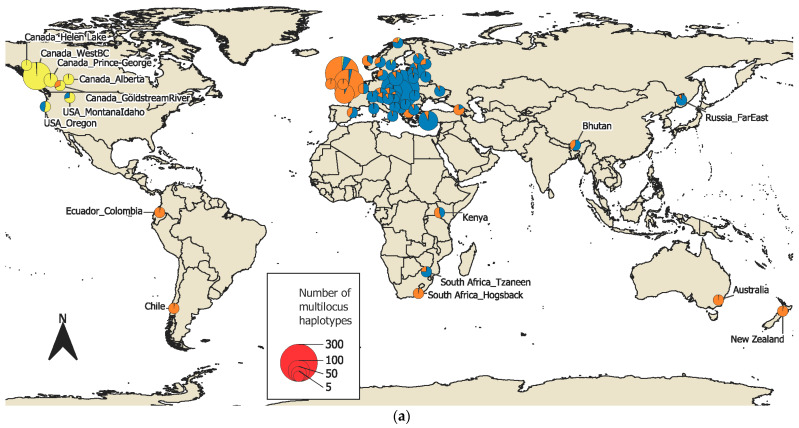
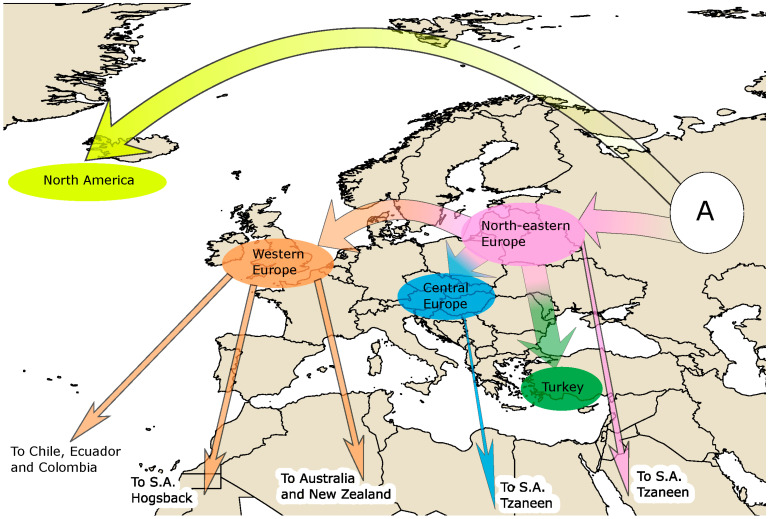
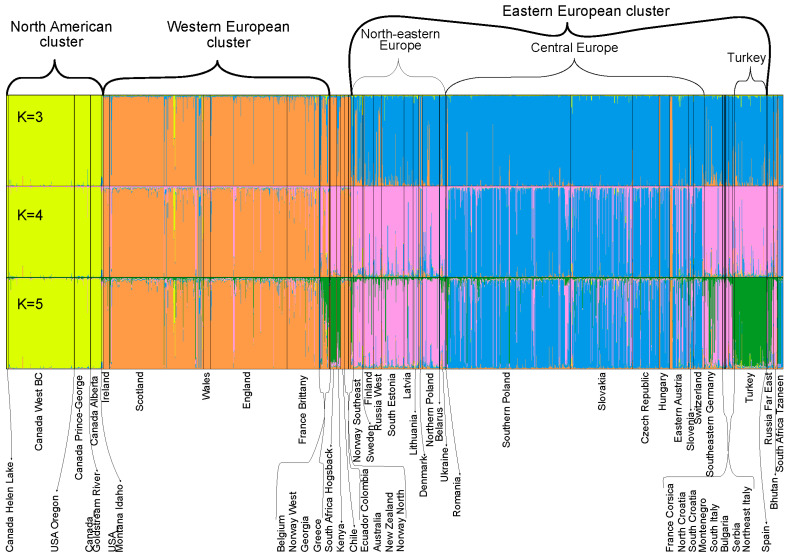
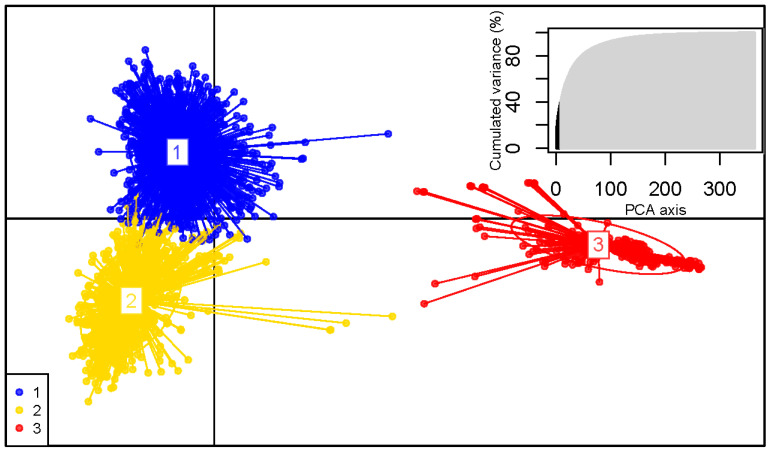
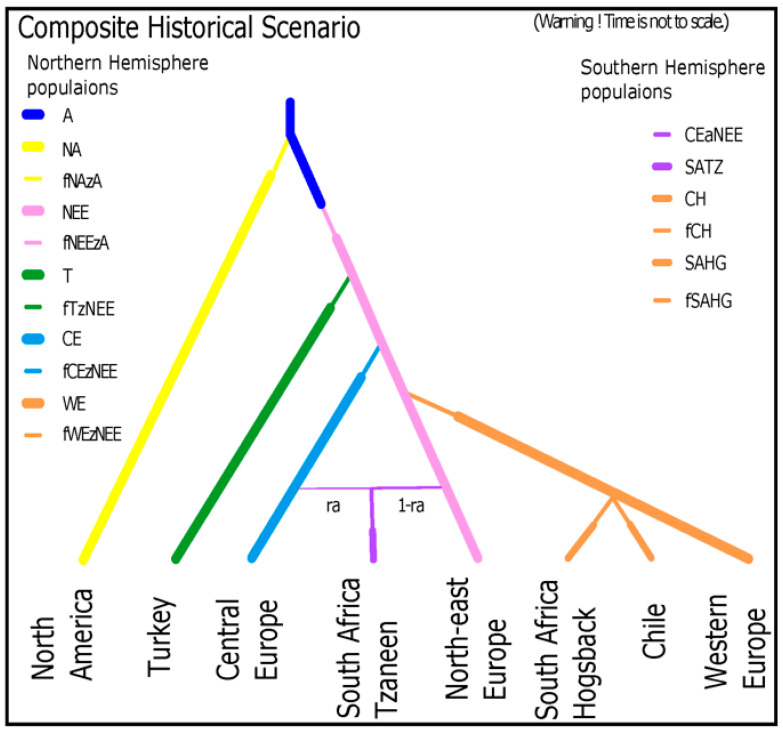
, the primary causal agent of Dothistroma needle blight, is one of the most significant foliar pathogens of pine worldwide. Its wide host and environmental ranges have led to its global success as a pathogen and severe economic damage to pine forests in many regions. This comprehensive global population study elucidated the historical migration pathways of the pathogen to reveal the Eurasian origin of the fungus. When over 3800 isolates were examined, three major population clusters were revealed: North America, Western Europe, and Eastern Europe, with distinct subclusters in the highly diverse Eastern European cluster. Modeling of historical scenarios using approximate Bayesian computation revealed the North American cluster was derived from an ancestral population in Eurasia. The Northeastern European subcluster was shown to be ancestral to all other European clusters and subclusters. The Turkish subcluster diverged first, followed by the Central European subcluster, then the Western European cluster, which has subsequently spread to much of the Southern Hemisphere. All clusters and subclusters contained both mating-types of the fungus, indicating the potential for sexual reproduction, although asexual reproduction remained the primary mode of reproduction. The study strongly suggests the native range of to be in Eastern Europe (i.e., the Baltic and Western Russia) and Western Asia.
散斑壳针孢菌是散斑壳针孢叶枯病的主要致病因子,是全球松树最重要的叶部病原菌之一。其广泛的寄主范围和环境适应性使其成为全球范围内成功的病原菌,并在许多地区对松林造成了严重的经济损失。这项全面的全球种群研究阐明了该病原菌的历史迁移路径,揭示了这种真菌起源于欧亚大陆。在检查了超过3800个分离株后,发现了三个主要的种群集群:北美、西欧和东欧,在高度多样化的东欧集群中有不同的亚集群。使用近似贝叶斯计算对历史情景进行建模表明,北美集群源自欧亚大陆的一个祖先种群。北欧亚集群被证明是所有其他欧洲集群和亚集群的祖先。土耳其亚集群最先分化,其次是中欧亚集群,然后是西欧集群,该集群随后传播到了南半球的大部分地区。所有集群和亚集群都包含该真菌的两种交配型,表明存在有性繁殖的可能性,尽管无性繁殖仍然是主要的繁殖方式。该研究有力地表明散斑壳针孢菌的原生范围在东欧(即波罗的海地区和俄罗斯西部)和西亚。