Lee Nahyun, Jang Dae Yong, Lee Do Hyeon, Jeong Haengdueng, Nam Ki Taek, Choi Dal-Woong, Lim Kyung-Min
College of Pharmacy, Ewha Womans University, Seoul 03760, Korea.
Department of Public Health Sciences, Transdisciplinary Major in Learning Health Systems, Graduate School, Korea University, Seoul 02481, Korea.
Toxics. 2021 Feb 3;9(2):29. doi: 10.3390/toxics9020029.
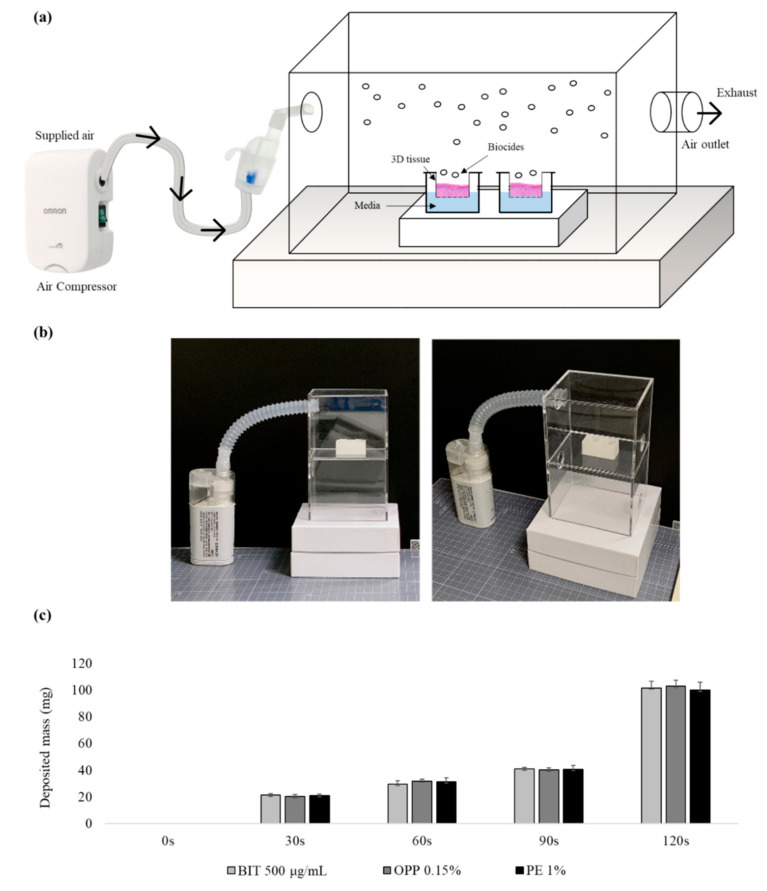
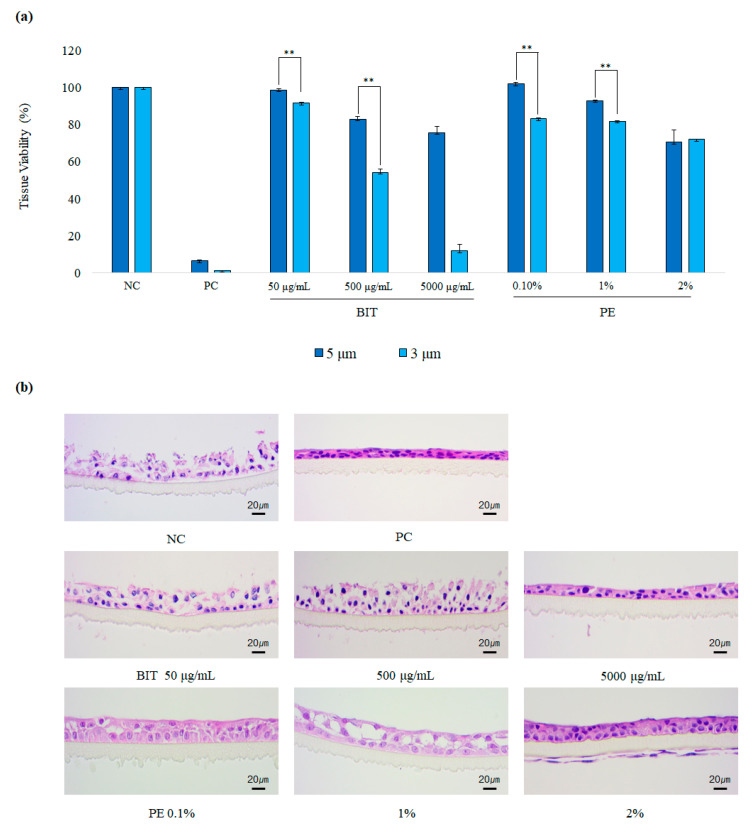
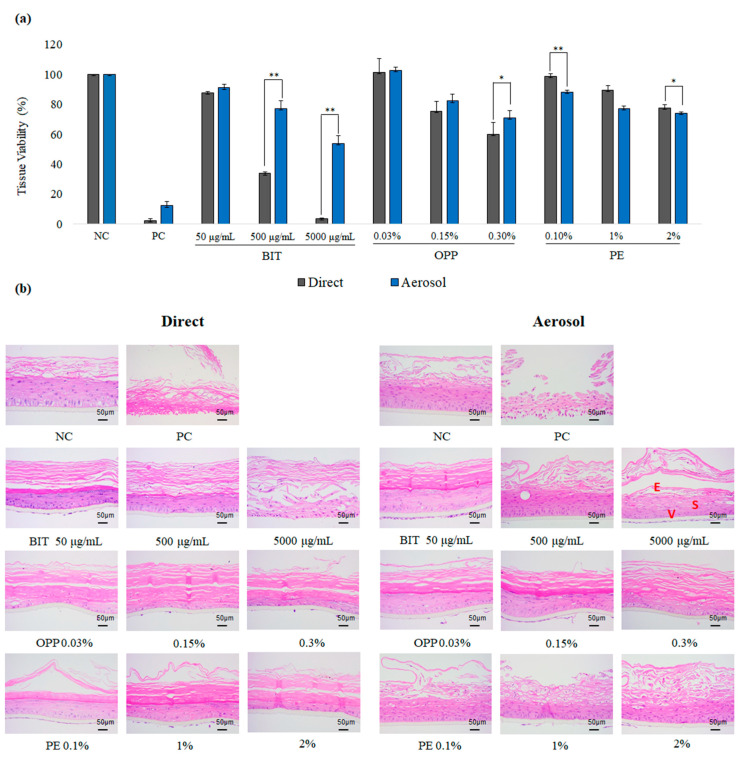
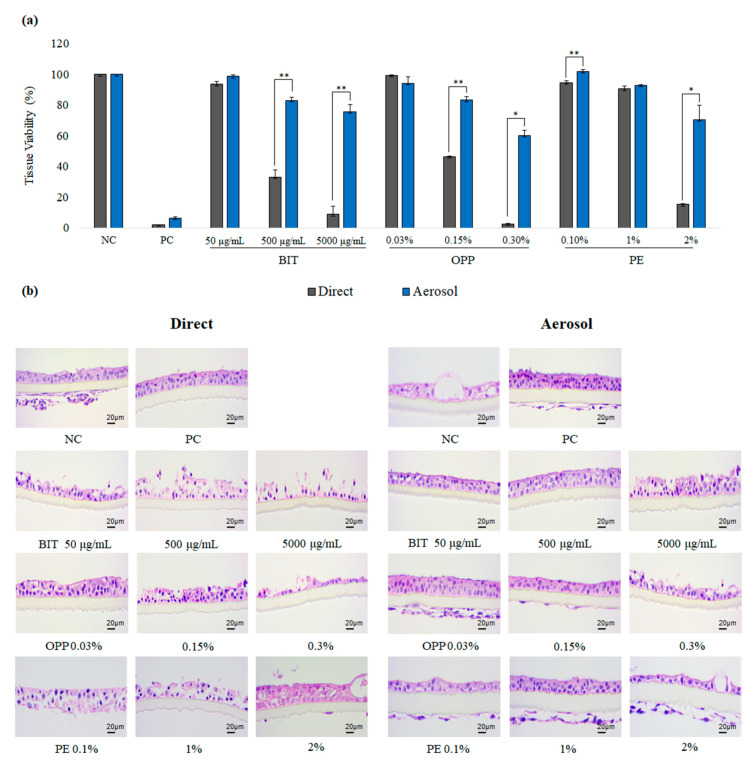
Biocides are commonly used as spray- or trigger-type formulations, thus dermal and respiratory exposure to biocide aerosol is unavoidable. However, little is known about the impact of aerosolization on the local toxicity of biocides on the skin or the airway. We compared the local toxicity of biocides after direct or aerosol exposure on reconstructed human skin epidermis and upper airway models. Three biocides, 1,2-benzisothiazol-3(2H)-one (BIT), 2-phenoxyethanol (PE), and 2-phenylphenol (OPP), most widely used in the market were selected. When the biocide was treated in aerosols, toxicity to the skin epidermis and upper airway tissue became significantly attenuated compared with the direct application as determined by the higher tissue viabilities. This was further confirmed in histological examination, wherein the tissue damages were less pronounced. LC-MS/MS and GC/MS analysis revealed that concentrations of biocides decreased during aerosolization. Importantly, the toxicity of biocides treated in 3 μm (median mass aerodynamic diameter (MMAD)) aerosols was stronger than that of 5 μm aerosol, suggesting that the aerosol particle size may affect biocide toxicity. Collectively, we demonstrated that aerosolization could affect the local toxicity of biocides on the skin epidermis and the upper airway.
杀生剂通常以喷雾型或按压式制剂的形式使用,因此皮肤和呼吸道不可避免地会接触到杀生剂气雾剂。然而,关于气雾剂化对杀生剂在皮肤或气道上的局部毒性的影响,我们所知甚少。我们比较了在重建的人类皮肤表皮和上呼吸道模型上直接接触或气雾剂接触后杀生剂的局部毒性。我们选择了市场上使用最广泛的三种杀生剂,即1,2 - 苯并异噻唑 - 3(2H)-酮(BIT)、2 - 苯氧乙醇(PE)和2 - 苯基苯酚(OPP)。当杀生剂以气雾剂形式处理时,与直接施用相比,对皮肤表皮和上呼吸道组织的毒性显著减弱,这是由更高的组织活力所决定的。这在组织学检查中得到了进一步证实,其中组织损伤不那么明显。液相色谱 - 串联质谱(LC - MS/MS)和气相色谱 - 质谱(GC/MS)分析表明,杀生剂在气雾剂化过程中浓度降低。重要的是,3μm(中位质量空气动力学直径(MMAD))气雾剂中处理的杀生剂的毒性比5μm气雾剂的毒性更强,这表明气雾剂颗粒大小可能会影响杀生剂的毒性。总体而言,我们证明了气雾剂化会影响杀生剂对皮肤表皮和上呼吸道的局部毒性。