London Centre for Neglected Tropical Disease Research (LCNTDR), Department of Infectious Disease Epidemiology, School of Public Health, Faculty of Medicine, Imperial College London, London, UK.
Children Investment Fund Foundation, London, UK.
Parasit Vectors. 2021 Feb 5;14(1):97. doi: 10.1186/s13071-021-04600-0.
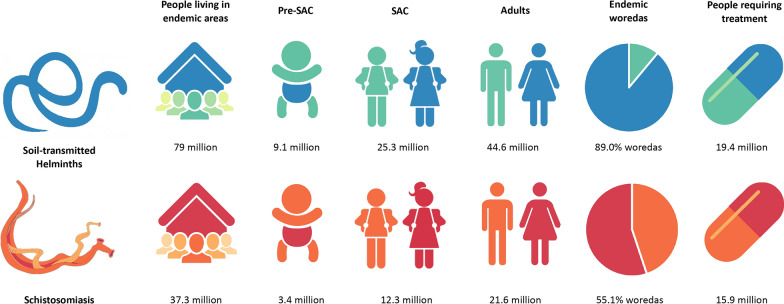
Ethiopia has set the ambitious national targets of eliminating soil-transmitted helminths (STH) and schistosomiasis (SCH) as public health problems by 2020, and breaking their transmission by 2025. This systematic review was performed to provide insight into the progress made by the national STH and SCH control programme purposed with reaching these targets.
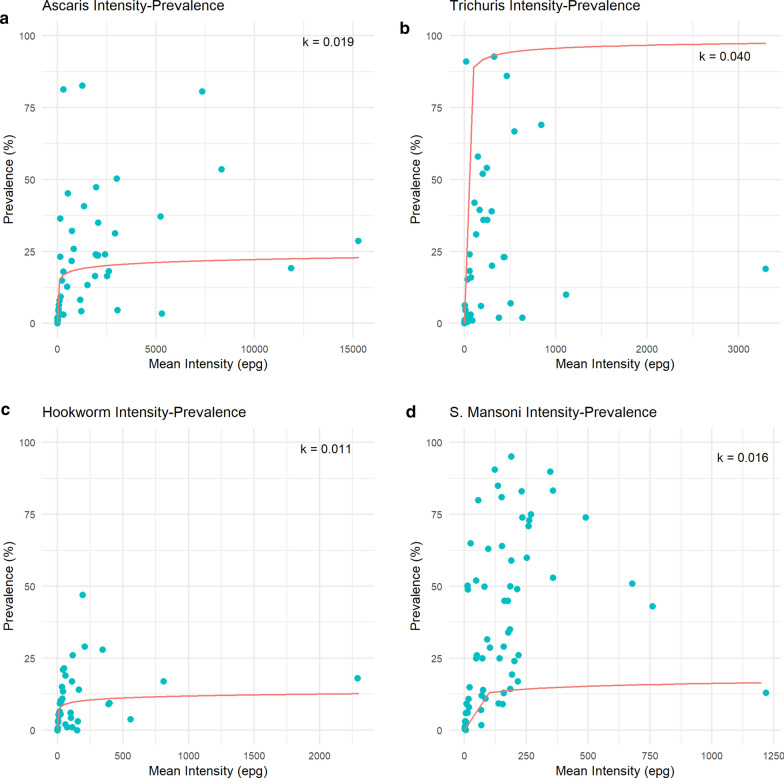
Studies published on STH and SCH in Ethiopia were searched for using Web of Science, PubMed, Scopus, and the resulting references of selected studies. Prevalence and intensity were analysed, stratified by region, age, and diagnostics.
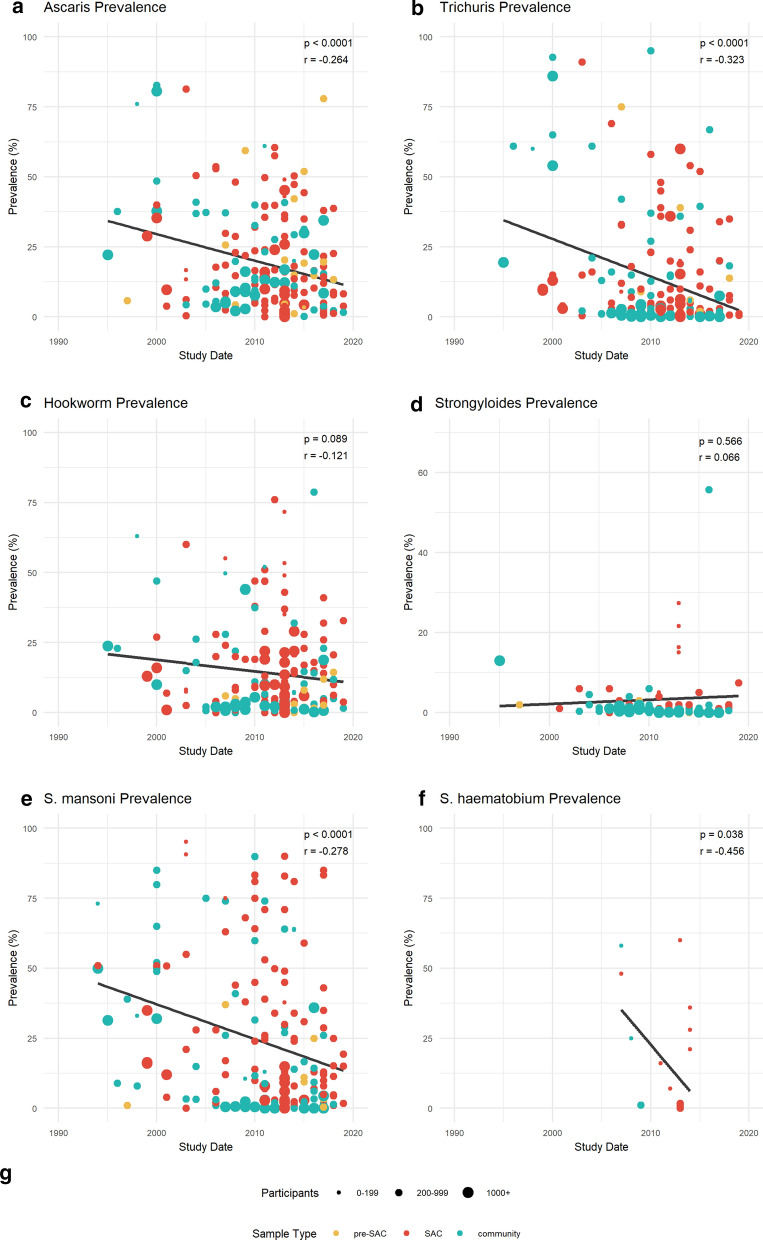
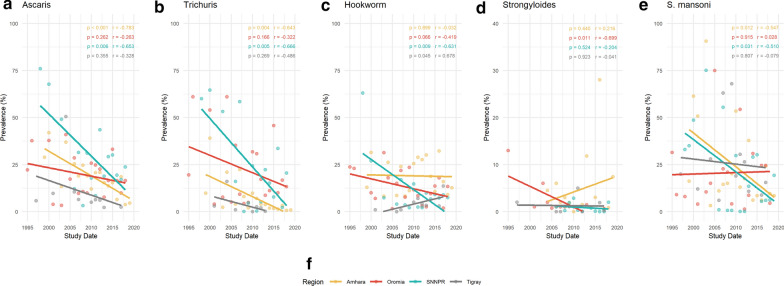
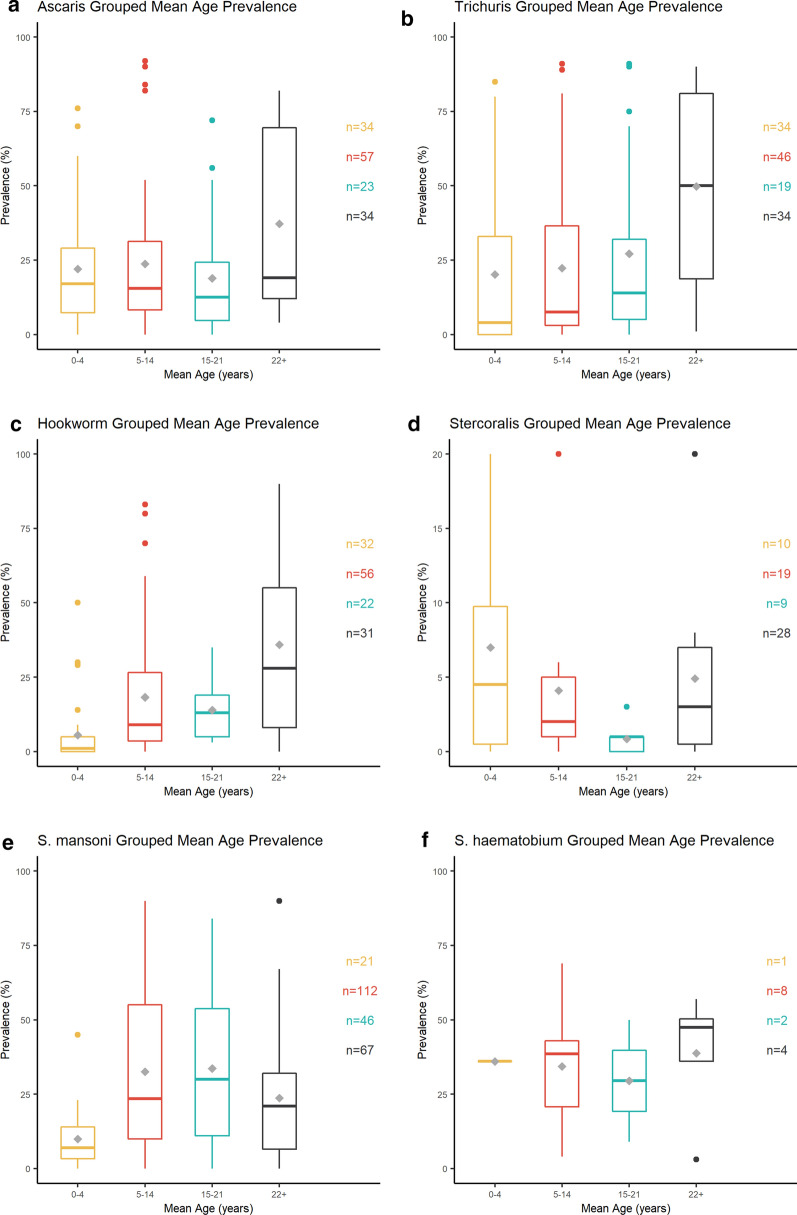
A total of 231 papers published between 2000 and 2020 were included. Over the past two decades, Trichuris trichiura (TT) infection has shown the most statistically significant decrease (93%, p < 0.0001), followed by Schistosoma mansoni (SM) (69%, p < 0.0001), Ascaris lumbricoides (AL) (67%, p < 0.0001) and Schistosoma haematobium (83%, p = 0.038) infections. Geographically, parasite burden has only consistently shown a significant reduction in the Southern Nations, Nationalities and Peoples' Region of Ethiopia, where AL, TT, hookworm and SM significantly decreased by 80% (p = 0.006), 95% (p = 0.005), 98% (p = 0.009) and 87% (p = 0.031), respectively. Prevalence of STH was highest among adults across all species, contrary to typical age-infection profiles for TT and AL that peak among school-aged children. Expanding treatment to the whole community would target reservoirs of adult and preschool-aged infection within the community, assisting Ethiopia in reaching their national transmission break targets. There was substantial heterogeneity in diagnostic methods used across studies, the majority of which predominantly used single-slide Kato-Katz. This low slide frequency provides poor diagnostic sensitivity, particularly in low endemic settings.
The prevalence of STH and SCH in Ethiopia has decreased over time due to the strategic use of anthelmintics. Both standardising and increasing the sensitivity of the diagnostics used, alongside the ubiquitous use of parasite intensity with prevalence, would enable a more accurate and comparable understanding of Ethiopia's epidemiological progress. Further work is needed on community-wide surveillance in order to understand the burden and subsequent need for treatment among those outside of the standard school-based control program.
埃塞俄比亚制定了雄心勃勃的国家目标,即在 2020 年之前消除土壤传播性蠕虫(STH)和血吸虫病(SCH)这两个公共卫生问题,并在 2025 年阻断其传播。本系统评价旨在深入了解旨在实现这些目标的国家 STH 和 SCH 控制规划所取得的进展。
使用 Web of Science、PubMed、Scopus 搜索了 2000 年至 2020 年期间在埃塞俄比亚发表的 STH 和 SCH 研究,并对选定研究的参考文献进行了分析。根据地区、年龄和诊断方法对流行率和强度进行了分析。
共纳入 231 篇发表于 2000 年至 2020 年期间的论文。在过去的二十年中,旋毛虫(TT)感染显示出统计学上最显著的下降(93%,p<0.0001),其次是曼氏血吸虫(SM)(69%,p<0.0001)、蛔虫(AL)(67%,p<0.0001)和埃及血吸虫(83%,p=0.038)感染。从地理上看,寄生虫负担仅在埃塞俄比亚南部各族州持续显著下降,在该地区,AL、TT、钩虫和 SM 分别显著下降 80%(p=0.006)、95%(p=0.005)、98%(p=0.009)和 87%(p=0.031)。所有物种中,成年人的 STH 患病率最高,与 TT 和 AL 的典型年龄感染模式相反,这两种模式在学龄儿童中达到高峰。在整个社区中扩大治疗范围将针对社区内成年人和学龄前儿童感染的储存库,帮助埃塞俄比亚实现国家传播阻断目标。研究中使用的诊断方法存在很大的异质性,其中大多数主要使用单张加藤氏厚涂片法。这种低载玻片频率提供了较差的诊断敏感性,尤其是在低流行地区。
由于驱虫药的战略使用,埃塞俄比亚的 STH 和 SCH 患病率随时间呈下降趋势。标准化和提高诊断方法的敏感性,以及普遍使用寄生虫感染强度与流行率相结合,将使人们能够更准确和可比地了解埃塞俄比亚的流行病学进展。需要进一步开展社区范围的监测工作,以了解标准学校为基础的控制方案之外人群的负担和随后的治疗需求。