Ethiopian Institute of Water Resources, Addis Ababa University, Addis Ababa, Ethiopia.
Medical Laboratory Sciences, College of Health and Medical Sciences, Haramaya University, Harar, Ethiopia.
BMC Infect Dis. 2024 Sep 12;24(1):961. doi: 10.1186/s12879-024-09704-3.
In Ethiopia, 79 million people live in soil transmitted helminths endemic areas. The Ethiopia established a National goal to eradicate STH transmission by 2025. To meet that goal, it is imperative that data is acquired on community helminth infection risk. This study examined the prevalence of STH and risk factors for infection in vegetable farmers working on Akaki River Bank, Addis Ababa, Ethiopia.
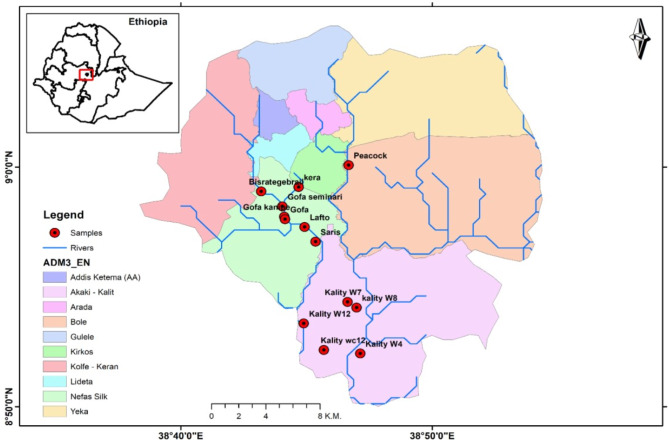
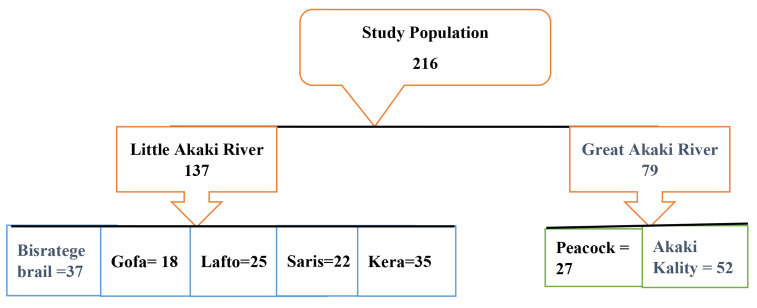
A cross-sectional study was conducted between November 7, 2022, and June 2023. A stratified random sampling was used to select farming households. Two hundred and sixteen farmers were enrolled in the study. Data on socio-demographic, WASH, wastewater irrigation related factors were collected by trained data collectors using a structured questionnaire. Kato-Katz concentration was utilized to detect STH. The data were entered using EpiData 3.1 and analyzed with Stata 14.0, using p-values less than 0.05 to identify significant factors. Logistic regression was used to identify independent risk factors for infection.
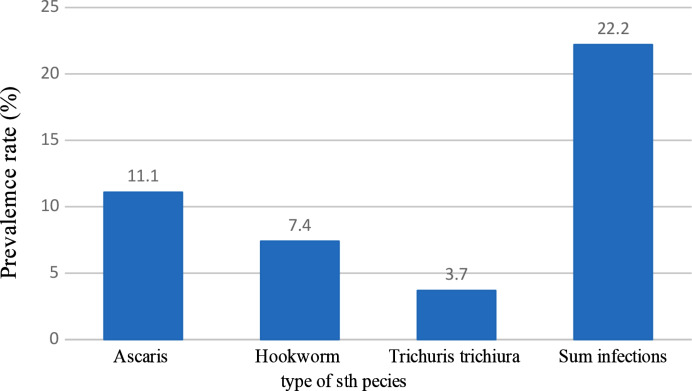
The prevalence of STH was 22.2% (95% CI = 13.6-27.9%), with Ascaris lumbricoides being the most common (11.1%), followed by hookworm (7.4%), and Trichuris trichiura (3.7%). Low income levels (AOR = 1.85, 95% CI = 1.25-5.99), lack of handwashing before eating (AOR = 2.25, 95% CI = 1.58 - 11.3), absence of fingernails cleanliness (AOR = 1.97, 95% CI = 1.74-39.5), not wearing shoes at work (AOR = 3.4, 95% CI = 2.98-82.2), touching the face with dirty hands (AOR = 2.9, 95% CI = 0.68-28.2), washing vegetables with irrigation wastewater (AOR = 2.1, 95% CI = 1.95-45.2), and not wearing protective clothing during farming activities (AOR = 2.99, 95% CI = 1.58 - 22.4) were the significant risk factors for infection with STH.
Of the farming communities examined in this study, one of the five was found to be infected with soil transmitted helminth. This research has shown clear risk factors for STH infection including: lack of personal hygiene practices, insufficient sanitation access, and limited use of protective equipment. To achieve the national goal, there is a need for farming communities to understand preventative risks of infection, improve WASH (Water access, sanitation and hygine) practices, WASH access, protective equipment, and health education.
在埃塞俄比亚,有 7900 万人生活在土壤传播性蠕虫流行地区。埃塞俄比亚制定了到 2025 年消除 STH 传播的国家目标。为了实现这一目标,必须获取关于社区蠕虫感染风险的数据。本研究调查了在埃塞俄比亚亚的斯亚贝巴阿克里河岸边工作的蔬菜种植者中 STH 的流行情况和感染的危险因素。
2022 年 11 月 7 日至 2023 年 6 月期间进行了一项横断面研究。采用分层随机抽样选择农户。共有 216 名农民参加了这项研究。经过培训的数据收集员使用结构化问卷收集社会人口统计学、WASH、废水灌溉相关因素的数据。使用加藤厚涂片法检测 STH。数据使用 EpiData 3.1 输入,并使用 Stata 14.0 进行分析,使用 p 值小于 0.05 来确定显著因素。使用逻辑回归确定感染的独立危险因素。
STH 的患病率为 22.2%(95%CI=13.6-27.9%),最常见的是蛔虫(11.1%),其次是钩虫(7.4%)和鞭虫(3.7%)。低收入水平(AOR=1.85,95%CI=1.25-5.99)、饭前未洗手(AOR=2.25,95%CI=1.58-11.3)、指甲不干净(AOR=1.97,95%CI=1.74-39.5)、工作时不穿鞋(AOR=3.4,95%CI=2.98-82.2)、用脏手摸脸(AOR=2.9,95%CI=0.68-28.2)、用灌溉废水洗蔬菜(AOR=2.1,95%CI=1.95-45.2)和在务农时不穿防护服(AOR=2.99,95%CI=1.58-22.4)是感染 STH 的显著危险因素。
在本研究中检查的种植社区中,有五分之一的人被发现感染了土壤传播性蠕虫。这项研究表明,存在明确的 STH 感染危险因素,包括:个人卫生习惯不佳、卫生设施不足以及防护设备使用有限。为了实现国家目标,需要让种植社区了解感染的预防风险,改善 WASH(水供应、卫生和个人卫生)做法、卫生设施、防护设备和健康教育。