Lv Hualiang, Yang Zhihong, Liu Bo, Wu Guanglei, Lou Zhichao, Fei Ben, Wu Renbing
Department of Materials Science, Fudan University, Shanghai, 200433, China.
College of Materials Science and Technology, Nanjing University of Aeronautics and Astronautics, Nanjing, 210016, China.
Nat Commun. 2021 Feb 5;12(1):834. doi: 10.1038/s41467-021-21103-9.
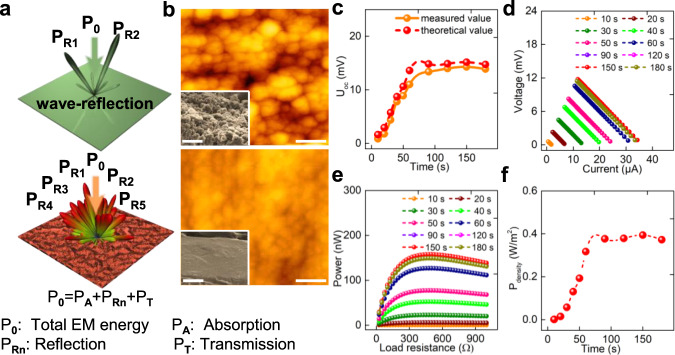
Developing an ultimate electromagnetic (EM)-absorbing material that can not only dissipate EM energy but also convert the generated heat into electricity is highly desired but remains a significant challenge. Here, we report a hybrid Sn@C composite with a biological cell-like splitting ability to address this challenge. The composite consisting of Sn nanoparticles embedded within porous carbon would split under a cycled annealing treatment, leading to more dispersed nanoparticles with an ultrasmall size. Benefiting from an electron-transmitting but a phonon-blocking structure created by the splitting behavior, an EM wave-electricity device constructed by the optimum Sn@C composite could achieve an efficiency of EM to heat at widely used frequency region and a maximum thermoelectric figure of merit of 0.62 at 473 K, as well as a constant output voltage and power under the condition of microwave radiation. This work provides a promising solution for solving EM interference with self-powered EM devices.
开发一种不仅能耗散电磁(EM)能量,还能将产生的热量转化为电能的终极电磁吸收材料是人们所高度期望的,但仍然是一项重大挑战。在此,我们报道了一种具有生物细胞样分裂能力的杂化Sn@C复合材料,以应对这一挑战。由嵌入多孔碳中的Sn纳米颗粒组成的复合材料在循环退火处理下会分裂,导致形成尺寸超小且分布更均匀的纳米颗粒。得益于分裂行为产生的电子传输但声子阻挡结构,由最佳Sn@C复合材料构建的电磁波 - 电装置在广泛使用的频率区域内可实现电磁到热的高效转换,在473 K时热电优值最高可达0.62,并且在微波辐射条件下具有恒定的输出电压和功率。这项工作为解决电磁干扰与自供电电磁装置问题提供了一个有前景的解决方案。