University Medical Center Utrecht, Heidelberglaan 100, 3584, CX, Utrecht, The Netherlands.
Maastricht University, P.O. Box 616, 6200, MD, Maastricht, The Netherlands.
Int J Cardiovasc Imaging. 2021 Jun;37(6):1903-1911. doi: 10.1007/s10554-021-02174-7. Epub 2021 Feb 5.
Cardiac resynchronisation therapy (CRT) improves left ventricular (LV) function acutely, with further improvements and reverse remodelling during chronic CRT. The current study investigated the relation between acute improvement of LV systolic function, acute mechanical recoordination, and long-term reverse remodelling after CRT.
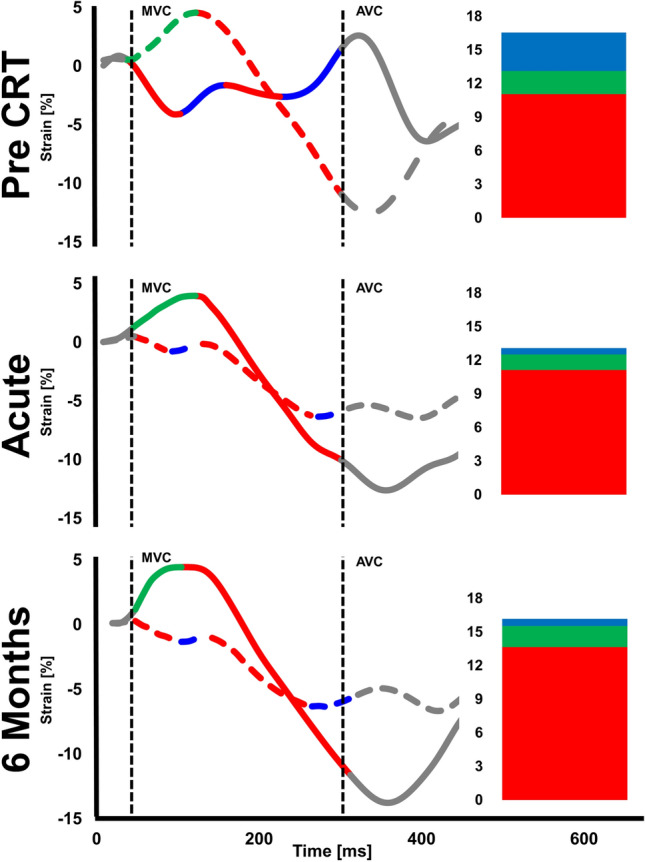
In 35 patients, LV speckle tracking longitudinal strain, LV volumes & ejection fraction (LVEF) were assessed by echocardiography before, acutely within three days, and 6 months after CRT. A subgroup of 25 patients underwent invasive assessment of the maximal rate of LV pressure rise (dP/dt) during CRT-implantation. The acute change in dP/dt, LVEF, systolic discoordination (internal stretch fraction [ISF] and LV systolic rebound stretch [SRSlv]) and systolic dyssynchrony (standard deviation of peak strain times [2DS-SD18]) was studied, and their association with long-term reverse remodelling were determined.
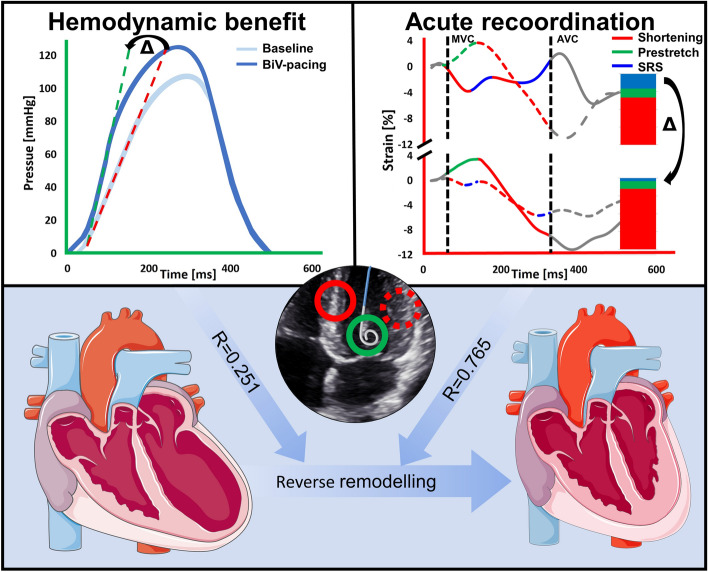
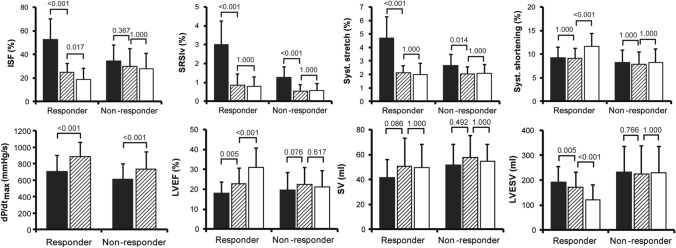
CRT induced acute and ongoing recoordination (ISF from 45 ± 18 to 27 ± 11 and 23 ± 12%, p < 0.001; SRS from 2.27 ± 1.33 to 0.74 ± 0.50 and 0.71 ± 0.43%, p < 0.001) and improved LV function (dP/dt 668 ± 185 vs. 817 ± 198 mmHg/s, p < 0.001; stroke volume 46 ± 15 vs. 54 ± 20 and 52 ± 16 ml; LVEF 19 ± 7 vs. 23 ± 8 and 27 ± 10%, p < 0.001). Acute recoordination related to reverse remodelling (r = 0.601 and r = 0.765 for ISF & SRSlv, respectively, p < 0.001). Acute functional improvements of LV systolic function however, neither related to reverse remodelling nor to the extent of acute recoordination.
Long-term reverse remodelling after CRT is likely determined by (acute) recoordination rather than by acute hemodynamic improvements. Discoordination may therefore be a more important CRT-substrate that can be assessed and, acutely restored.
心脏再同步治疗(CRT)可使左心室(LV)功能在急性时得到改善,并在慢性 CRT 期间进行进一步改善和逆向重构。本研究旨在探讨 LV 收缩功能的急性改善、急性机械协调性以及 CRT 后长期逆向重构之间的关系。
在 35 例患者中,通过超声心动图在 CRT 植入前、植入后 3 天内和 6 个月时评估 LV 斑点追踪纵向应变、LV 容积和射血分数(LVEF)。亚组的 25 例患者在 CRT 植入期间接受了 LV 压力上升最大率(dP/dt)的侵入性评估。研究了 dP/dt、LVEF、收缩不协调(内部拉伸分数 [ISF]和 LV 收缩反弹拉伸 [SRSlv])和收缩不同步(峰值应变时间的标准差 [2DS-SD18])的急性变化,并确定其与长期逆向重构的关系。
CRT 诱导了急性和持续的协调性恢复(ISF 从 45±18%降至 27±11%和 23±12%,p<0.001;SRS 从 2.27±1.33 降至 0.74±0.50 和 0.71±0.43%,p<0.001)和 LV 功能改善(dP/dt 从 668±185 升至 817±198mmHg/s,p<0.001;从 46±15 升至 54±20 和 52±16ml;LVEF 从 19±7%升至 23±8%和 27±10%,p<0.001)。急性协调性与逆向重构相关(ISF 和 SRSlv 的 r 值分别为 0.601 和 0.765,p<0.001)。然而,LV 收缩功能的急性功能改善既与逆向重构无关,也与急性协调性改善无关。
CRT 后长期逆向重构可能由(急性)协调性决定,而不是由急性血流动力学改善决定。因此,不协调可能是更重要的 CRT 底物,可以进行评估并在急性时恢复。