Kanenawa Kenji, Isotani Akihiro, Yamaji Kyohei, Nakamura Miho, Tanaka Yuichi, Hirose-Inui Kaoru, Fujioka Shimpei, Mori Shintaro, Yano Mariko, Ito Shinya, Morinaga Takashi, Fukunaga Masato, Hyodo Makoto, Ando Kenji
Department of Cardiology, Kokura Memorial Hospital, 3-2-1 Asano, Kokurakita-ku, Kitakyushu, 802-8555, Japan.
ESC Heart Fail. 2021 Apr;8(2):1552-1561. doi: 10.1002/ehf2.13254. Epub 2021 Feb 6.
There is currently no gold standard in evaluating frailty in patients with heart failure (HF), and the prognostic value of frailty according to the Canadian Study of Health and Aging Clinical Frailty Scale (CFS) on mortality in patients with HF is still unknown.
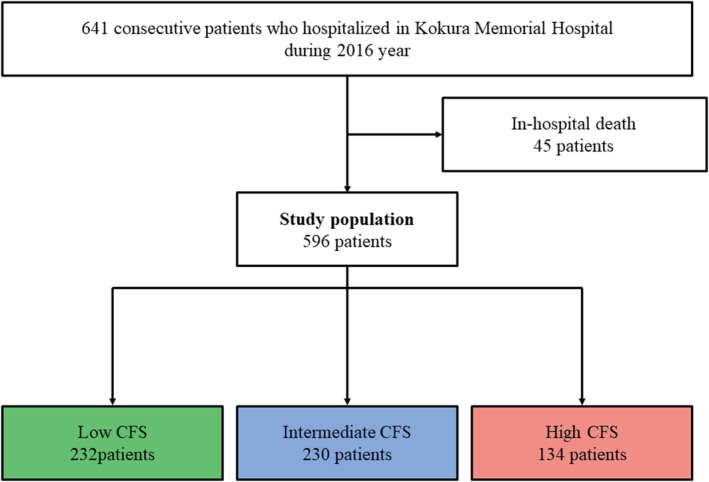
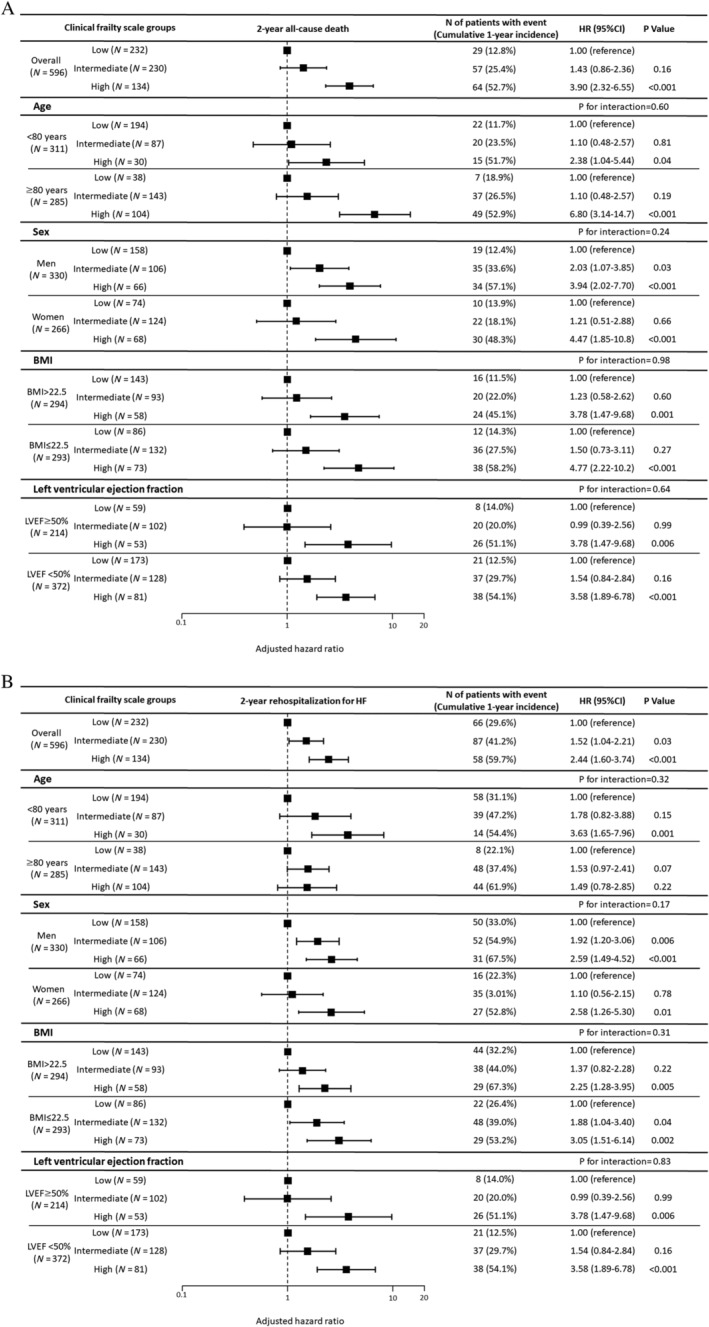
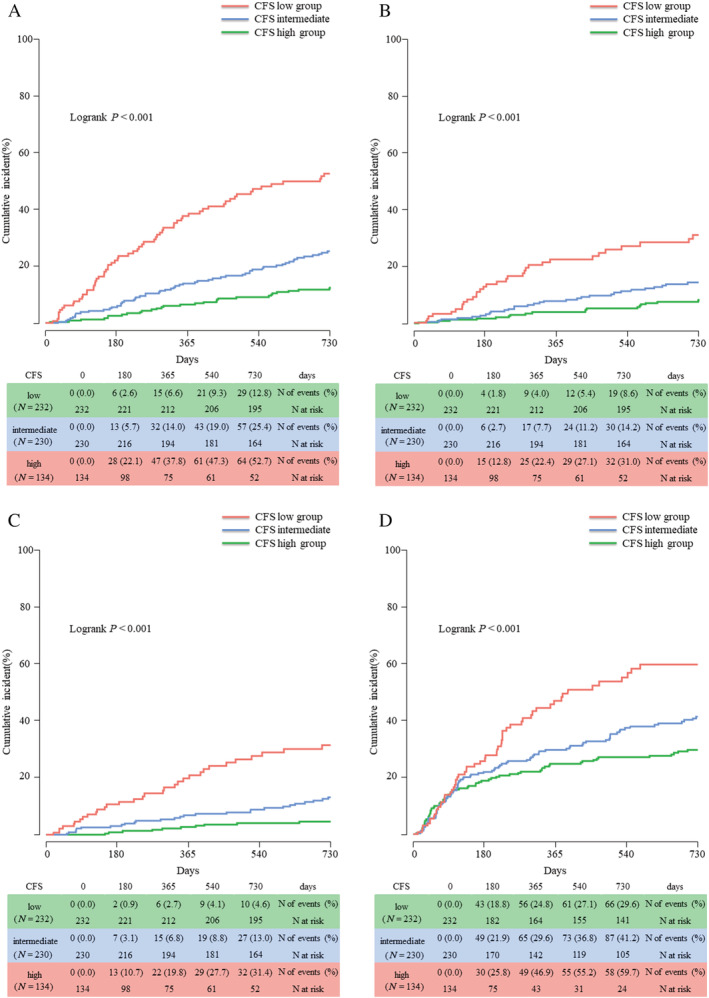
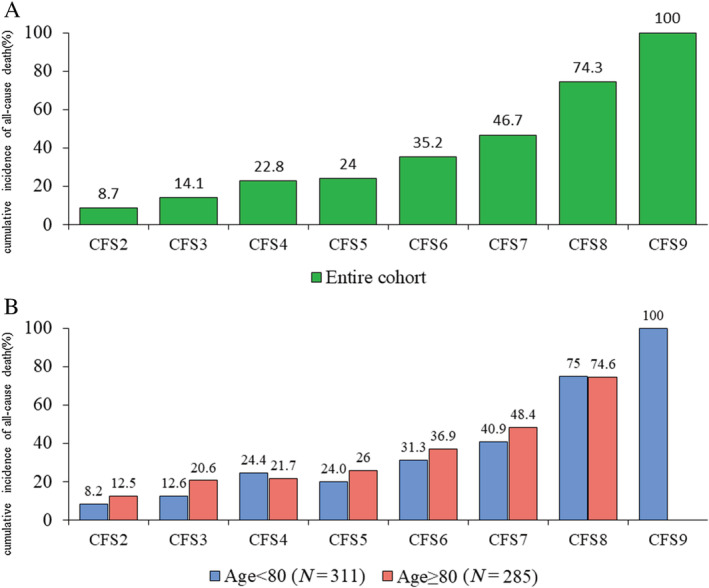
Among consecutive 596 patients after their discharge from HF in Kokura Memorial Hospital (Kitakyushu, Japan) during 2015, their frailty at discharge was assessed according to CFS. Patients were classified into three groups: low (N = 232, 38.9%), intermediate (N = 230, 38.6%), and high (N = 134, 22.5%). The primary endpoint was defined as 2 year all-cause death. The mean age was 76.6 ± 10.1 years, and 55.3% were men in entire cohort. There were significant differences in age, living environment, and dementia among low, intermediate, and high CFS groups. Left ventricular ejection fraction (LVEF) and co-morbidities such as severe renal failure and severe anaemia tended to increase with frailty severity, while body mass index (BMI) and albumin level tended to decrease with frailty severity. Two year cumulative incidences of all-cause death for the three groups were 12.8%, 25.4%, and 52.7% (P < 0.001), respectively. This significant difference in the risk for all-cause death among the CFS groups was driven by the risk for cardiac (8.6%, 14.2%, and 31.0%, respectively, P < 0.001) and non-cardiac death (4.6%, 13.0%, and 31.4%, respectively, P < 0.001). The multivariate analysis showed that high frailty was independently associated with all-cause death (intermediate CFS group: adjusted hazard ratio, 1.43, 95% confidence interval, 0.86-2.36, P = 0.16; high CFS group: adjusted hazard ratio, 3.90, 95% confidence interval, 2.32-6.55, P < 0.001), and this result was consistent, irrespective of stratification based on age, sex, BMI, and LVEF without significant interaction.
The simple CFS tool was successful in predicting the risk for all-cause death in patients with HF, and frailty according to CFS was independently associated with all-cause death irrespective of stratification based on age, sex, BMI, and LVEF without significant interaction. The CFS is a valuable prognostic tool in clinical settings.
目前在评估心力衰竭(HF)患者的衰弱程度方面尚无金标准,根据加拿大健康与衰老临床衰弱量表(CFS)评估的衰弱对HF患者死亡率的预后价值仍不清楚。
2015年期间,对小仓纪念医院(日本北九州市)连续596例HF出院患者,根据CFS评估其出院时的衰弱程度。患者分为三组:低衰弱组(N = 232,38.9%)、中度衰弱组(N = 230,38.6%)和高衰弱组(N = 134,22.5%)。主要终点定义为2年全因死亡。整个队列的平均年龄为76.6±10.1岁,男性占55.3%。低、中、高CFS组在年龄、生活环境和痴呆方面存在显著差异。左心室射血分数(LVEF)以及严重肾衰竭和严重贫血等合并症倾向于随衰弱严重程度增加,而体重指数(BMI)和白蛋白水平倾向于随衰弱严重程度降低。三组的2年全因死亡累积发生率分别为12.8%、25.4%和52.7%(P<0.001)。CFS组间全因死亡风险的显著差异是由心脏性死亡风险(分别为8.6%、14.2%和31.0%,P<0.001)和非心脏性死亡风险(分别为4.6%、13.0%和31.4%,P<0.001)驱动的。多变量分析显示,高衰弱与全因死亡独立相关(中度CFS组:调整后风险比,1.43,95%置信区间,0.86 - 2.36,P = 0.16;高CFS组:调整后风险比,3.90,95%置信区间,2.32 - 6.55,P<0.001),且无论基于年龄、性别、BMI和LVEF进行分层且无显著交互作用,该结果均一致。
简单的CFS工具成功预测了HF患者的全因死亡风险,且根据CFS评估的衰弱与全因死亡独立相关,无论基于年龄、性别、BMI和LVEF进行分层且无显著交互作用。CFS是临床环境中有价值的预后工具。