Department of Psychology, Brock University, 1812 Sir Isaac Brock Way, St. Catharines, ON, L2S 3A1, Canada.
Department of Psychology, Ryerson University, 350 Victoria Street, Toronto, ON, M5B 2K3, Canada.
Body Image. 2021 Jun;37:6-13. doi: 10.1016/j.bodyim.2021.01.004. Epub 2021 Jan 22.
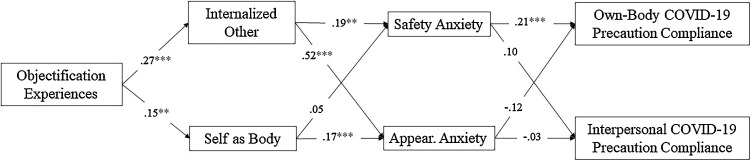
In the present paper, we tested an objectification theory model including compliance with COVID-19 safety measures as an outcome. Safety measures recommended by governments and health organizations include monitoring one's body and interpersonal and social distance from others. We contend that the diffuse safety anxiety stemming from sexual and self-objectification encourages targets to broadly adopt behaviors that protect against body-based dangers, including COVID-19. Accordingly, safety anxiety should predict greater compliance with COVID-19 safety measures. U.S. residents (N = 501) were recruited online and completed measures of sexual objectification, self-objectification, safety anxiety, appearance anxiety, and COVID-19 safety compliance. Two-step mediation analyses revealed a positive indirect effect of sexual objectification on safety anxiety through internalization of observers' perspectives (self-objectification Factor 1); in turn, there was a positive indirect effect of internalized others on COVID-19 body-based safety compliance through safety anxiety. Moreover, women (vs. men) reported higher levels of sexual objectification, internalization of observers' perspectives, safety anxiety, appearance anxiety, and COVID-19 safety measure compliance. Not only is safety anxiety relevant to cautionary behaviors protective against sexual objectification threat, but it also predicts compliance with measures that reduce the risk of contracting COVID-19. Implications for objectification theory are discussed.
在本文中,我们测试了一个客观化理论模型,其中包括遵守 COVID-19 安全措施作为结果。政府和卫生组织推荐的安全措施包括监测自己的身体以及与他人的人际和社会距离。我们认为,性和自我客观化引起的弥漫性安全焦虑鼓励目标广泛采取保护身体危险的行为,包括 COVID-19。因此,安全焦虑应该预测更高的 COVID-19 安全措施遵守率。我们在线招募了 501 名美国居民,完成了性客观化、自我客观化、安全焦虑、外表焦虑和 COVID-19 安全遵守的测量。两步中介分析显示,性客观化对安全焦虑的正向间接影响通过观察者观点的内化(自我客观化因子 1);反过来,内化的他人对 COVID-19 身体安全遵守的正向间接影响通过安全焦虑。此外,女性(与男性相比)报告了更高水平的性客观化、观察者观点的内化、安全焦虑、外表焦虑和 COVID-19 安全措施遵守。安全焦虑不仅与预防性行为有关,这些行为可以保护免受性客观化威胁,而且还可以预测遵守减少感染 COVID-19 风险的措施。本文讨论了客观化理论的意义。