Department of Sociology, Utrecht University, the Netherlands.
Jacobs Center for Productive Youth Development, University of Zurich, Switzerland.
Soc Sci Med. 2021 Jan;268:113370. doi: 10.1016/j.socscimed.2020.113370. Epub 2020 Sep 16.
Adolescents and young adults were identified internationally as a group with potentially low compliance rates with public health measures aimed at curbing the spread of coronavirus disease 2019 (COVID-19). Although non-compliance research during pandemics has typically focused on concurrent correlates, less is known about how prior social and psychological risk factors are associated with non-compliance during pandemics.
This paper leverages a prospective-longitudinal cohort study with data before and during the pandemic to describe patterns of non-compliance with COVID- 19 related public health measures in young adults and to identify which characteristics increase the risk of non-compliance.
Data came from an ongoing cohort study in Zurich, Switzerland (n=737). Non-compliance with public health measures and concurrent correlates were measured at age 22. Antecedent sociodemographic, social, and psychological factors were measured at ages 15-20. Young adults generally complied with COVID-19 public health measures, although non-compliance with some measures (e.g., cleaning/disinfecting mobile phones, standing 1.5-2 meters apart) was relatively higher.
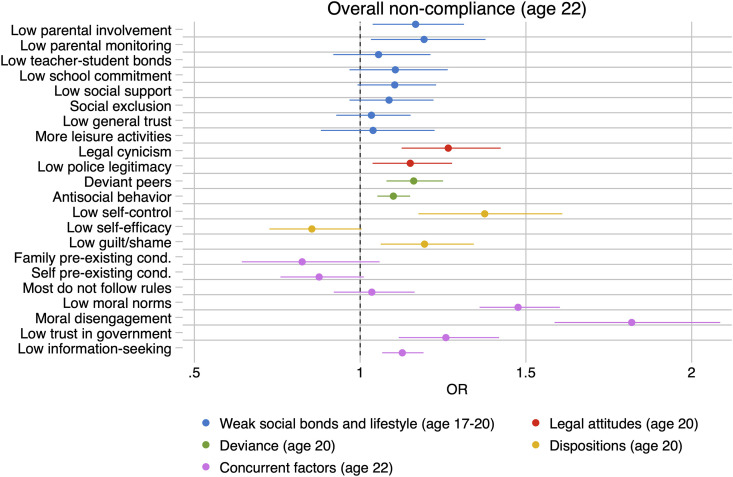
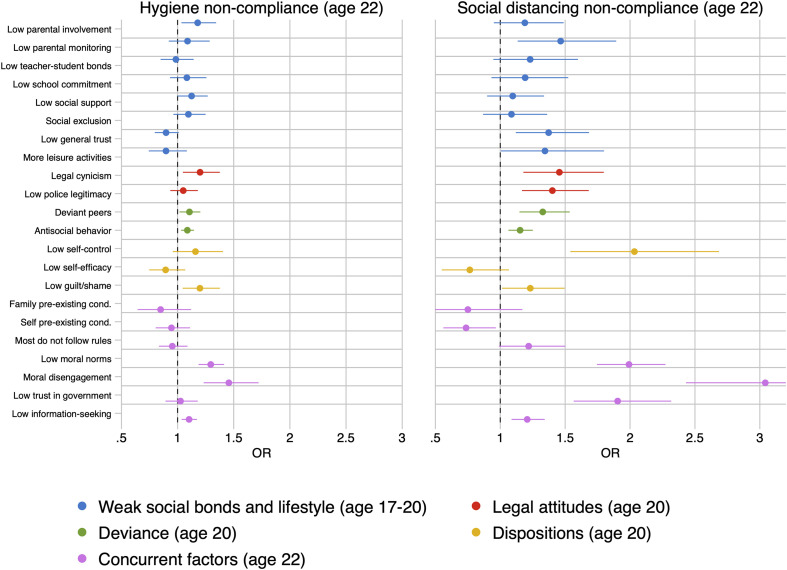
Non-compliance, especially with hygiene-related measures, was more prevalent in males, and in individuals with higher education, higher SES, and a nonmigrant background. Non-compliance was higher in young adults who had previously scored high on indicators of "antisocial potential," including low acceptance of moral rules, pre-pandemic legal cynicism, low shame/guilt, low self-control, engagement in delinquent behaviors, and association with delinquent peers. Young adults with low trust, including in the government's measures for fighting the virus, also complied less.
In order to increase voluntary compliance with COVID-19 measures, public health campaigns should implement strategies that foster moral obligation and trust in authorities, or leverage trustworthy individuals in the community to disseminate information. For young adults with low self-control, self-monitoring, environmental restructuring, or nudging may increase compliance. Long-term investments into integrating youth with antisocial potential into society may decrease rule-breaking behaviors, including during pandemics when compliance saves lives.
青少年和年轻人被国际上认定为对旨在遏制 2019 年冠状病毒病(COVID-19)传播的公共卫生措施可能具有低遵从率的群体。尽管大流行期间的不遵守研究通常侧重于同时存在的相关性,但对于先前的社会和心理风险因素如何与大流行期间的不遵守相关联,了解较少。
本文利用一项具有前瞻性的纵向队列研究,该研究在大流行之前和期间都有数据,描述了年轻人对 COVID-19 相关公共卫生措施的不遵守模式,并确定了哪些特征会增加不遵守的风险。
数据来自瑞士苏黎世的一项正在进行的队列研究(n=737)。在 22 岁时测量了对公共卫生措施的不遵守情况和同时存在的相关性。15-20 岁时测量了先前的社会人口统计学、社会和心理因素。年轻人通常遵守 COVID-19 公共卫生措施,尽管对某些措施(例如,清洁/消毒手机,保持 1.5-2 米的距离)的不遵守相对较高。
不遵守规定,尤其是与卫生相关的措施,在男性中更为普遍,在受教育程度较高、社会经济地位较高、非移民背景的人群中更为普遍。在先前在“反社会潜力”指标上得分较高的年轻人中,不遵守的情况更为普遍,这些指标包括道德规则接受度低、大流行前的法律犬儒主义、低羞耻/内疚感、低自我控制、从事犯罪行为以及与犯罪同伴交往。对信任度低的年轻人,包括对政府抗击病毒措施的信任度低,也较少遵守规定。
为了提高对 COVID-19 措施的自愿遵守率,公共卫生运动应实施策略,培养道德义务和对当局的信任,或利用社区中的可信赖人员来传播信息。对于自我控制、自我监控、环境重构或轻推能力较低的年轻人,可能会提高其遵守率。对具有反社会潜力的年轻人进行长期投资,将其融入社会,可能会减少违反规则的行为,包括在遵守规则可以挽救生命的大流行期间。