Göhde Ronja, Naumann Benjamin, Laundon Davis, Imig Cordelia, McDonald Kent, Cooper Benjamin H, Varoqueaux Frédérique, Fasshauer Dirk, Burkhardt Pawel
Sars International Centre for Molecular Marine Biology, University of Bergen, 5006 Bergen, Norway.
Institute of Zoology and Evolutionary Research, Friedrich Schiller University Jena, 07743 Jena, Germany.
Philos Trans R Soc Lond B Biol Sci. 2021 Mar 29;376(1821):20190759. doi: 10.1098/rstb.2019.0759. Epub 2021 Feb 8.
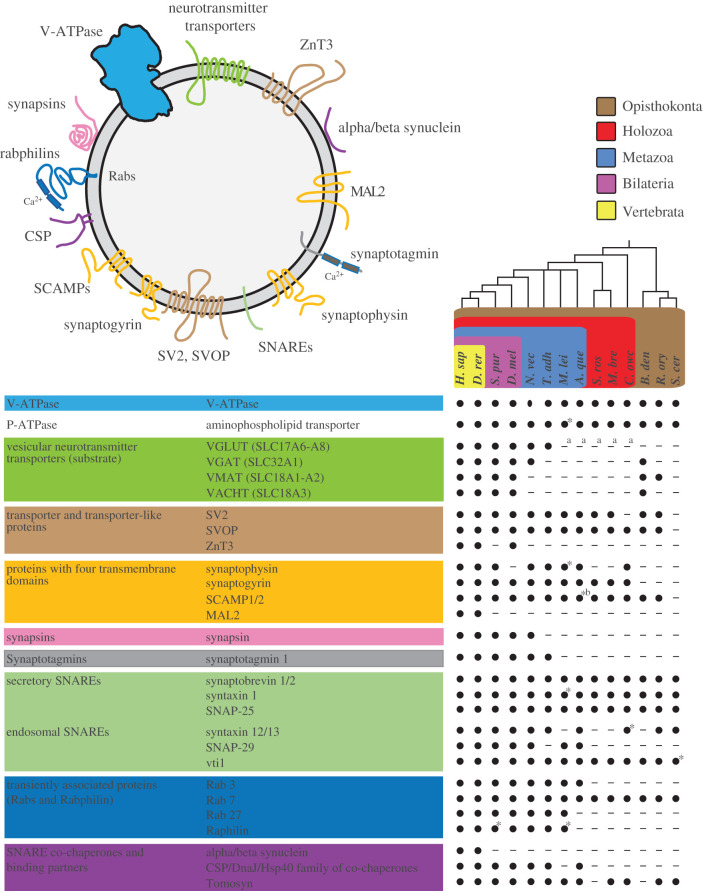
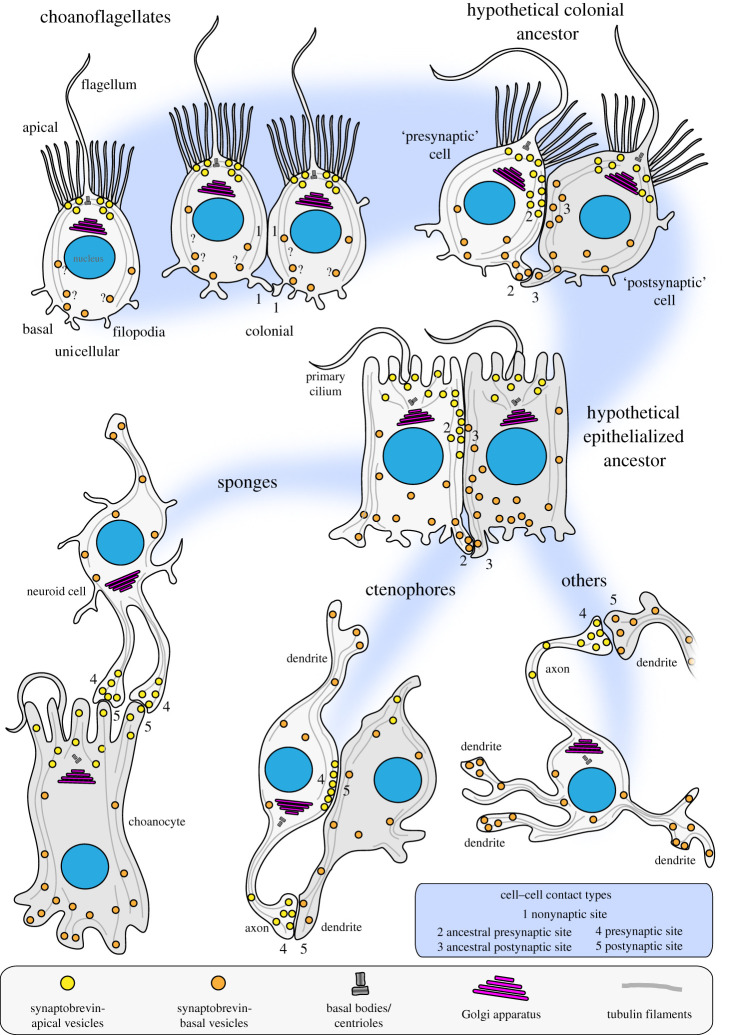
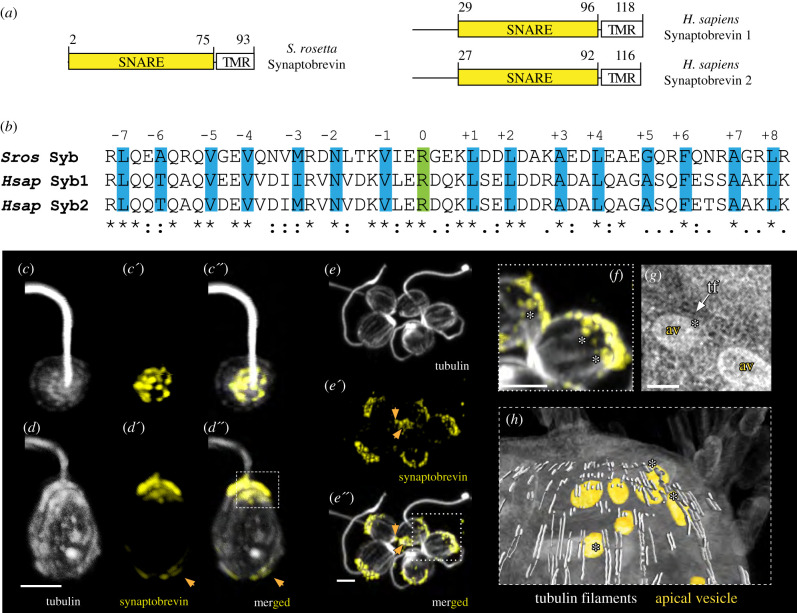
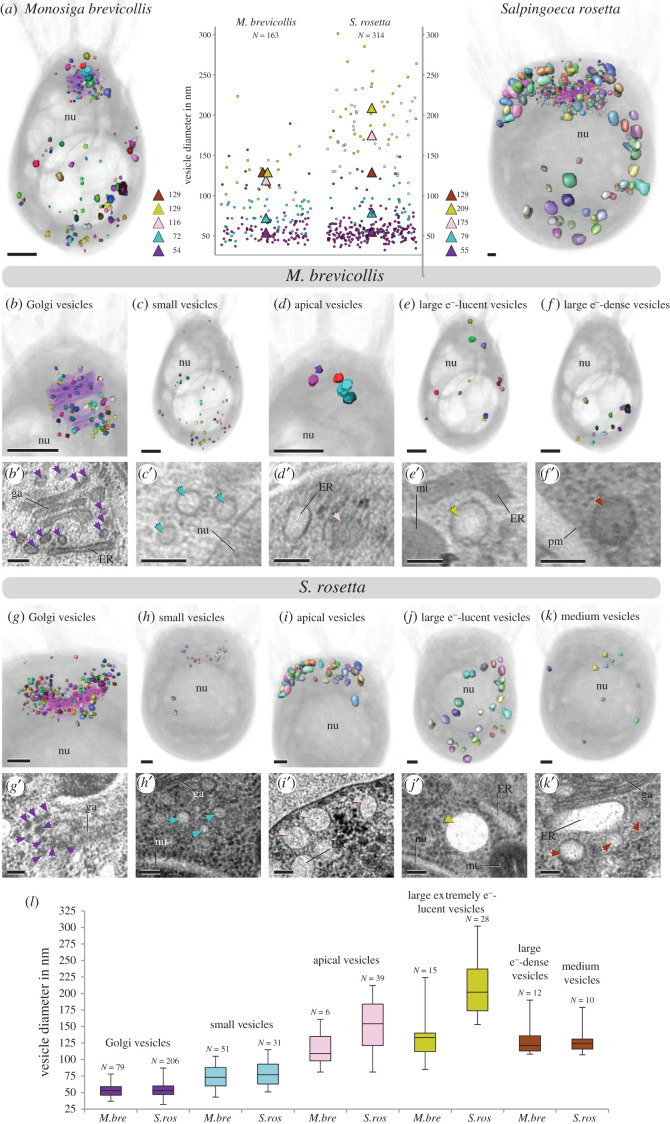
Neurosecretory vesicles are highly specialized trafficking organelles that store neurotransmitters that are released at presynaptic nerve endings and are, therefore, important for animal cell-cell signalling. Despite considerable anatomical and functional diversity of neurons in animals, the protein composition of neurosecretory vesicles in bilaterians appears to be similar. This similarity points towards a common evolutionary origin. Moreover, many putative homologues of key neurosecretory vesicle proteins predate the origin of the first neurons, and some even the origin of the first animals. However, little is known about the molecular toolkit of these vesicles in non-bilaterian animals and their closest unicellular relatives, making inferences about the evolutionary origin of neurosecretory vesicles extremely difficult. By comparing 28 proteins of the core neurosecretory vesicle proteome in 13 different species, we demonstrate that most of the proteins are present in unicellular organisms. Surprisingly, we find that the vesicular membrane-associated soluble N-ethylmaleimide-sensitive factor attachment protein receptor protein synaptobrevin is localized to the vesicle-rich apical and basal pole in the choanoflagellate Our 3D vesicle reconstructions reveal that the choanoflagellates and exhibit a polarized and diverse vesicular landscape reminiscent of the polarized organization of chemical synapses that secrete the content of neurosecretory vesicles into the synaptic cleft. This study sheds light on the ancestral molecular machinery of neurosecretory vesicles and provides a framework to understand the origin and evolution of secretory cells, synapses and neurons. This article is part of the theme issue 'Basal cognition: multicellularity, neurons and the cognitive lens'.
神经分泌囊泡是高度特化的运输细胞器,储存着在前突触神经末梢释放的神经递质,因此对动物细胞间信号传导很重要。尽管动物体内神经元在解剖结构和功能上存在很大差异,但两侧对称动物中神经分泌囊泡的蛋白质组成似乎相似。这种相似性表明它们有共同的进化起源。此外,许多关键神经分泌囊泡蛋白的假定同源物在第一批神经元出现之前就已存在,有些甚至在第一批动物出现之前就已存在。然而,对于非两侧对称动物及其最接近的单细胞亲属中这些囊泡的分子工具包知之甚少,这使得推断神经分泌囊泡的进化起源极其困难。通过比较13个不同物种中核心神经分泌囊泡蛋白质组的28种蛋白质,我们证明大多数蛋白质存在于单细胞生物中。令人惊讶的是,我们发现囊泡膜相关的可溶性N - 乙基马来酰亚胺敏感因子附着蛋白受体蛋白突触小泡蛋白定位于领鞭毛虫富含囊泡的顶端和基部极。我们的3D囊泡重建显示,领鞭毛虫表现出极化且多样的囊泡景观,让人联想到将神经分泌囊泡内容物分泌到突触间隙的化学突触的极化组织。这项研究揭示了神经分泌囊泡的原始分子机制,并为理解分泌细胞、突触和神经元的起源与进化提供了一个框架。本文是主题为“基础认知:多细胞性、神经元与认知视角”的一部分。