Scharner Sophie, Stengel Andreas
Department for Psychosomatic Medicine, Charité Center for Internal Medicine and Dermatology, Berlin Institute of Health, Charité-Universitätsmedizin Berlin, Humboldt-Universität zu Berlin, Berlin, Germany.
Department of Psychosomatic Medicine and Psychotherapy, University Hospital Tübingen, Tübingen, Germany.
Front Hum Neurosci. 2021 Jan 20;14:596381. doi: 10.3389/fnhum.2020.596381. eCollection 2020.
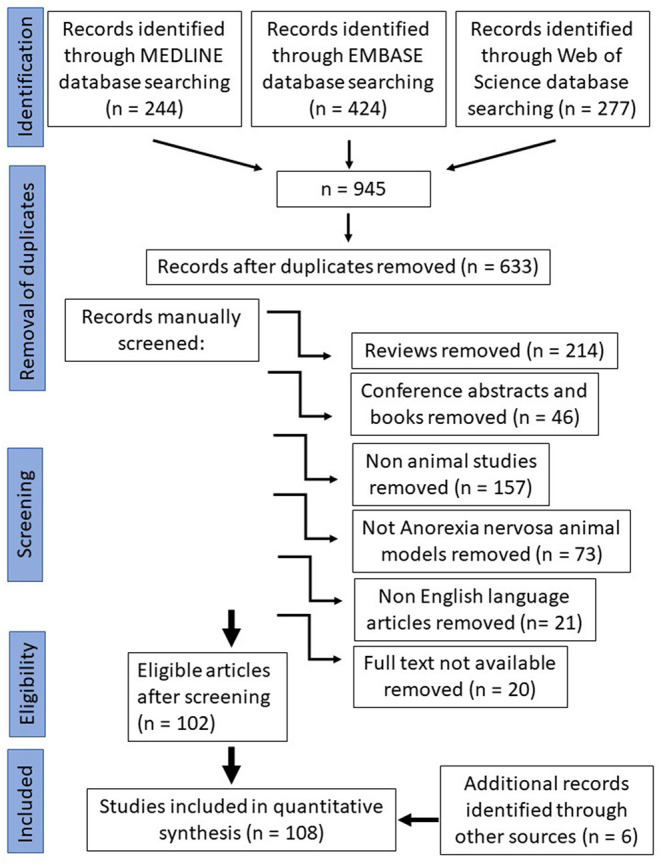
Anorexia nervosa is an eating disorder characterized by intense fear of gaining weight and a distorted body image which usually leads to low caloric intake and hyperactivity. The underlying mechanism and pathogenesis of anorexia nervosa is still poorly understood. In order to learn more about the underlying pathophysiology of anorexia nervosa and to find further possible treatment options, several animal models mimicking anorexia nervosa have been developed. The aim of this review is to systematically search different databases and provide an overview of existing animal models and to discuss the current knowledge gained from animal models of anorexia nervosa. For the systematic data search, the Pubmed-Medline database, Embase database, and Web of Science database were searched. After removal of duplicates and the systematic process of selection, 108 original research papers were included in this systematic review. One hundred and six studies were performed with rodents and 2 on monkeys. Eighteen different animal models for anorexia nervosa were used in these studies. Parameters assessed in many studies were body weight, food intake, physical activity, cessation of the estrous cycle in female animals, behavioral changes, metabolic and hormonal alterations. The most commonly used animal model (75 of the studies) is the activity-based anorexia model in which typically young rodents are exposed to time-reduced access to food (a certain number of hours a day) with unrestricted access to a running wheel. Of the genetic animal models, one that is of particular interest is the mice model. Animal models have so far contributed many findings to the understanding of mechanisms of hunger and satiety, physical activity and cognition in an underweight state and other mechanisms relevant for anorexia nervosa in humans.
神经性厌食症是一种饮食失调症,其特征是强烈害怕体重增加和身体形象扭曲,通常导致热量摄入过低和多动。神经性厌食症的潜在机制和发病原因仍知之甚少。为了更多地了解神经性厌食症的潜在病理生理学并寻找更多可能的治疗方案,已经开发了几种模拟神经性厌食症的动物模型。这篇综述的目的是系统地检索不同数据库,概述现有的动物模型,并讨论从神经性厌食症动物模型中获得的当前知识。为了进行系统的数据检索,检索了PubMed-Medline数据库、Embase数据库和科学网数据库。在去除重复项并经过系统的筛选过程后,108篇原创研究论文被纳入本系统综述。其中106项研究使用了啮齿动物,2项研究使用了猴子。这些研究中使用了18种不同的神经性厌食症动物模型。许多研究中评估的参数包括体重、食物摄入量、身体活动、雌性动物发情周期的停止、行为变化、代谢和激素改变。最常用的动物模型(75项研究)是基于活动的厌食模型,通常让年轻的啮齿动物每天在有限的时间内获取食物(每天一定小时数),同时可以无限制地使用跑步机。在基因动物模型中,一个特别受关注的是小鼠模型。迄今为止,动物模型为理解饥饿和饱腹感机制、体重过轻状态下的身体活动和认知以及与人类神经性厌食症相关的其他机制做出了许多贡献。