Zhou Hongyue, Jiang Mengyu, Yuan Hongyan, Ni Weihua, Tai Guixiang
Department of Immunology, College of Basic Medical Science, Jilin University, Changchun, Jilin 130021, P.R. China.
Oncol Lett. 2021 Feb;21(2):149. doi: 10.3892/ol.2020.12410. Epub 2020 Dec 24.
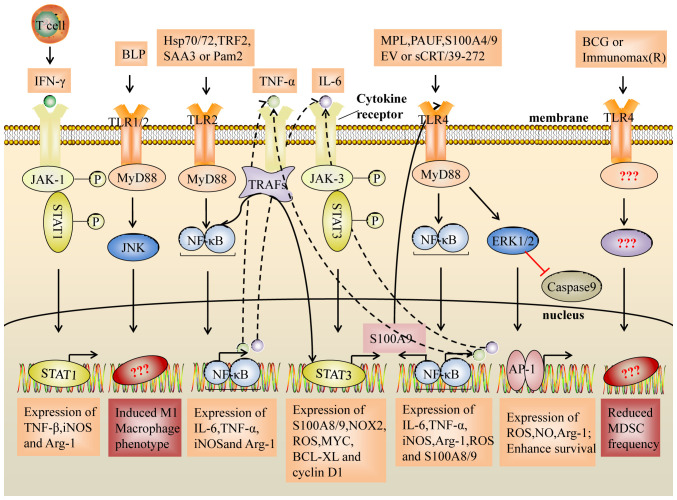
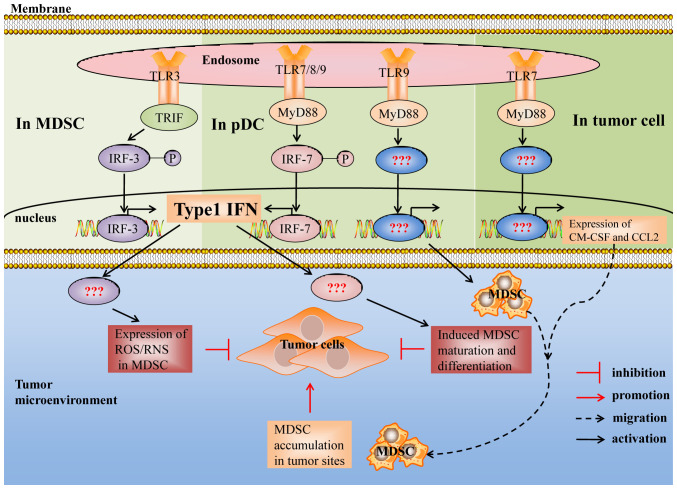
Myeloid-derived suppressor cells (MDSCs) are one of the major components of the tumor microenvironment (TME), and are the main mediators of tumor-induced immunosuppression. Recent studies have reported that the survival, differentiation and immunosuppressive activity of MDSCs are affected by the Toll-like receptor (TLR) signaling pathway. However, the regulatory effect of TLR signaling on MDSCs remains controversial. TLR-induced MDSC can acquire different immunosuppressive activities to influence the immune response that can be either beneficial or detrimental to cancer immunotherapy. The present review summarizes the effects of TLR signals on the number, phenotype and inhibitory activity of MDSCs, and their role in cancer immunotherapy, which cannot be ignored if effective cancer immunotherapies are to be developed for the immunosuppression of the TME.
髓源性抑制细胞(MDSCs)是肿瘤微环境(TME)的主要组成部分之一,也是肿瘤诱导免疫抑制的主要介质。最近的研究报道,MDSCs的存活、分化和免疫抑制活性受Toll样受体(TLR)信号通路影响。然而,TLR信号对MDSCs的调节作用仍存在争议。TLR诱导的MDSC可获得不同的免疫抑制活性,从而影响对癌症免疫治疗可能有益或有害的免疫反应。本综述总结了TLR信号对MDSCs数量、表型和抑制活性的影响,以及它们在癌症免疫治疗中的作用。如果要开发有效的癌症免疫疗法来抑制TME的免疫抑制,这些作用不可忽视。