Liang Li, Li Xin, Li Dong, Liu Ping, Nong Lin, Dong Ying, Liu Jumei, Huang Sixia, Li Ting
Department of Pathology, Peking University First Hospital, Beijing 100034, P.R. China.
Oncol Lett. 2021 Feb;21(2):174. doi: 10.3892/ol.2021.12435. Epub 2021 Jan 4.
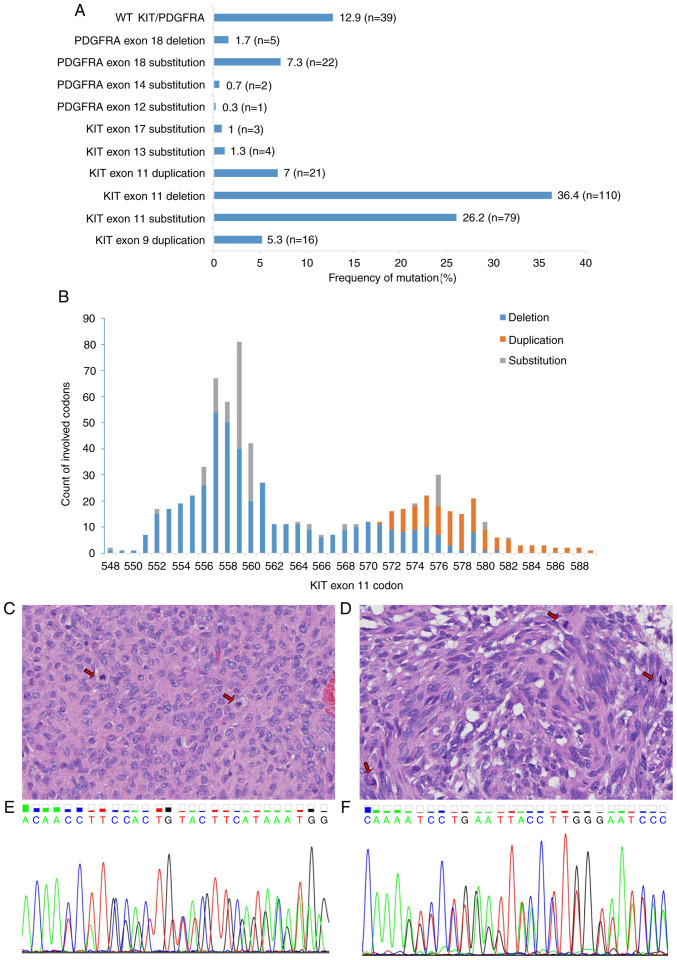
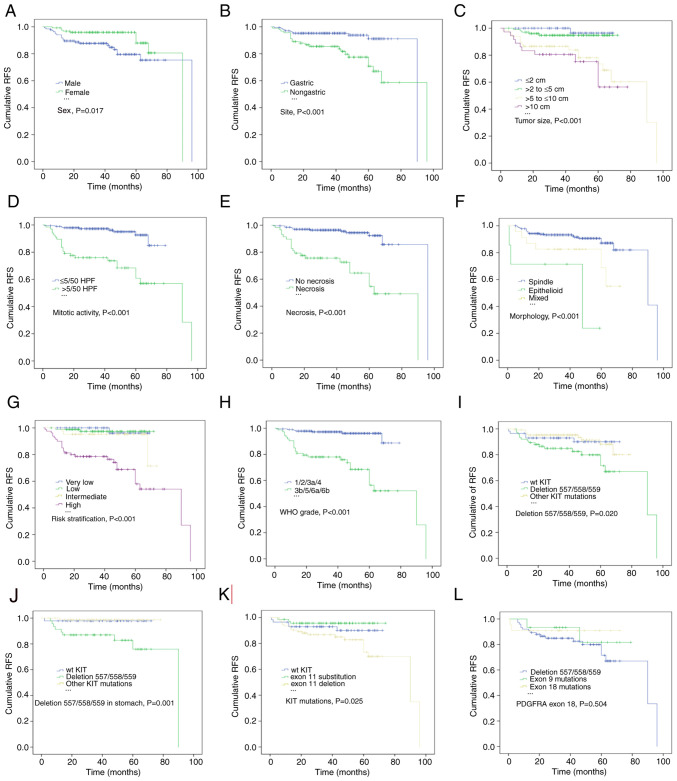
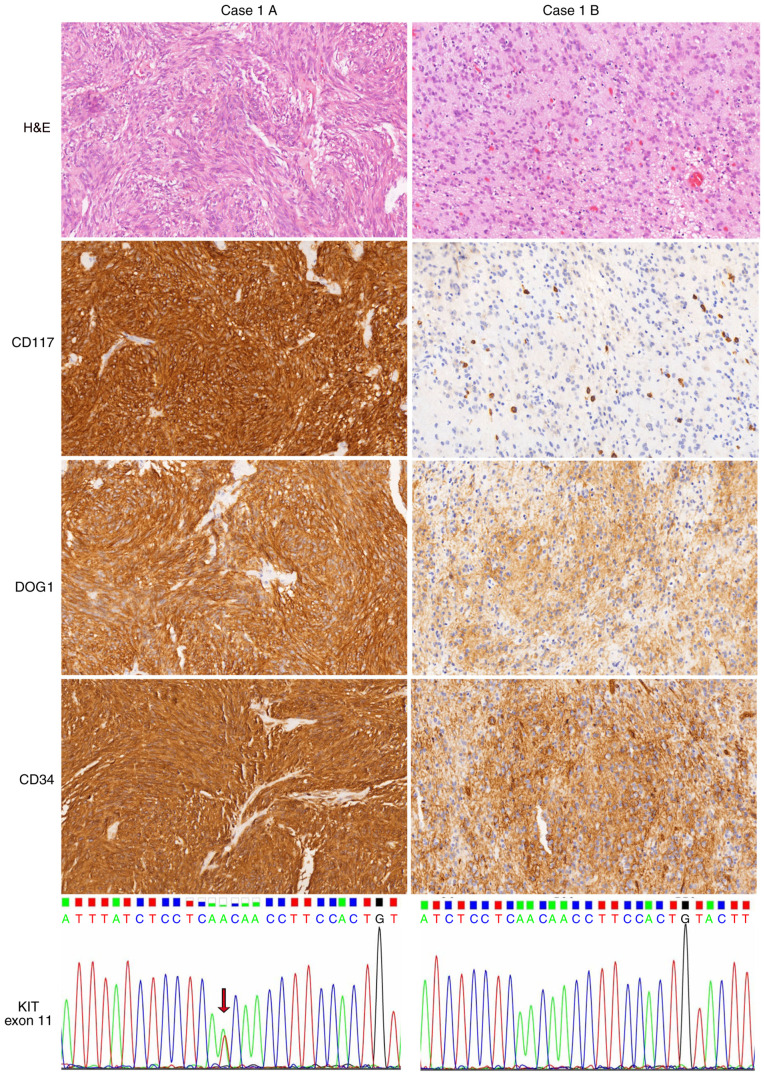
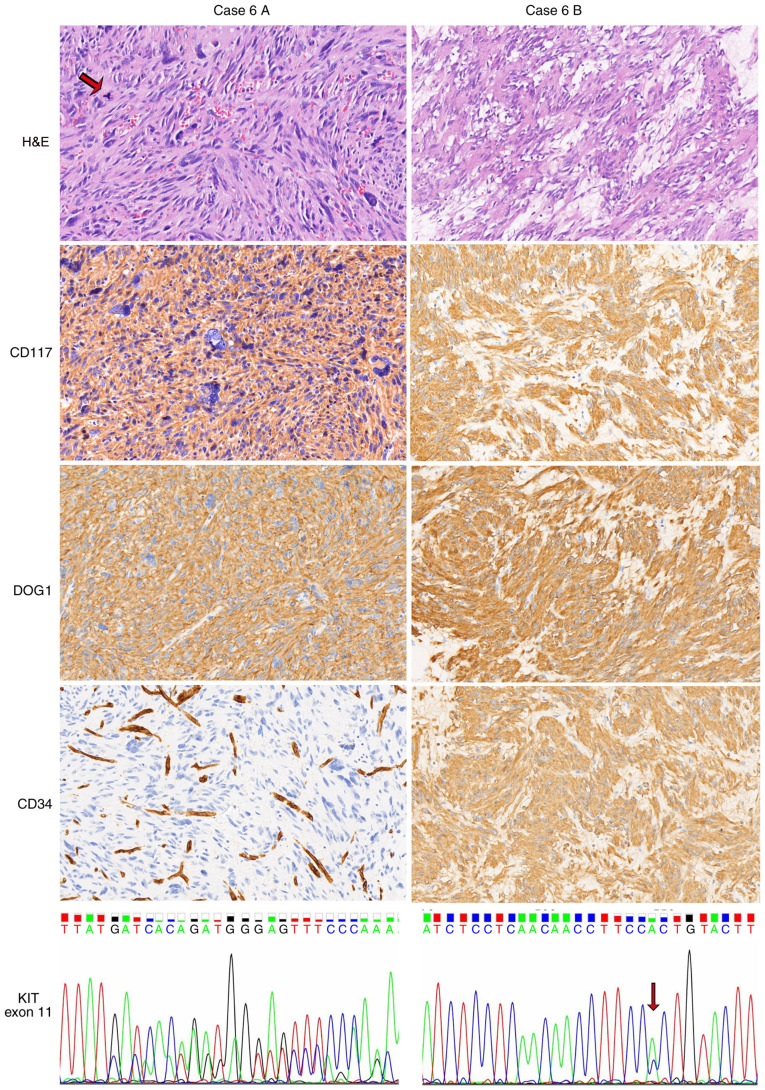
Gastrointestinal stromal tumors (GISTs) represent a spectrum of tumors characterized by variable behaviors and activating mutations in KIT proto-oncogene, receptor tyrosine kinase () or platelet derived growth factor receptor α () genes. However, whether genotype analysis should be regarded as a prognostic indicator remains unclear. In the present study, clinicopathological data and the mutation phenotypes of and genes were assessed in a series of 302 patients with GISTs at a single center. Univariate and multivariate Cox regression analyses were performed to identify the clinicopathological and mutational factors associated with relapse-free survival (RFS) in patients who had undergone complete primary GIST resection. and mutations were identified in 233 (77.2%) and 30 (9.9%) cases, respectively. The following clinicopathological parameters were significantly associated with a shorter RFS: Male, non-gastric tumor origin, larger tumor size (>5 cm), high mitotic activity (>5/50 high-power fields), necrosis and epithelioid morphology. Tumors at non-gastric sites, with high National Institutes of Health risk classification, high World Health Organization (WHO) grade and deletion involving codons 557/558/559 exhibited a significantly higher risk of progression. In the Cox regression model, deletion involving codons 557/558/559, non-gastric origin and high WHO grade were independent indicators of RFS. The adverse prognosis associated with deletions involving codons 557/558/559 was also observed for gastric GISTs. Conversely, spindle morphology, exon 11 substitution and exon 18 mutation were associated with a longer RFS and lower rate of relapse. Furthermore, the coexistence of exon 11 deletion and exon 13 duplication was observed in one tumor, with adverse prognostic features. Heterogeneity affecting morphology, immunostaining and genotype was identified in 4 cases. In addition, the presence of succinate dehydrogenase-deficient GIST was found in 5 cases (3.6%). In conclusion, the tumor genotype with regard to and mutations exhibited prognostic significance for the risk of GIST progression and may be helpful for the optimization of tailored adjuvant therapy.
胃肠道间质瘤(GISTs)是一类具有不同生物学行为且在KIT原癌基因、受体酪氨酸激酶()或血小板衍生生长因子受体α()基因中存在激活突变的肿瘤。然而,基因型分析是否应被视为预后指标仍不明确。在本研究中,对单中心的302例GIST患者的临床病理数据以及和基因的突变表型进行了评估。进行单因素和多因素Cox回归分析,以确定与接受原发性GIST完整切除患者的无复发生存期(RFS)相关的临床病理和突变因素。分别在233例(77.2%)和30例(9.9%)病例中检测到和突变。以下临床病理参数与较短的RFS显著相关:男性、非胃肿瘤起源、肿瘤较大(>5 cm)、高有丝分裂活性(>5/50高倍视野)、坏死和上皮样形态。非胃部位的肿瘤、美国国立卫生研究院高风险分类、世界卫生组织(WHO)高级别以及涉及密码子557/558/559的缺失显示出显著更高的进展风险。在Cox回归模型中,涉及密码子557/558/559的缺失、非胃起源和高WHO级别是RFS的独立指标。在胃GIST中也观察到与涉及密码子557/558/559缺失相关的不良预后。相反,梭形形态、外显子11替代和外显子18突变与较长的RFS和较低的复发率相关。此外,在一个肿瘤中观察到外显子11缺失和外显子13重复共存,具有不良预后特征。在4例中发现了影响形态、免疫染色和基因型的异质性。此外,在5例(3.6%)中发现了琥珀酸脱氢酶缺陷型GIST。总之,关于和突变的肿瘤基因型对GIST进展风险具有预后意义,可能有助于优化个体化辅助治疗。