Nieto-Garai Jon Ander, Arboleya Aroa, Otaegi Sara, Chojnacki Jakub, Casas Josefina, Fabriàs Gemma, Contreras F-Xabier, Kräusslich Hans-Georg, Lorizate Maier
Instituto Biofisika (UPV/EHU, CSIC) University of the Basque Country Leioa E-48940 Spain.
Fundación Biofísica Bizkaia/Biofisika Bizkaia Fundazioa (FBB) Barrio Sarriena s/n Leioa E-48940 Spain.
Adv Sci (Weinh). 2020 Dec 21;8(3):2003468. doi: 10.1002/advs.202003468. eCollection 2021 Feb.
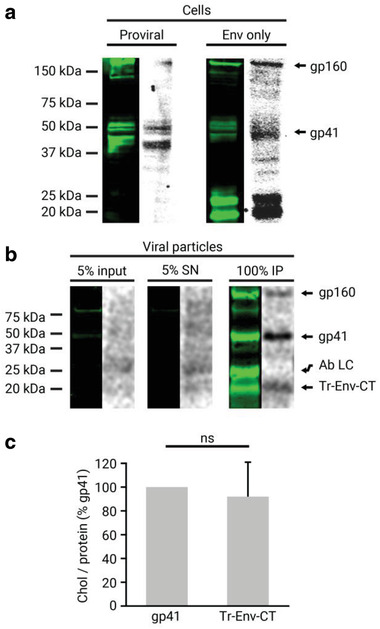
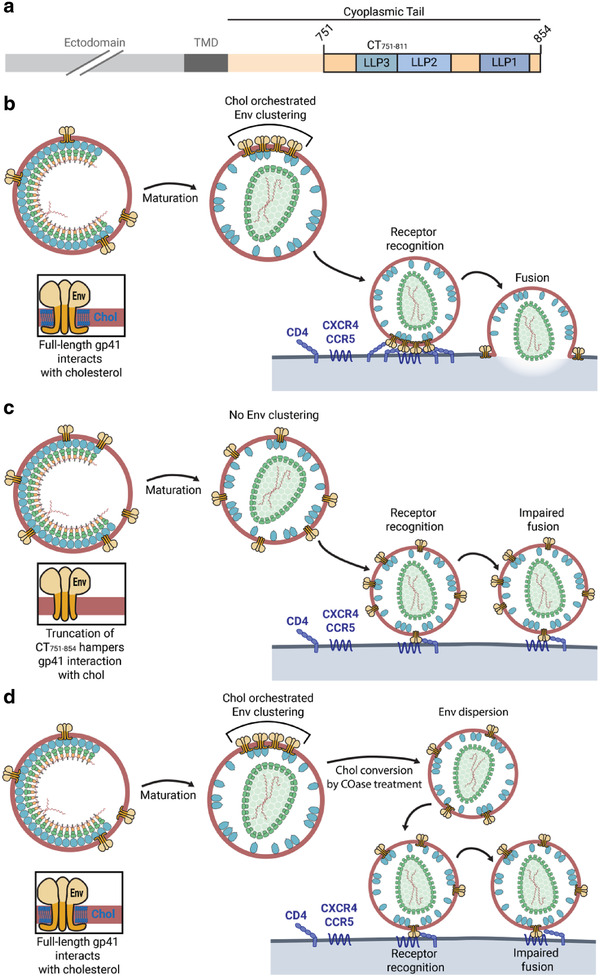
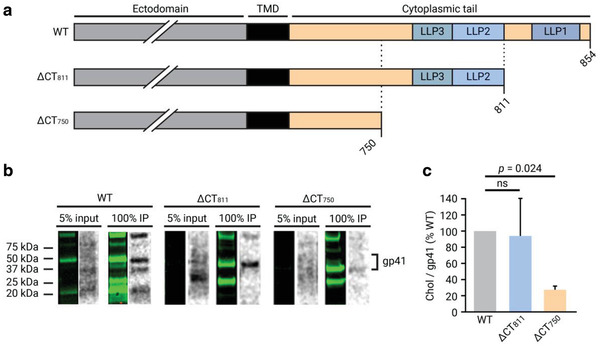
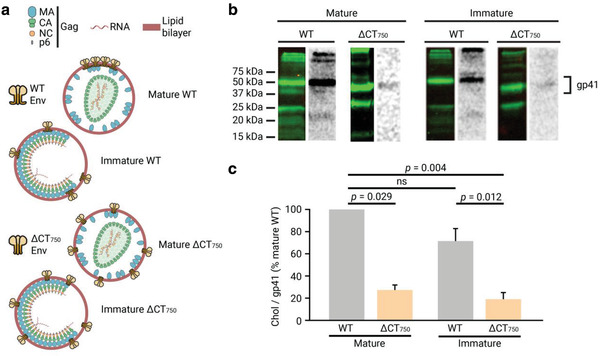
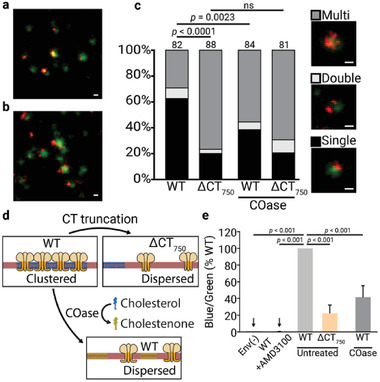
HIV-1 entry requires the redistribution of envelope glycoproteins (Env) into a cluster and the presence of cholesterol (chol) in the viral membrane. However, the molecular mechanisms underlying the specific role of chol in infectivity and the driving force behind Env clustering remain unknown. Here, gp41 is demonstrated to directly interact with chol in the viral membrane via residues 751-854 in the cytoplasmic tail (CT). Super-resolution stimulated emission depletion (STED) nanoscopy analysis of Env distribution further demonstrates that both truncation of gp41 CT and depletion of chol leads to dispersion of Env clusters in the viral membrane and inhibition of virus entry. This work reveals a direct interaction of gp41 CT with chol and indicates that this interaction is an important orchestrator of Env clustering.
HIV-1进入细胞需要包膜糖蛋白(Env)重新分布形成簇,以及病毒膜中存在胆固醇(chol)。然而,chol在感染性中发挥特定作用的分子机制以及Env聚集背后的驱动力仍然未知。在这里,gp41被证明通过细胞质尾巴(CT)中的751 - 854位残基直接与病毒膜中的chol相互作用。Env分布的超分辨率受激发射损耗(STED)纳米显微镜分析进一步表明,gp41 CT的截断和chol的耗尽都会导致Env簇在病毒膜中分散,并抑制病毒进入。这项工作揭示了gp41 CT与chol的直接相互作用,并表明这种相互作用是Env聚集的重要协调者。