Yang Qian, Zou Peizhuo, Cao Zhi, Wang Qingyao, Fu Songzhe, Xie Guosi, Huang Jie
Laboratory for Marine Fisheries Science and Food Production Processes, Qingdao National Laboratory for Marine Science and Technology, Qingdao, China.
Key Laboratory of Maricultural Organism Disease Control, Ministry of Agriculture and Rural Affairs, Qingdao, China.
Front Cell Infect Microbiol. 2021 Jan 21;10:594652. doi: 10.3389/fcimb.2020.594652. eCollection 2020.
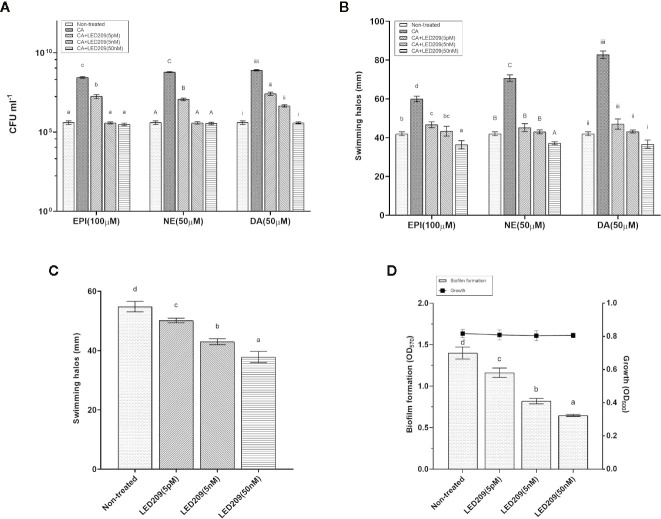
Acute hepatopancreatic necrosis disease (AHPND) caused by resulted in great economic losses in global shrimp aquaculture. There is an urgent need for development of novel strategies to combat AHPND-causing (), given that one of the greatest challenges currently is the widespread use of antibiotics and subsequent emergence of multidrug-resistant bacteria. Here, we proposed a broad-spectrum antivirulence approach targeting a conserved histidine kinase, QseC, which has been demonstrated to activate virulence expression in several Gram-negative pathogens. Our results showed that QseC mediated the catecholamine stimulated effects on growth and flagellar motility of . Transcriptome analysis revealed that QseC was involved in the global regulation of the virulence of as the Δ mutant exhibited a decreased expression of genes related to type IV pilin, flagellar motility, and biofilm formation, while an overexpression of type VI secretion system and cell wall biosynthesis. Subsequently, the bacterial catecholamine receptor antagonist LED209 not only neutralized the stimulatory effects of host catecholamines on the growth and motility of , but also attenuated the virulence of towards brine shrimp larvae and white shrimp . Additionally, LED209 presented no interference with pathogen growth, nor the toxicity to the experimental animals. These results suggest that QseC can be an attractive antivirulence therapy target, and LED209 is a promising candidate for development of broad-spectrum antivirulence agents. This is the first study that demonstrated the role of QseC in the global regulation of infection and demonstrated the antivirulence potential of LED209, which provides insight into the use of an antivirulence approach for targeting not only , but also a much larger collection of pathogenic bacteria.
由[具体病原体]引起的急性肝胰腺坏死病(AHPND)给全球对虾养殖业造成了巨大经济损失。鉴于目前最大的挑战之一是抗生素的广泛使用以及随后出现的多重耐药细菌,迫切需要开发新的策略来对抗引起AHPND的[具体病原体]。在此,我们提出了一种针对保守组氨酸激酶QseC的广谱抗毒力方法,该激酶已被证明可激活多种革兰氏阴性病原体中的毒力表达。我们的结果表明,QseC介导了儿茶酚胺对[具体病原体]生长和鞭毛运动的刺激作用。转录组分析显示,QseC参与了[具体病原体]毒力的全局调控,因为Δ突变体表现出与IV型菌毛、鞭毛运动和生物膜形成相关基因的表达降低,而VI型分泌系统和细胞壁生物合成的表达则上调。随后,细菌儿茶酚胺受体拮抗剂LED209不仅中和了宿主儿茶酚胺对[具体病原体]生长和运动的刺激作用,还减弱了[具体病原体]对卤虫幼虫和凡纳滨对虾的毒力。此外,LED209对病原体生长无干扰,对实验动物也无毒性。这些结果表明,QseC可以成为一个有吸引力的抗毒力治疗靶点,而LED209是开发广谱抗毒力药物的有希望的候选物。这是第一项证明QseC在[具体病原体]感染的全局调控中的作用并证明LED209抗毒力潜力的研究,为不仅针对[具体病原体],而且针对更多病原菌的抗毒力方法的应用提供了见解。