Cortes-Ramirez J, Vilcins D, Jagals P, Soares Magalhaes R J
School of Public Health and Social Work, Queensland University of Technology, Australia.
Children's Health and Environment Program, Child Health Research Centre, The University of Queensland, South Brisbane 4101, Queensland, Australia.
One Health. 2020 Dec 17;12:100206. doi: 10.1016/j.onehlt.2020.100206. eCollection 2021 Jun.
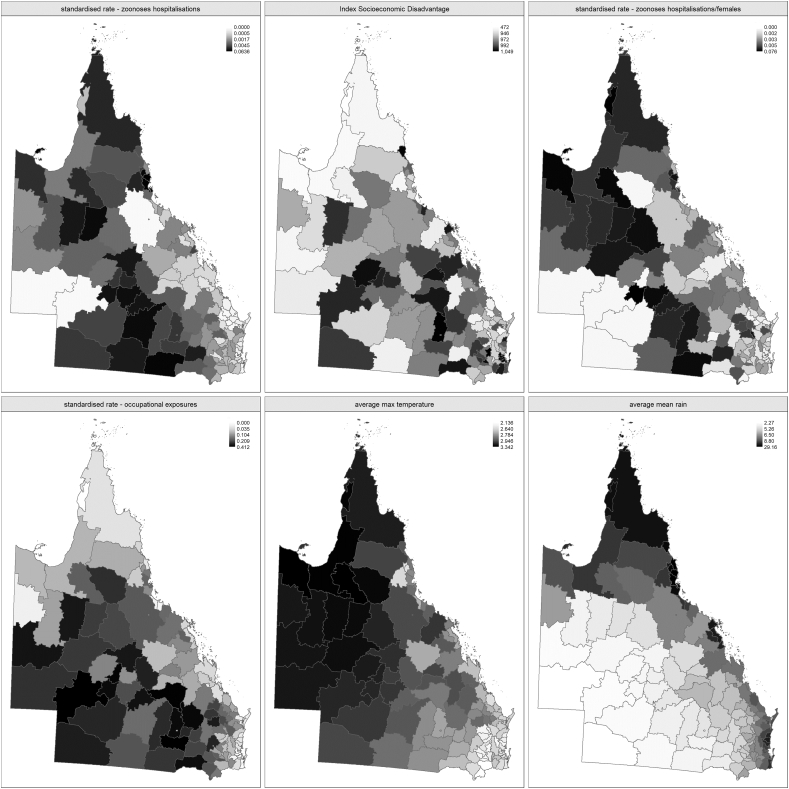
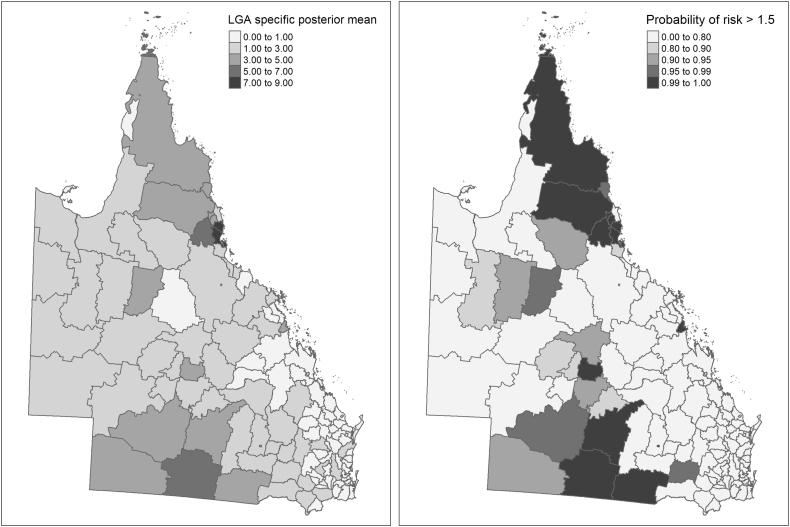
Zoonoses impart a significant public health burden in Australia particularly in Queensland, a state with increasing environmental stress due to extreme weather events and rapid expansion of agriculture and urban developments. Depending on the organism and the environment, a proportion of zoonotic pathogens may survive from hours to years outside the animal host and contaminate the air, water, food, or inanimate objects facilitating their transmission through the environment (i.e. environmentally transmitted). Although most of these zoonotic infections are asymptomatic, severe cases that require hospitalisation are an important indicator of zoonotic infection risk. To date, no studies have investigated the risk of hospitalisation due to environmentally transmitted zoonotic diseases and its association with proxies of sociodemographic and environmental stress. In this study we analysed hospitalisation data for a group of environmentally transmitted zoonoses during a 15-year period using a Bayesian spatial hierarchical model. The analysis incorporated the longest intercensal-year period of consistent Local Government Area (LGA) boundaries in Queensland (1996-2010). Our results showed an increased risk of environmentally transmitted zoonoses hospitalisation in people in occupations such as animal farming, and hunting and trapping animals in natural habitats. This risk was higher in females, compared to the general population. Spatially, the higher risk was in a discrete set of north-eastern, central and southern LGAs of the state, and a probability of 1.5-fold or more risk was identified in two separate LGA clusters in the northeast and south of the state. The increased risk of environmentally transmitted zoonoses hospitalisations in some LGAs indicates that the morbidity due these diseases can be partly attributed to spatial variations in sociodemographic and occupational risk factors in Queensland. The identified high-risk areas can be prioritised for health support and zoonosis control strategies in Queensland.
人畜共患病给澳大利亚带来了重大的公共卫生负担,在昆士兰州尤为如此。由于极端天气事件以及农业和城市发展的迅速扩张,该州面临着日益严重的环境压力。根据病原体和环境的不同,一部分人畜共患病原体可在动物宿主之外存活数小时至数年,并污染空气、水、食物或无生命物体,从而便于它们通过环境传播(即环境传播)。尽管这些人畜共患病大多无症状,但需要住院治疗的严重病例是人畜共患感染风险的重要指标。迄今为止,尚无研究调查环境传播的人畜共患病导致住院的风险及其与社会人口统计学和环境压力指标的关联。在本研究中,我们使用贝叶斯空间分层模型分析了一组环境传播的人畜共患病在15年期间的住院数据。该分析纳入了昆士兰州地方政府区域(LGA)边界一致的最长普查间期(1996 - 2010年)。我们的结果显示,从事动物养殖、在自然栖息地狩猎和诱捕动物等职业的人群中,因环境传播的人畜共患病而住院的风险增加。与普通人群相比,女性的这种风险更高。在空间上,该州东北部、中部和南部的一些离散LGA风险较高,并且在该州东北部和南部的两个独立LGA集群中发现了风险增加1.5倍或更多的概率。一些LGA中环境传播的人畜共患病住院风险增加表明,这些疾病的发病率可部分归因于昆士兰州社会人口统计学和职业风险因素的空间差异。在昆士兰州,可将确定的高风险地区作为卫生支持和人畜共患病控制策略的重点区域。