School of Law, Queensland University of Technology, Brisbane, Australia.
CSIRO, Health and Biosecurity Business Unit, Australian Centre for Disease Preparedness, Geelong, Australia.
Global Health. 2022 Jul 26;18(1):73. doi: 10.1186/s12992-022-00850-4.
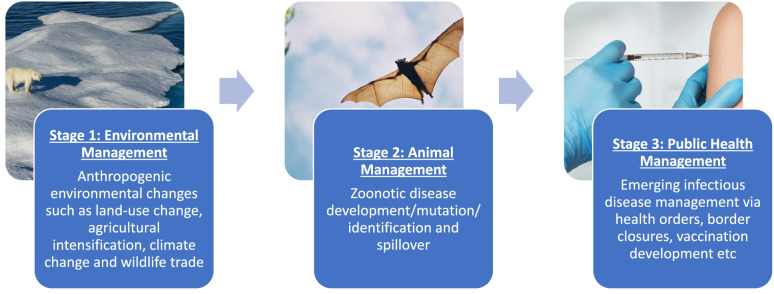
The emergence of SARS-CoV-2 and the subsequent COVID-19 pandemic has resulted in significant global impact. However, COVID-19 is just one of several high-impact infectious diseases that emerged from wildlife and are linked to the human relationship with nature. The rate of emergence of new zoonoses (diseases of animal origin) is increasing, driven by human-induced environmental changes that threaten biodiversity on a global scale. This increase is directly linked to environmental drivers including biodiversity loss, climate change and unsustainable resource extraction. Australia is a biodiversity hotspot and is subject to sustained and significant environmental change, increasing the risk of it being a location for pandemic origin. Moreover, the global integration of markets means that consumption trends in Australia contributes to the risk of disease spill-over in our regional neighbours in Asia-Pacific, and beyond. Despite the clear causal link between anthropogenic pressures on the environment and increasing pandemic risks, Australia's response to the COVID-19 pandemic, like most of the world, has centred largely on public health strategies, with a clear focus on reactive management. Yet, the span of expertise and evidence relevant to the governance of pandemic risk management is much wider than public health and epidemiology. It involves animal/wildlife health, biosecurity, conservation sciences, social sciences, behavioural psychology, law, policy and economic analyses to name just a few.The authors are a team of multidisciplinary practitioners and researchers who have worked together to analyse, synthesise, and harmonise the links between pandemic risk management approaches and issues in different disciplines to provide a holistic overview of current practice, and conclude the need for reform in Australia. We discuss the adoption of a comprehensive and interdisciplinary 'One Health' approach to pandemic risk management in Australia. A key goal of the One Health approach is to be proactive in countering threats of emerging infectious diseases and zoonoses through a recognition of the interdependence between human, animal, and environmental health. Developing ways to implement a One Health approach to pandemic prevention would not only reduce the risk of future pandemics emerging in or entering Australia, but also provide a model for prevention strategies around the world.
SARS-CoV-2 的出现及其引发的 COVID-19 大流行,给全球带来了重大影响。然而,COVID-19 只是几种源自野生动物并与人类与自然关系相关的高影响力传染病之一。由于人类活动导致的环境变化对全球生物多样性构成威胁,新出现的人畜共患病(动物源疾病)的出现率正在上升。这种增加与环境驱动因素直接相关,包括生物多样性丧失、气候变化和不可持续的资源开采。澳大利亚是生物多样性热点地区,正受到持续和重大的环境变化的影响,这增加了它成为大流行病起源地的风险。此外,全球市场的一体化意味着澳大利亚的消费趋势增加了疾病在亚太地区及其以外地区蔓延的风险。尽管人类对环境的压力与不断增加的大流行病风险之间存在明显的因果关系,但与世界大多数国家一样,澳大利亚对 COVID-19 大流行的应对主要集中在公共卫生战略上,重点明确放在反应性管理上。然而,与大流行病风险管理相关的专业知识和证据范围比公共卫生和流行病学广泛得多。它涉及动物/野生动物健康、生物安全、保护科学、社会科学、行为心理学、法律、政策和经济分析等领域。作者是一个多学科从业者和研究人员团队,他们共同分析、综合和协调大流行病风险管理方法与不同学科之间的联系,提供当前实践的全面概述,并得出澳大利亚需要改革的结论。我们讨论了在澳大利亚采用全面和跨学科的“同一健康”方法来管理大流行病风险。同一健康方法的一个关键目标是通过认识到人类、动物和环境健康之间的相互依存关系,积极应对新发传染病和人畜共患病的威胁。制定实施同一健康方法预防大流行病的方法不仅可以降低未来大流行病在澳大利亚出现或进入澳大利亚的风险,还可以为世界各地的预防策略提供一个模式。