Ito Renma, Ikematsu Hiroaki, Murano Tatsuro, Shinmura Kensuke, Kojima Motohiro, Kumahara Kana, Furue Yasuaki, Sunakawa Hironori, Minamide Tatsunori, Sato Daiki, Yamamoto Yoichi, Takashima Kenji, Yoda Yusuke, Hori Keisuke, Yano Tomonori
Department of Gastroenterology and Endoscopy.
Division of Pathology, National Cancer Center Hospital East.
Endosc Int Open. 2021 Feb;9(2):E271-E277. doi: 10.1055/a-1324-3083. Epub 2021 Feb 3.
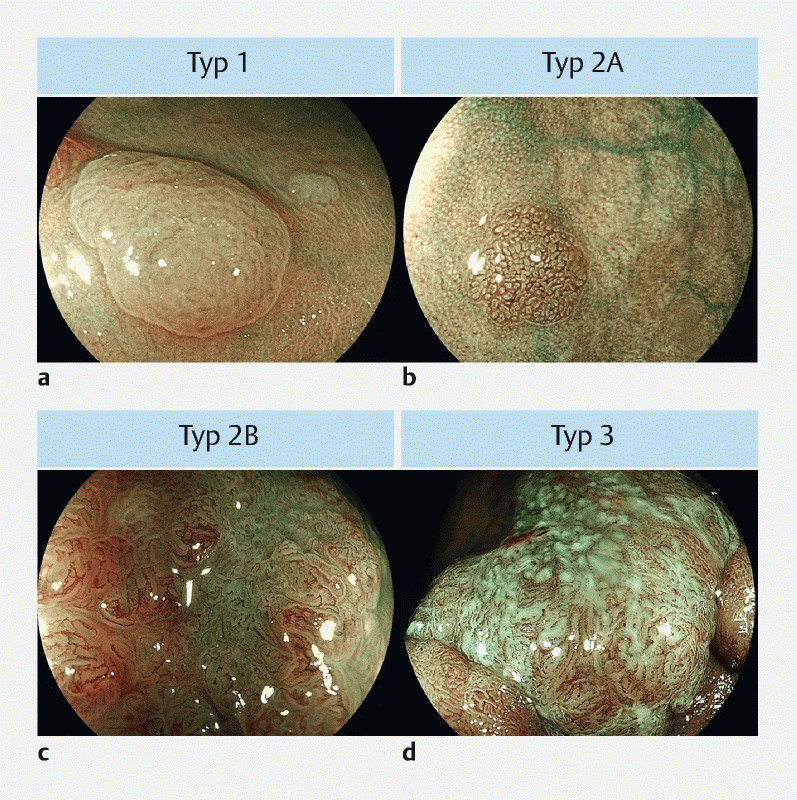
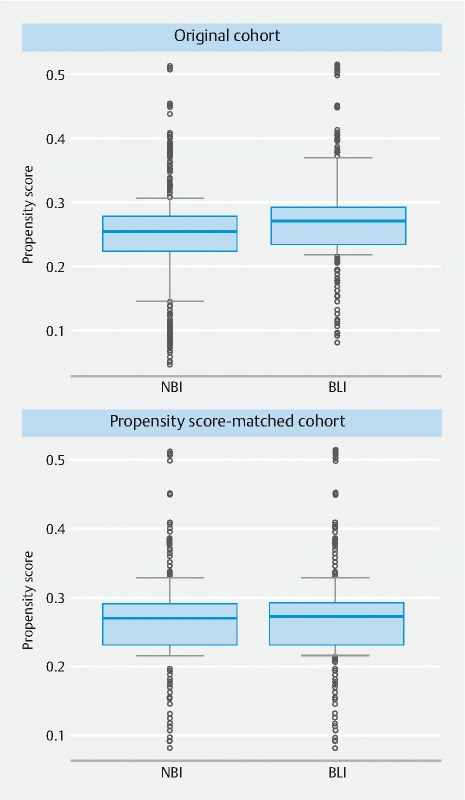
The Japan Narrow-band imaging (NBI) Expert Team (JNET) classification was proposed for evaluating colorectal lesions. However, it remains unknown whether the JNET classification can be applied to magnifying endoscopy with image-enhanced endoscopies other than NBI. This study aimed to compare the diagnostic ability of JNET classification by magnifying endoscopy with blue laser imaging (ME-BLI) and with ME-NBI. We retrospectively assessed consecutive patients diagnosed per the JNET classification by ME-BLI (BLI group) or ME-NBI (NBI group) between March 2014 and June 2017. We compared the diagnostic value of JNET classification between the groups with one-to-one propensity score matching. Four hundred and seventy-one propensity score-matched pairs of lesions were analyzed. In the BLI and NBI groups, the overall diagnostic accuracies were 92.1 % and 91.7 %, respectively, and those for differentiating between neoplastic and non-neoplastic polyps were 96.6 % and 96.8 %, respectively. The positive predictive value by each JNET classification in BLI vs. NBI group was 90.6 % vs. 96.2 % in Type 1, 94.3 % vs. 94.6 % in Type 2A, 57.7 % vs. 42.3 % in Type 2B, and 100 % vs. 91.7 % in Type 3. The negative predictive value was 97.0 % vs. 96.9 % in Type 1, 88.1 % vs. 82.8 % in Type 2A, 98.0 % vs. 98.2 % in Type 2B, and 98.5 % vs. 98.7 % in Type 3. No statistical difference in the diagnostic results was found between the groups. The diagnostic ability of the JNET classification by ME-BLI and ME-NBI was comparable, with the former also applicable for diagnosis of colorectal lesions.
日本窄带成像(NBI)专家组(JNET)分类法被提出用于评估结直肠病变。然而,JNET分类法是否可应用于除NBI之外的图像增强型内镜的放大内镜检查仍不清楚。本研究旨在比较通过放大内镜联合蓝光成像(ME-BLI)和联合ME-NBI的JNET分类法的诊断能力。我们回顾性评估了2014年3月至2017年6月期间根据ME-BLI(BLI组)或ME-NBI(NBI组)按照JNET分类法诊断的连续患者。我们采用一对一倾向评分匹配比较了两组之间JNET分类法的诊断价值。分析了471对倾向评分匹配的病变。在BLI组和NBI组中,总体诊断准确率分别为92.1%和91.7%,区分肿瘤性息肉和非肿瘤性息肉的准确率分别为96.6%和96.8%。BLI组与NBI组中各JNET分类的阳性预测值在1型中分别为90.6%和96.2%,2A型中分别为94.3%和94.6%,2B型中分别为57.7%和42.3%,3型中分别为100%和91.7%。阴性预测值在1型中分别为97.0%和96.9%,2A型中分别为88.1%和82.8%,2B型中分别为98.0%和98.2%,3型中分别为98.5%和98.7%。两组之间的诊断结果未发现统计学差异。ME-BLI和ME-NBI的JNET分类法的诊断能力相当,前者也适用于结直肠病变的诊断。