Inoue Ken, Yoshida Naohisa, Kobayashi Reo, Tomita Yuri, Hashimoto Hikaru, Sugino Satoshi, Hirose Ryohei, Dohi Osamu, Yasuda Hiroaki, Yasuda Ritsu, Murakami Takaaki, Inada Yutaka, Itoh Yoshito
Molecular Gastroenterology and Hepatology, Kyoto Prefectural University of Medicine Graduate School of Medical Science, Kyoto, Japan.
Department of Gastroenterology, Nara City Hospital, Nara, Japan.
Gastroenterol Res Pract. 2022 Apr 12;2022:9998280. doi: 10.1155/2022/9998280. eCollection 2022.
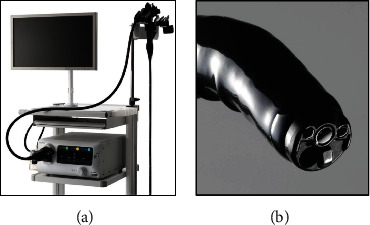
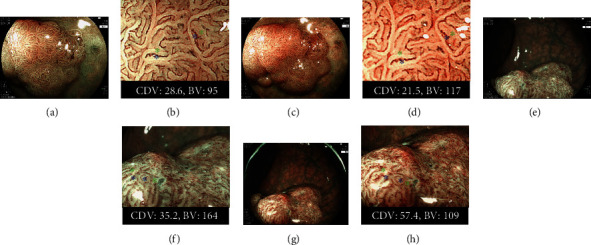
: A compact and cost-effective light source-processor combined 3-color light-emitting diode (LED) endoscopic system (ELUXEO-Lite: EP-6000, Fujifilm Co., Tokyo) with a magnified colonoscope (EC-6600ZP, Fujifilm Co.) has been released. : In this study, we analyzed the efficacy of this system for colorectal tumor characterization with magnified blue light imaging (BLI-LED) and image's subjective and objective evaluations, compared to a magnified blue laser imaging (BLI-LASER) using a standard LASER endoscopic system. : We retrospectively reviewed 37 lesions observed with both BLI-LED and BLI-LASER systems from 2019 using the Japanese narrow band imaging classification. Two representative magnified images, one BLI-LED and one BLI-LASER, of the same area of a lesion were evaluated for diagnostic accuracy and visualization quality by three experts and three non-experts. Their color difference values (CDVs) and brightness values (BVs) were also calculated as objective indicators. : Among 37 lesions, mean tumor size was 18.9 ± 13.1 mm, and 21 lesions were nonpolypoid. Histopathology revealed 14 sessile serrated lesions, 7 adenomas, 12 high-grade dysplasias and T1a cancers, and 4 T1b cancers. The diagnostic accuracy rates of BLI-LED/BLI-LASER of experts and non-experts were 90.1% and 87.4% ( = 0.52) and 89.2% and 89.2% ( = 0.99). The percentages of instances where BLI-LED images were better, the two imaging types were equivalent, or BLI-LASER images were better were 16%/83%/1% for experts and 19%/58%/23% for non-experts ( < 0.001). CDVs and BVs between BLI-LED and BLI-LASER were not significantly different (CDVs: = 0.653, BVs: = 0.518). : BLI-LED using the compact system was noninferior to BLI-LASER for colorectal tumor characterization and image quality.
一种紧凑且经济高效的光源 - 处理器组合式三色发光二极管(LED)内镜系统(ELUXEO - Lite:EP - 6000,富士胶片株式会社,东京)与放大结肠镜(EC - 6600ZP,富士胶片株式会社)已发布。在本研究中,我们分析了该系统在使用放大蓝光成像(BLI - LED)对结直肠肿瘤特征进行表征以及图像的主观和客观评估方面的效果,并与使用标准激光内镜系统的放大蓝光激光成像(BLI - LASER)进行比较。我们回顾性分析了2019年使用日本窄带成像分类法通过BLI - LED和BLI - LASER系统观察到的37个病变。由三位专家和三位非专家对同一病变区域的两张代表性放大图像(一张BLI - LED图像和一张BLI - LASER图像)进行诊断准确性和可视化质量评估。还计算了它们的色差值(CDV)和亮度值(BV)作为客观指标。在37个病变中,平均肿瘤大小为18.9±13.1毫米,21个病变为非息肉样。组织病理学显示有14个无蒂锯齿状病变、7个腺瘤、12个高级别发育异常和T1a期癌以及4个T1b期癌。专家和非专家对BLI - LED/BLI - LASER的诊断准确率分别为90.1%和87.4%(P = 0.