Lorenz David R, Misra Vikas, Chettimada Sukrutha, Uno Hajime, Wang Lanqing, Blount Benjamin C, De Jesús Víctor R, Gelman Benjamin B, Morgello Susan, Wolinsky Steven M, Gabuzda Dana
Department of Cancer Immunology and Virology, Dana-Farber Cancer Institute, Center for Life Science 1010, 450 Brookline Avenue, Boston, MA 02215, USA.
Department of Data Sciences, Dana-Farber Cancer Institute, Boston, MA, USA.
EClinicalMedicine. 2021 Jan 11;31:100697. doi: 10.1016/j.eclinm.2020.100697. eCollection 2021 Jan.
Marijuana smoke contains some of the same toxicants present in tobacco smoke. Marijuana smoking is prevalent among HIV+ individuals, but few studies have characterized smoke-related toxicants or associated health outcomes in exclusive marijuana users.
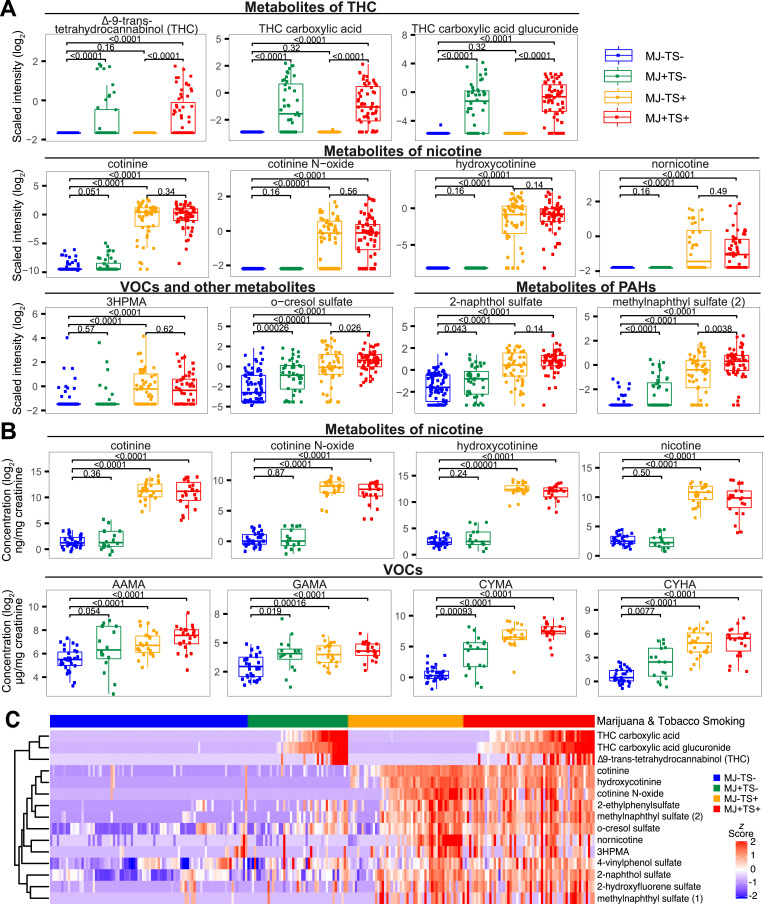
This longitudinal study included 245 participants over age 40 (76% HIV+). 33 plasma and 28 urine metabolites of nicotine, ∆-9-trans-tetrahydrocannabinol, polycyclic aromatic hydrocarbons, and volatile organic compounds were assayed by liquid or gas chromatography/mass spectrometry. Exposures and health outcomes were assessed from surveys and medical records.
At baseline, 18% of participants were marijuana-only smokers, 20% tobacco-only smokers, and 24% dual marijuana-tobacco smokers (median (IQR) age 53 (47-60) years, 78% male, 54% white race). Marijuana smoking was independently associated with elevated plasma naphthalenes, 2-hydroxyfluorene sulfate, 4-vinylphenol sulfate, and o-cresol sulfate 0·05) and urine acrylonitrile and acrylamide metabolites (0·05), but levels were lower than those associated with tobacco smoking. Acrolein metabolite N-Acetyl-S-(3-hydroxypropyl)-l-cysteine (3HPMA) was significantly elevated in plasma and urine in tobacco-only and dual but not marijuana-only smokers, and correlated with nicotine metabolites (0·05). The highest tertile of 3HPMA was associated with increased cardiovascular disease diagnoses independent of tobacco smoking, traditional risk factors, and HIV status (odds ratio [95% CI] 3·34 [1·31-8·57]; 0·012).
Smoke-related toxicants, including acrylonitrile and acrylamide metabolites, are detectable in exclusive marijuana smokers, but exposures are lower compared with tobacco or dual smokers. Acrolein exposure is increased by tobacco smoking but not exclusive marijuana smoking in HIV+ and HIV- adults, and contributes to cardiovascular disease in tobacco smokers.
U.S. NIH.
大麻烟雾中含有一些与烟草烟雾中相同的有毒物质。吸食大麻在HIV阳性个体中很普遍,但很少有研究描述仅吸食大麻者与烟雾相关的有毒物质或相关健康结果。
这项纵向研究纳入了245名40岁以上的参与者(76%为HIV阳性)。通过液相或气相色谱/质谱法测定了33种血浆和28种尿液中的尼古丁、Δ-9-反式-四氢大麻酚、多环芳烃和挥发性有机化合物的代谢产物。通过调查和医疗记录评估暴露情况和健康结果。
在基线时,18%的参与者仅吸食大麻,20%仅吸食烟草,24%同时吸食大麻和烟草(年龄中位数[四分位间距]53[47-60]岁,78%为男性,54%为白人)。吸食大麻与血浆萘、2-羟基芴硫酸盐、4-乙烯基苯酚硫酸盐和邻甲酚硫酸盐水平升高独立相关(P<0.05),以及尿液丙烯腈和丙烯酰胺代谢产物水平升高相关(P<0.05),但这些水平低于与吸食烟草相关的水平。丙烯醛代谢产物N-乙酰-S-(3-羟丙基)-l-半胱氨酸(3HPMA)在仅吸食烟草者和同时吸食大麻和烟草者的血浆和尿液中显著升高,但在仅吸食大麻者中未升高,且与尼古丁代谢产物相关(P<0.05)。3HPMA的最高三分位数与心血管疾病诊断增加相关,独立于吸烟、传统危险因素和HIV状态(比值比[95%置信区间]3.34[1.31-8.57];P=0.012)。
在仅吸食大麻者中可检测到与烟雾相关的有毒物质,包括丙烯腈和丙烯酰胺代谢产物,但与吸食烟草者或同时吸食大麻和烟草者相比,暴露水平较低。在HIV阳性和HIV阴性成年人中,吸烟会增加丙烯醛暴露,但仅吸食大麻不会,且吸烟会导致吸烟者患心血管疾病。
美国国立卫生研究院。