Lukic Yanick Xavier, Shih Chen-Hsuan Iris, Hernandez Reguera Alvaro, Cotti Amanda, Fleisch Elgar, Kowatsch Tobias
Centre for Digital Health Interventions, Department of Management, Technology, and Economics, ETH Zurich, Zurich, Switzerland.
Universidad de Sevilla, Sevilla, Spain.
JMIR Serious Games. 2021 Feb 8;9(1):e22802. doi: 10.2196/22802.
Slow-paced breathing training (6 breaths per minute [BPM]) improves physiological and psychological well-being by inducing relaxation characterized by increased heart rate variability (HRV). However, classic breathing training has a limited target group, and retention rates are very low. Although a gameful approach may help overcome these challenges, it is crucial to enable breathing training in a scalable context (eg, smartphone only) and ensure that they remain effective. However, despite the health benefits, no validated mobile gameful breathing training featuring a biofeedback component based on breathing seems to exist.
This study aims to describe the design choices and their implementation in a concrete mobile gameful breathing training app. Furthermore, it aims to deliver an initial validation of the efficacy of the resulting app.
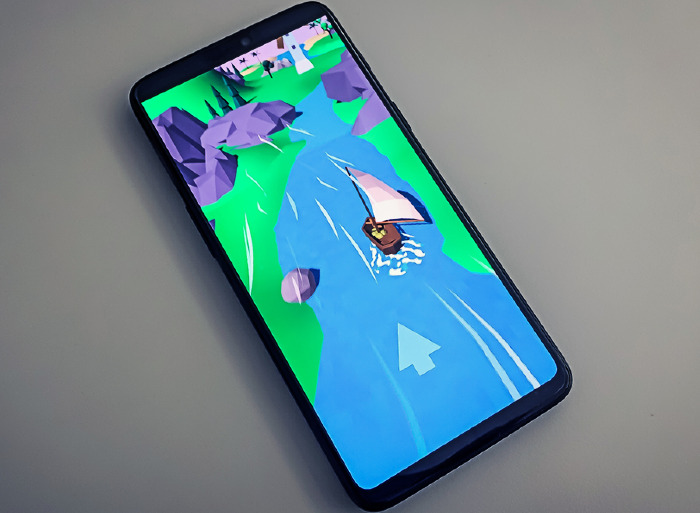
Previous work was used to derive informed design choices, which, in turn, were applied to build the gameful breathing training app Breeze. In a pretest (n=3), design weaknesses in Breeze were identified, and Breeze was adjusted accordingly. The app was then evaluated in a pilot study (n=16). To ascertain that the effectiveness was maintained, recordings of breathing rates and HRV-derived measures (eg, root mean square of the successive differences [RMSSDs]) were collected. We compared 3 stages: baseline, standard breathing training deployed on a smartphone, and Breeze.
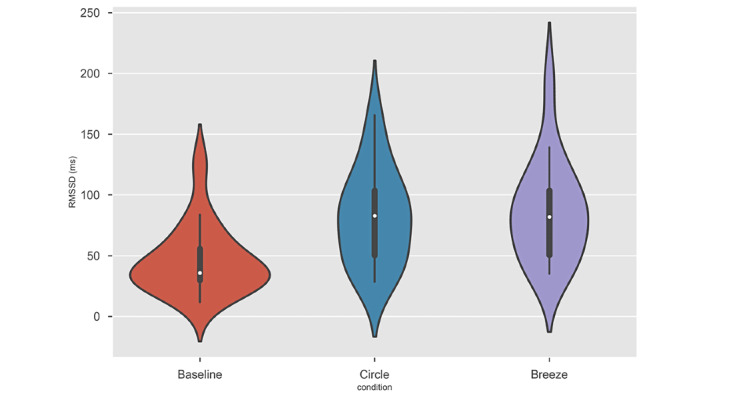
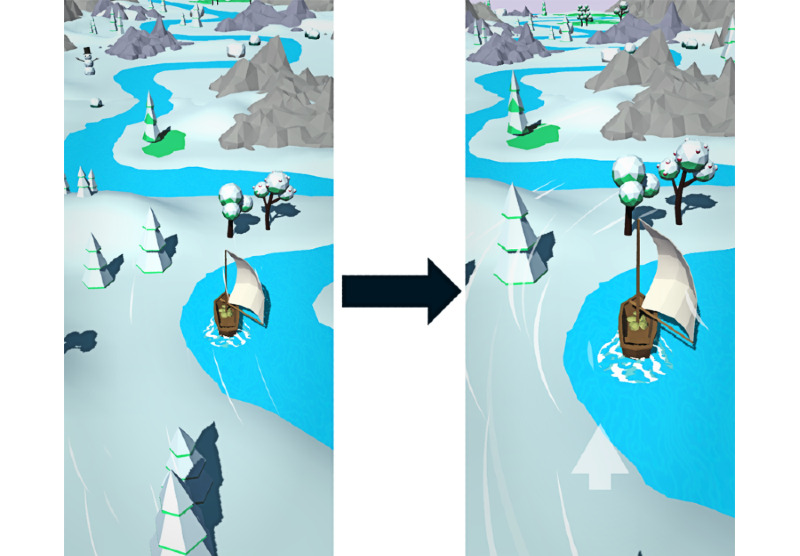
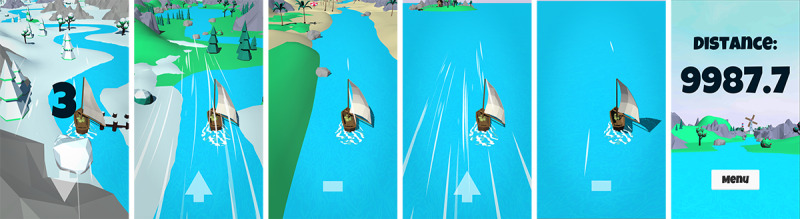
Overall, 5 design choices were made: use of cool colors, natural settings, tightly incorporated game elements, game mechanics reflecting physiological measures, and a light narrative and progression model. Breeze was effective, as it resulted in a slow-paced breathing rate of 6 BPM, which, in turn, resulted in significantly increased HRV measures compared with baseline (P<.001 for RMSSD). In general, the app was perceived positively by the participants. However, some criticized the somewhat weaker clarity of the breathing instructions when compared with a standard breathing training app.
The implemented breathing training app Breeze maintained its efficacy despite the use of game elements. Moreover, the app was positively perceived by participants although there was room for improvement.
慢节奏呼吸训练(每分钟6次呼吸[BPM])通过诱导以心率变异性(HRV)增加为特征的放松来改善生理和心理健康。然而,传统的呼吸训练目标群体有限,留存率非常低。尽管游戏化方法可能有助于克服这些挑战,但在可扩展的环境(例如仅智能手机)中进行呼吸训练并确保其有效性至关重要。然而,尽管有健康益处,但似乎不存在经过验证的具有基于呼吸的生物反馈组件的移动游戏化呼吸训练。
本研究旨在描述具体移动游戏化呼吸训练应用程序中的设计选择及其实现方式。此外,旨在对所得应用程序的功效进行初步验证。
利用先前的工作得出明智的设计选择,进而将其应用于构建游戏化呼吸训练应用程序Breeze。在一项预测试(n = 3)中,识别出Breeze的设计弱点,并相应地对Breeze进行了调整。然后在一项试点研究(n = 16)中对该应用程序进行评估。为确定有效性是否得以维持,收集了呼吸频率和HRV衍生指标(例如逐次差值的均方根[RMSSD])的记录。我们比较了三个阶段:基线、在智能手机上部署的标准呼吸训练以及Breeze。
总体而言,做出了五项设计选择:使用冷色调、自然场景、紧密融入的游戏元素、反映生理指标的游戏机制以及轻松的叙事和进展模式。Breeze是有效的,因为它使呼吸频率降至6 BPM的慢节奏,这反过来又导致与基线相比HRV指标显著增加(RMSSD的P <.001)。总体而言,参与者对该应用程序的评价积极。然而,一些人批评与标准呼吸训练应用程序相比,呼吸指导的清晰度稍弱。
尽管使用了游戏元素,但所实施的呼吸训练应用程序Breeze仍保持其功效。此外,尽管仍有改进空间,但参与者对该应用程序的评价积极。