Shaapan Raafat M, Al-Abodi Hiba Riyadh, Alanazi Abdullah D, Abdel-Shafy Sobhy, Rashidipour Marzieh, Shater Abdullah F, Mahmoudvand Hossein
Department of Zoonosis, Veterinary Research Division, National Research Centre, El-Tahrir Street, Dokki, Giza 12622, Egypt.
Department of Environment, College of Science, University of Al-Qadisiyah, P.O. Box 88, Al-Diwaniyah 58001, Iraq.
Molecules. 2021 Feb 4;26(4):819. doi: 10.3390/molecules26040819.
() is a wild aromatic plant used for traditional herbal medicine that can be demonstrated in insecticidal, antioxidant, anti-inflammatory, and antimicrobial activity of its essential oils (MCEO).
The present study aimed to evaluate the prophylactic effects of essential oil (MCEO) against chronic toxoplasmosis induced by the Tehran strain of in mice.
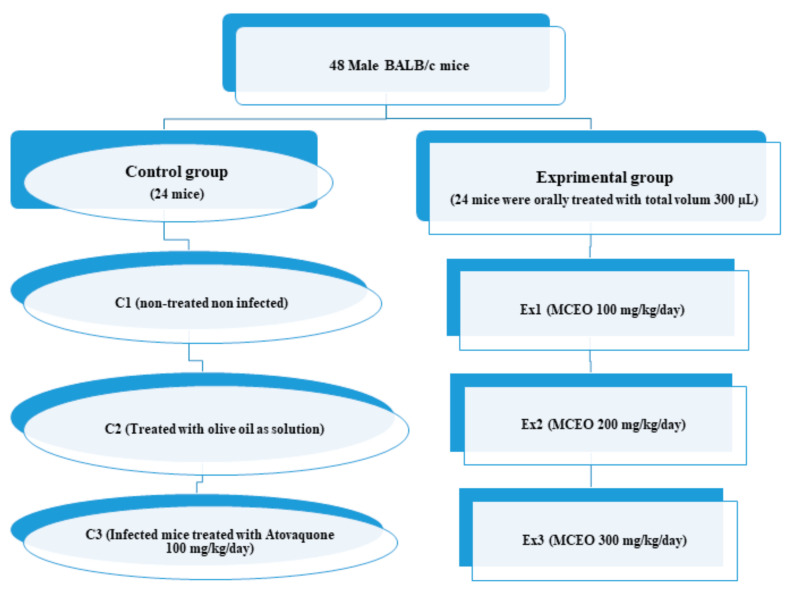
Gas chromatography/mass spectrometry (GC/MS) analysis was performed to determine the chemical composition of MCEO. Mice were then orally administrated with MCEO at the doses of 100, 200, and 300 mg/kg/day and also atovaquone 100 mg/kg for 21 days. On the 15th day, the mice were infected with the intraperitoneal inoculation of 20-25 tissue cysts from the Tehran strain of . The mean numbers of brain tissue cysts and the mRNA levels of IL-12 and IFN-γ in mice of each tested group were measured.
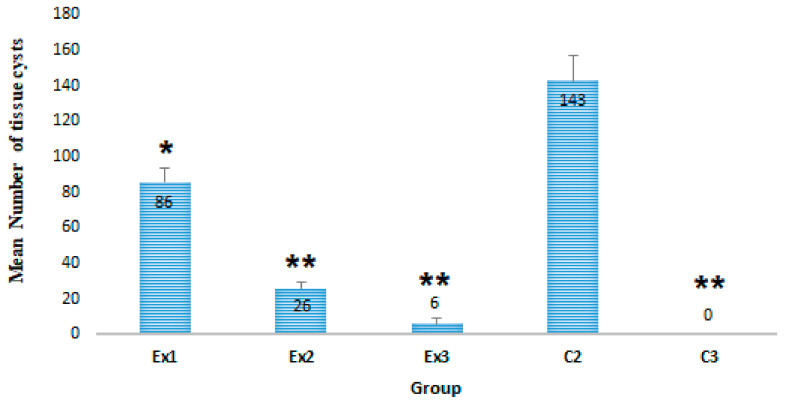
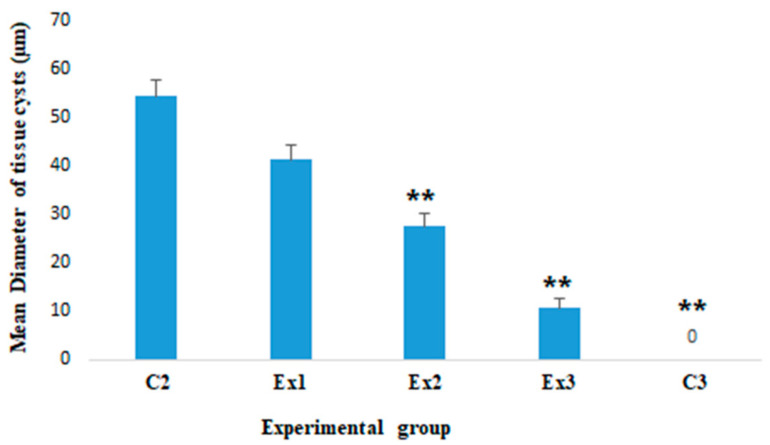
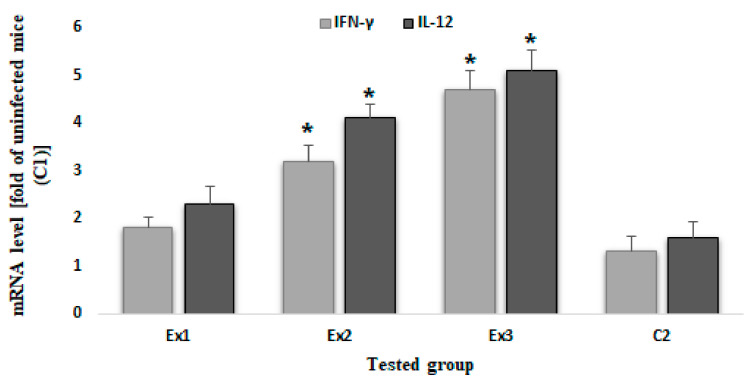
By GC/MS, the major constituents were α-pinene (24.7%), 1,8-cineole (19.6%), and linalool (12.6%), respectively. The results demonstrated that the mean number of tissue cysts in experimental groups Ex1 ( < 0.05), Ex2 ( < 0.001) and Ex3 ( < 0.001) was meaningfully reduced in a dose-dependent manner compared with the control group (C2). The mean diameter of tissue cyst was significantly reduced in mice of the experimental groups Ex2 ( < 0.01) and Ex3 ( < 0.001). The results demonstrated that although the mRNA levels of IFN-γ and IL-12 were elevated in all mice of experimental groups, a significant increase ( < 0.001) was observed in tested groups of Ex2 and Ex3 when compared with control groups.
The findings of the present study demonstrated the potent prophylactic effects of MCEO especially in the doses 200 and 300 mg/kg in mice infected with . Although the exceptional anti- effects of MCEO and other possessions, such as improved innate immunity and low toxicity are positive topics, there is, however, a need for more proof from investigations in this field.
()是一种野生芳香植物,用于传统草药,其精油(MCEO)具有杀虫、抗氧化、抗炎和抗菌活性。
本研究旨在评估精油(MCEO)对德黑兰株在小鼠中诱导的慢性弓形虫病的预防作用。
采用气相色谱/质谱(GC/MS)分析确定MCEO的化学成分。然后,小鼠分别以100、200和300mg/kg/天的剂量口服MCEO,以及100mg/kg的阿托伐醌,持续21天。在第15天,通过腹腔接种20 - 25个来自德黑兰株的组织囊肿对小鼠进行感染。测量每个测试组小鼠脑组织囊肿的平均数量以及IL - 12和IFN - γ的mRNA水平。
通过GC/MS分析,主要成分分别为α-蒎烯(24.7%)、1,8 - 桉叶素(19.6%)和芳樟醇(12.6%)。结果表明,与对照组(C2)相比,实验组Ex1(P < 0.05)、Ex2(P < 0.001)和Ex3(P < 0.001)中组织囊肿的平均数量以剂量依赖性方式显著减少。实验组Ex2(P < 0.01)和Ex3(P < 0.001)小鼠中组织囊肿的平均直径显著减小。结果表明,尽管实验组所有小鼠中IFN - γ和IL - 12的mRNA水平均升高,但与对照组相比,Ex2和Ex3测试组中观察到显著升高(P < 0.001)。
本研究结果表明MCEO对感染的小鼠具有强大的预防作用,尤其是在200和300mg/kg剂量时。尽管MCEO具有出色的抗作用以及其他特性,如改善先天免疫和低毒性等都是积极的方面,但然而,该领域的研究仍需要更多证据。