Cornell University, Ithaca, NY, USA.
Department of Psychiatry, University of Oxford, Oxford, UK.
Mol Psychiatry. 2022 Jan;27(1):141-153. doi: 10.1038/s41380-021-01032-1. Epub 2021 Feb 8.
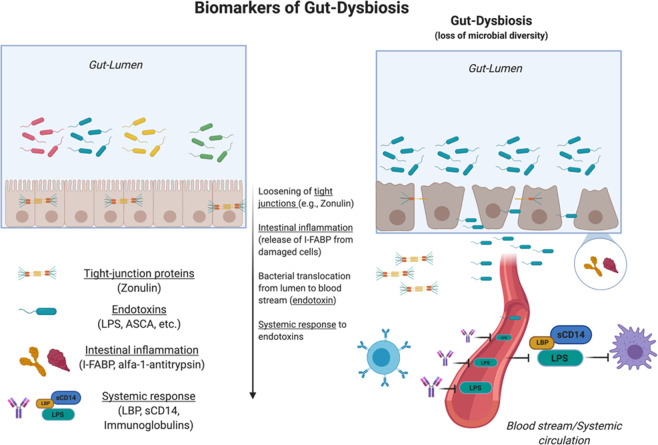
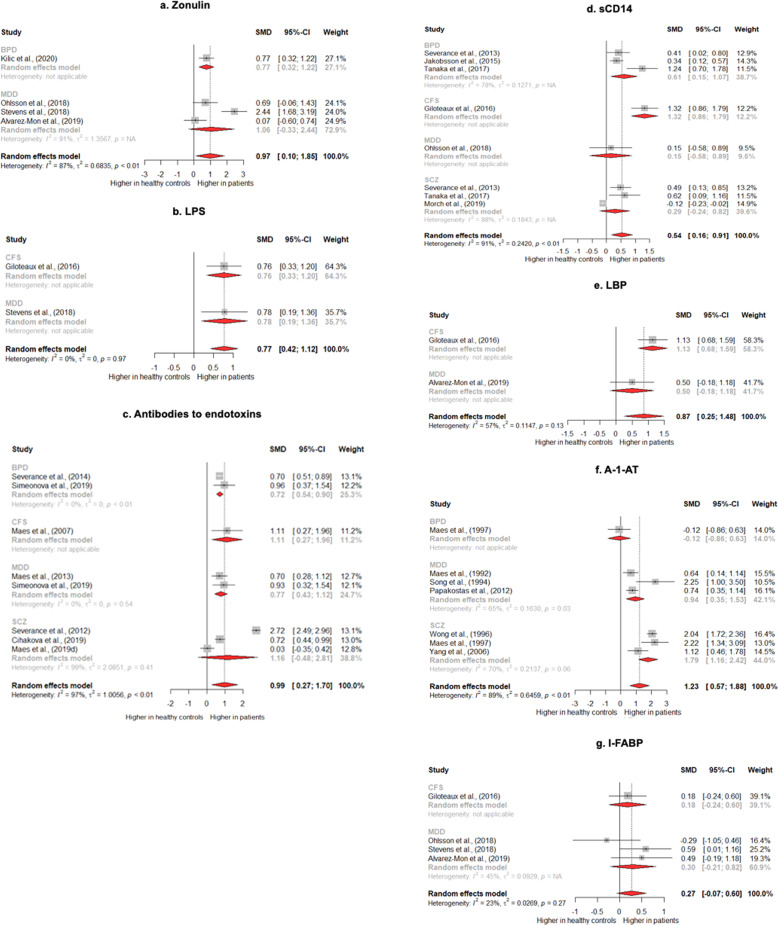
Reduced gut-microbial diversity ("gut dysbiosis") has been associated with an anhedonic/amotivational syndrome ("sickness behavior") that manifests across severe mental disorders and represent the key clinical feature of chronic fatigue. In this systematic review and meta-analysis, we investigated differences in proxy biomarkers of gut dysbiosis in patients with severe mental illness and chronic fatigue vs. controls and the association of these biomarkers with sickness behavior across diagnostic categories. Following PRISMA guidelines, we searched from inception to April 2020 for all the studies investigating proxy biomarkers of gut dysbiosis in patients with severe mental illness and chronic fatigue. Data were independently extracted by multiple observers, and a random-mixed model was used for the analysis. Heterogeneity was assessed with the I index. Thirty-three studies were included in the systematic review; nineteen in the meta-analysis (N = 2758 patients and N = 1847 healthy controls). When compared to controls, patients showed increased levels of zonulin (four studies reporting data on bipolar disorder and depression, SMD = 0.97; 95% Cl = 0.10-1.85; P = 0.03, I = 86.61%), lipopolysaccharide (two studies reporting data on chronic fatigue and depression, SMD = 0.77; 95% Cl = 0.42-1.12; P < 0.01; I = 0%), antibodies against endotoxin (seven studies reporting data on bipolar disorder, depression, schizophrenia, and chronic fatigue, SMD = 0.99; 95% CI = 0.27-1.70; P < 0.01, I = 97.14%), sCD14 (six studies reporting data on bipolar disorder, depression, schizophrenia, and chronic fatigue, SMD = 0.54; 95% Cl 0.16-0.81; P < 0.01, I = 90.68%), LBP (LBP, two studies reporting data on chronic fatigue and depression, SMD = 0.87; 95% Cl = 0.25-1.48; P < 0.01; I = 56.80%), alpha-1-antitripsin (six studies reporting data on bipolar disorder, depression, and schizophrenia, SMD = 1.23; 95% Cl = 0.57-1.88; P < 0.01, I: 89.25%). Elevated levels of gut dysbiosis markers positively correlated with severity of sickness behavior in patients with severe mental illness and chronic fatigue. Our findings suggest that gut dysbiosis may underlie symptoms of sickness behavior across traditional diagnostic boundaries. Future investigations should validate these findings comparing the performances of the trans-diagnostic vs. categorical approach. This will facilitate treatment breakthrough in an area of unmet clinical need.
肠道微生物多样性减少(“肠道菌群失调”)与快感缺失/动机缺乏综合征(“疾病行为”)有关,这种综合征表现为严重精神障碍,并代表慢性疲劳的主要临床特征。在这项系统评价和荟萃分析中,我们调查了严重精神疾病和慢性疲劳患者与对照组相比,肠道菌群失调的替代生物标志物的差异,以及这些生物标志物与跨诊断类别的疾病行为的相关性。根据 PRISMA 指南,我们从成立到 2020 年 4 月,对所有研究严重精神疾病和慢性疲劳患者肠道菌群失调替代生物标志物的研究进行了检索。数据由多个观察者独立提取,并使用随机混合模型进行分析。使用 I 指数评估异质性。这项系统评价纳入了 33 项研究;19 项研究纳入荟萃分析(n=2758 名患者和 n=1847 名健康对照者)。与对照组相比,患者的肠屏障通透性标志物(zonulin)水平升高(四项研究报告双相障碍和抑郁症的数据,SMD=0.97;95%置信区间 0.10-1.85;P=0.03,I=86.61%)、内毒素(两项研究报告慢性疲劳和抑郁症的数据,SMD=0.77;95%置信区间 0.42-1.12;P<0.01;I=0%)、内毒素抗体(七项研究报告双相障碍、抑郁症、精神分裂症和慢性疲劳的数据,SMD=0.99;95%置信区间 0.27-1.70;P<0.01,I=97.14%)、sCD14(六项研究报告双相障碍、抑郁症、精神分裂症和慢性疲劳的数据,SMD=0.54;95%置信区间 0.16-0.81;P<0.01,I=90.68%)、LBP(LBP,两项研究报告慢性疲劳和抑郁症的数据,SMD=0.87;95%置信区间 0.25-1.48;P<0.01;I=56.80%)和α-1-抗胰蛋白酶(六项研究报告双相障碍、抑郁症和精神分裂症的数据,SMD=1.23;95%置信区间 0.57-1.88;P<0.01,I:89.25%)水平升高。肠道菌群失调标志物水平升高与严重精神疾病和慢性疲劳患者疾病行为的严重程度呈正相关。我们的研究结果表明,肠道菌群失调可能是跨传统诊断边界出现疾病行为症状的基础。未来的研究应通过比较跨诊断与分类方法的表现来验证这些发现。这将有助于在这一未满足临床需求的领域取得治疗突破。